
 AI Governance
 Data Centers
 Drones
 Climate
 Privacy
 2026 Maine Senate
 Bob Dylan
Google Pairs Solar With Long-Duration Storage
Coverage from WebProNews, Herald Dispatch, and others
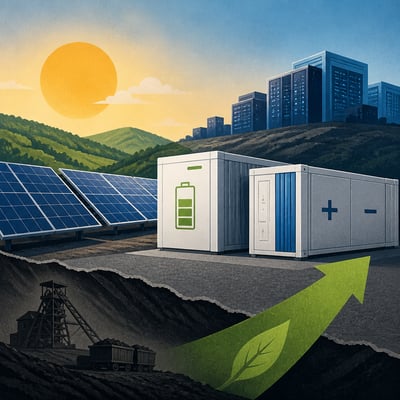
MN8 Energy, Google, and Eos Energy Enterprises plan to build the Mammoth Solar project on a reclaimed coal mine in Kanawha County, West Virginia.
The facility is expected to combine 86 MW of solar generation with 70 MW/280 MWh of lithium-ion storage and 10 MW/100 MWh of Eos zinc-based long-duration storage, serving Google data-center demand and the PJM grid. Construction is planned for 2027, with the components expected to enter service in phases from 2028 through 2030; developers also estimate up to $350 million in investment, about 200 construction jobs, and local tax benefits.
If you read one thing
It offers the clearest broad overview of the project, its hybrid storage design, Google’s procurement role, and its relevance to the PJM grid.
The evidence
It provides validated project figures and explains how combined lithium and zinc storage could firm solar for data-center demand and grid reliability.
The local angle
It adds the West Virginia site perspective by focusing on the reclaimed coal mine’s proposed conversion and local economic significance.
Hybrid storage is the project's reliability proposition
Mammoth Solar is designed to combine 86 MW of solar with lithium-ion and zinc-based storage, converting variable generation into dispatchable PJM capacity. The project remains prospective, with solar and storage planned to enter service in phases from 2028 through 2030.
Data-center demand is reshaping clean-energy procurement
Google's involvement ties the project to procurement of electricity, capacity, reliability, and clean-energy attributes rather than generation alone. The reported 20-year purchase arrangement provides a commercial anchor linked to regional data-center demand.
PJM's fossil-heavy growth strengthens the case for firm clean capacity
PJM is described as lagging other U.S. grids in renewable and battery deployment while relying on gas and aging coal for near-term generation growth. That dependence is associated with peak-price and reliability concerns, while limited multi-day storage leaves a continuing need for fossil backup or additional storage innovation.
$170 billion annual rate
U.S. private manufacturing construction spending
“A report published Aug. 20 by ReImagine Appalachia found that clean-energy and manufacturing investment in the second quarter of 2026 remained below 2024 peaks in the United States and the four-state Appalachian region of West Virginia, Kentucky, Ohio and Pennsylvania. U.S. private manufacturing construction spending rose to a $249 billion annual rate by November 2024 before falling to $170 billion by June 2026.”
10 megawatt-hours
zinc-based storage energy capacity
“Known as Mammoth Solar, the MN8-owned project will combine 86 megawatts of solar generation with 10 megawatts, or 10 megawatt-hours, of Eos’ zinc-based long-duration storage and 70 megawatts, or 280 megawatt-hours, of lithium-ion storage. The system is designed to add dispatchable capacity to the grid serving Google data centers throughout the region.”
280 megawatt-hours
lithium-ion storage energy capacity
“Known as Mammoth Solar, the MN8-owned project will combine 86 megawatts of solar generation with 10 megawatts, or 10 megawatt-hours, of Eos’ zinc-based long-duration storage and 70 megawatts, or 280 megawatt-hours, of lithium-ion storage. The system is designed to add dispatchable capacity to the grid serving Google data centers throughout the region.”
86 megawatts
utility-scale project / solar generation capacity
“Known as Mammoth Solar, the MN8-owned project will combine 86 megawatts of solar generation with 10 megawatts, or 10 megawatt-hours, of Eos’ zinc-based long-duration storage and 70 megawatts, or 280 megawatt-hours, of lithium-ion storage. The system is designed to add dispatchable capacity to the grid serving Google data centers throughout the region.”
$350 million USD
project cost
“The $350 million Mammoth Solar project combines 86 megawatts of utility-scale solar with two storage technologies. Short-duration lithium-ion batteries will provide 70 megawatts and 280 megawatt-hours. Eos's zinc-based system will add 10 megawatts and 100 megawatt-hours, with the zinc batteries capable of running for 10 hours at full output. Together, the systems are intended to turn variable solar generation into dispatchable capacity on the PJM grid.”
The supplied articles reiterate the existing Mammoth Solar project, its solar-and-storage design, and its role in supporting Google data-center demand and the PJM grid. They do not establish a material change in the project’s status or outlook.
Previously
Google, MN8 Energy, and Eos Energy Enterprises plan to build the Mammoth Solar project on a reclaimed coal mine in Kanawha County, West Virginia. The development would combine 86 MW of solar generation with lithium-ion and Eos zinc-based long-duration storage, supplying energy, capacity, and clean-energy attributes for Google's regional data centers through the PJM grid. The project is planned in phases from 2028 to 2030 and could bring substantial investment, construction employment, and local tax revenue, but the reported schedule and benefits remain prospective.
The current version largely confirms the previously reported project scope, schedule, financing, and Google-linked demand. It adds a more specific estimate of approximately 200 construction jobs but does not indicate that construction or operations have begun.
The project timeline is now more specific, with construction planned to begin in 2027 before phased operations from 2028 to 2030. The reported investment and community benefits remain prospective rather than confirmed outcomes.