
 AI Governance
 Data Centers
 Drones
 Climate
 Privacy
 2026 Maine Senate
 Bob Dylan
Everglades Restoration Boosts Carbon Storage
Coverage from WFSU News, Phys.org, and others
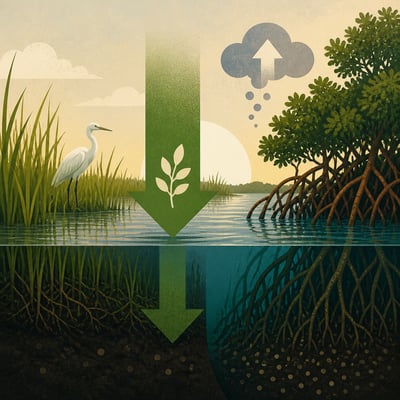
Research on Florida's Everglades finds that freshwater marshes and coastal mangroves remove roughly 14 million metric tons of carbon dioxide from the atmosphere each year, with carbon sequestration increasing by about 18% between 2003 and 2020.
Coastal mangroves capture carbon more effectively than freshwater marshes, while methane emissions offset a much larger share of freshwater-marsh storage. The findings support restoration and improved water management, but show that climate benefits depend on balancing carbon dioxide uptake with methane releases across different wetland types.
The story is more explicitly framed as a management and restoration decision problem: the Everglades' carbon sink value is confirmed, but the new emphasis is on how methane-heavy freshwater marshes complicate net climate benefits. The current version also broadens the practical implications to water-supply, flood-control, habitat, and coastal-protection planning.
The update mainly tightens and slightly reframes the Everglades carbon story: the sink estimate is now presented as a range, and the methane penalty is described as more substantial. It also shifts the framing from broad restoration/ecology toward wetland carbon accounting and mitigation relevance.