
 AI Governance
 Data Centers
 Drones
 Climate
 Privacy
 2026 Maine Senate
 Bob Dylan
Europe Faces Fragmented Climate Adaptation
Coverage from Nature, IMF, and others
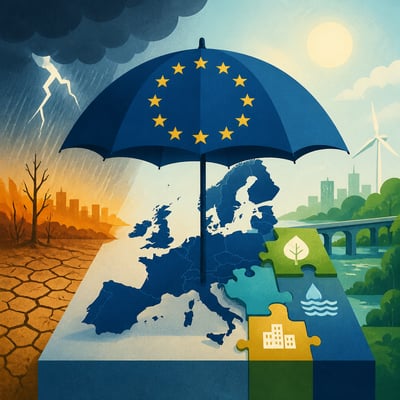
Europe is facing rising losses from floods, droughts, wildfires, heat, and other climate hazards while adaptation planning remains fragmented across countries and sectors.
European scientific and policy institutions are calling for common risk scenarios, measurable resilience goals, stronger monitoring, and greater public and private financing. The discussion also increasingly links adaptation to insurance protection, fiscal stability, ecosystem restoration, and flexible planning that can respond as risks change.
The story now frames adaptation less as a coordination problem alone and more as a financing-and-flexibility challenge, linking climate resilience to public budgets, debt management, and sector-specific economic risks. It also adds major institutional actors, especially the ECB, EIOPA, and the IMF, to the policy discussion.
The story is now backed by much sharper quantitative evidence and a more explicit framing of adaptation as a fiscal-resilience problem, not just a planning gap. It also places more emphasis on fragmented governance and implementation constraints as the main barrier to progress.
- EU weather damages are estimated at €822 billion from 1980-2024.
- Roughly one quarter of those losses occurred between 2021 and 2024.
- About 75% of Europe's natural-disaster damage is reportedly uninsured.
- Fragmented governance and uneven national capacity are highlighted as key adaptation constraints.
- Peatland and forest restoration are added as adaptation measures.
The story has widened from a mostly European adaptation-planning debate into one centered on implementation finance and fiscal risk, with insurance and public-balance-sheet stress becoming much more prominent. It also now explicitly links Europe’s adaptation challenge to IMF warnings about sovereign debt and small-island climate vulnerability.
- Insurance gaps and uninsured damage are pressuring households and public budgets.
- Reinsurance and mandatory coverage are being proposed as responses.
- Climate shocks are now treated as sovereign debt and macroeconomic risks.
- IMF assessments extend the issue to small-island economies like the Solomon Islands.
The story has shifted from a general push for better-coordinated adaptation toward a more specific framework centered on adaptive pathways, resilience targets, and scenario choices. The biggest new issue is disagreement over which warming pathways EU planning should explicitly prepare for, including 1.5°C overshoot.
The story now places more emphasis on financing and execution gaps, while also clarifying that the evidence base is largely coming from European research and advisory institutions. The main policy direction remains the same, but the framing is sharper around implementation constraints and timing.
European climate adaptation policy is moving toward more coordinated planning, shared risk scenarios, and better-timed investment. The dominant signal is pressure to turn fragmented resilience efforts into a more coherent EU framework that can act on short policy windows and long-term climate risks.