Climate Risks Move Into Public HealthClimate Risks Move Into Public HealthCoverage from Nature, CBS News Colorado, and others
00/00/0000
DailyWeekly
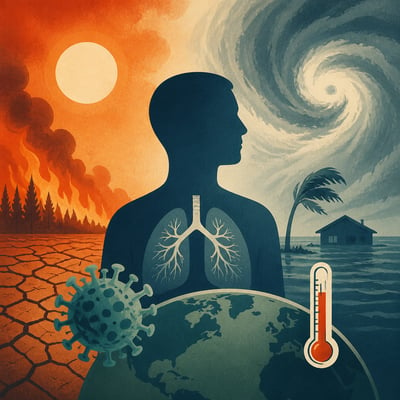
Climate change is increasingly being framed as a public health emergency, with evidence and expert assessments linking heat, extreme weather, air pollution, food and water insecurity, displacement, and changing infectious-disease patterns to rising health risks.
A WHO-linked European commission has recommended classifying the climate crisis as a public health emergency of international concern, while researchers and health organizations are calling for resilient healthcare, water and sanitation systems, surveillance, early-warning capacity, and locally led adaptation. Coastal saltwater intrusion illustrates how climate impacts can simultaneously threaten drinking water, food production, ecosystems, livelihoods, and community health.
Looking Back
735 Day Timeline
Articles published over time. Hover any bar for the period and its article count.
Jul '24
Nov '24
Mar '25
Jul '25
Nov '25
Mar '26
Jul '26
History
09/07/2026
The story broadens from general climate-health preparedness to interconnected coastal, water, food, livelihood, and community-health impacts. It also emphasizes unequal adaptation capacity and more concrete local measures such as cooling centers, clean-air centers, and sustained financing.
07/23/2026
The story has shifted from a broad call for WHO emergency action to a more specific emphasis on disease surveillance and climate-resilient health systems. It also adds clearer focus on waterborne disease and the harms climate disruption poses to children.
Research describes how climate drivers modify transmission of vector-borne, waterborne, and respiratory pathogens and shift outbreak patterns and predictability.
Researchers at the University of Colorado Anschutz Medical Campus published a Nature Reviews Microbiology review linking climate change to shifting risks for waterborne pathogens, informing public health adaptation planning.
Climate health commentary links warming, heat and air quality to increased non communicable disease risk and calls for funded adaptation in healthcare and communities.
A WHO convened pan European commission recommends declaring climate a public health emergency of international concern to address rising health risks from heat, extremes, disease, and air pollution.
5/16/2026 • Policy, Politics & Governance • General
WHO convened a pan European climate and health commission in Europe, recommending the climate crisis be declared a public health emergency of international concern before the WHO world health assembly.
A cost-estimation methodology for climate-resilient care services infrastructure is applied to Bangladesh to support adaptation planning for early childhood and long-term care.
Kate Tully and climate reporting resources describe inland saltwater intrusion threats to crops and freshwater across coastal regions, with adaptation strategies for farms and drinking water.
Researchers at the University of Colorado Anschutz reviewed evidence that climate-driven heat, rainfall extremes, drought, and hurricanes are shifting cyclospora and other waterborne disease risks.
Katrín Jakobsdóttir and WHO Europe convened a pan-European Climate and Health Commission releasing 17 recommendations for government and WHO action across the 53-country region.
5/17/2026 • Policy, Politics & Governance • General
Eos / Kiera O'Donnell, Emily S. Bernhardt, Aeran Coughlin, Ken W. Krauss and Xi Yang58
In 2022, the SWISLR Research Coordination Network began connecting scientists and rural stakeholders to study saltwater intrusion and sea level rise impacts across the North American Coastal Plain.
World Health Assembly in Geneva calls the climate crisis an international public health emergency, citing health impacts from heat, flooding, infections, food insecurity, and air pollution.
A pan-European climate and health commission led by Katrín Jakobsdóttir recommended WHO classify climate change as a PHEIC to address health system unpreparedness and fossil-fuel harms across Europe.
A report released recently warns climate change will intensify health risks faster than health systems can adapt, with developing nations facing up to $20 trillion in losses by 2050.
World Economic Forum and Oliver Wyman report (2024) finds 14.5 million additional climate-related deaths by 2050 and urges resilient health systems and funding globally.
7/24/2024 • Adaptation & Resilience • General
The Guardian / Prof Alan Stein and Dr Lynette Okengo50
Alan Stein and Lynette Okengo call for declaring the climate crisis a global public health emergency and prioritizing child impacts in health adaptation planning.
5/21/2026 • Adaptation & Resilience • General
World Health Organization Sees Climate Change as ... / Allison Kozicharow48
WHO identifies climate related health threats globally as the United States withdraws from WHO and WiRED International expands community health worker programs.
WHO climate-as-health-emergency framing for Europe is disputed based on EM-DAT trends and temperature-mortality attribution concerns tied to population aging.
6/9/2026 • Policy, Politics & Governance • General
Bloomberg Intelligence estimates extreme weather costs will exceed 20 trillion over the next decade as University of East Anglia research finds human caused warming makes fires more damaging.
6/4/2026 • Economy, Business & Innovation • General
7wire Ventures outlines how escalating climate impacts on patient health and healthcare infrastructure are driving near-term investment in adaptation-focused digital health, resilient facilities, and climate-informed analytics.

 AI Governance
 Data Centers
 Drones
 Climate
 Privacy
 2026 Maine Senate
 Bob Dylan