
 AI Governance
 Data Centers
 Drones
 Climate
 Privacy
 2026 Maine Senate
 Bob Dylan
Climate Risks Move Into Public Health
Coverage from Nature, CBS News Colorado, and others
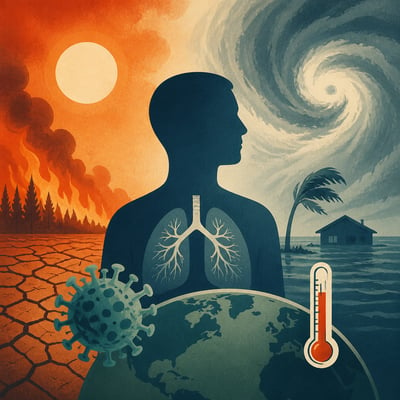
Climate change is increasingly being framed as a public health emergency, with evidence and expert assessments linking heat, extreme weather, air pollution, food and water insecurity, displacement, and changing infectious-disease patterns to rising health risks.
A WHO-linked European commission has recommended classifying the climate crisis as a public health emergency of international concern, while researchers and health organizations are calling for resilient healthcare, water and sanitation systems, surveillance, early-warning capacity, and locally led adaptation. Coastal saltwater intrusion illustrates how climate impacts can simultaneously threaten drinking water, food production, ecosystems, livelihoods, and community health.
The story broadens from general climate-health preparedness to interconnected coastal, water, food, livelihood, and community-health impacts. It also emphasizes unequal adaptation capacity and more concrete local measures such as cooling centers, clean-air centers, and sustained financing.
The story has shifted from a broad call for WHO emergency action to a more specific emphasis on disease surveillance and climate-resilient health systems. It also adds clearer focus on waterborne disease and the harms climate disruption poses to children.
The story has shifted from a general WHO-linked push to treat climate change as a health emergency into a more concrete WHO-convened commission recommendation ahead of the World Health Assembly. It also broadens the health rationale by emphasizing infectious-disease dynamics, non-communicable disease risks, and the healthcare sector’s own emissions burden.
- WHO-convened commission recommends a formal emergency designation.
- Climate change is altering infectious-disease outbreak timing and predictability.
- Healthcare contributes about 5% of global emissions.
- Recommended responses include cooling and clean-air centers.
- Commission urges removal of fossil-fuel subsidies.
The story is now more explicitly centered on Europe and on operational adaptation measures, not just calls to recognize climate change as a health emergency. At the same time, a new dissenting article introduces direct pushback against the emergency framing by disputing the mortality evidence behind it.
The story shifts from broad climate-health concern to a more specific WHO Europe-led campaign to classify climate change as a public health emergency, with new emphasis on concrete adaptation financing and vulnerability framing. The added material also introduces a practical roadmap lens through the Belém Health Action Plan.
- WHO-linked commissions seek public health emergency of international concern classification.
- Calls include fossil-fuel subsidy reform and increased resilience funding.
- Belém Health Action Plan is cited as a health-ministry roadmap.
- Flood, outage, and infrastructure stress on hospitals are newly emphasized.
- New named figures include Hans Kluge and Katrín Jakobsdóttir.
Recent coverage treats climate change as a direct health threat that is worsening faster than health systems can adapt. The strongest signal is a move toward health-system resilience, international coordination, and emergency framing, especially from WHO-linked and public health organizations. Repeated themes include heat, infectious disease, air pollution, food and water insecurity, and rising losses in lower-income regions. The topic is coherent and structurally ongoing, with current emphasis on governance, preparedness, and financing rather than isolated impacts.