
 AI Governance
 Data Centers
 Drones
 Climate
 Privacy
 2026 Maine Senate
 Bob Dylan
Europe Expands Heat Adaptation
Coverage from Deutsche Welle, Genetic Literacy Project, and others
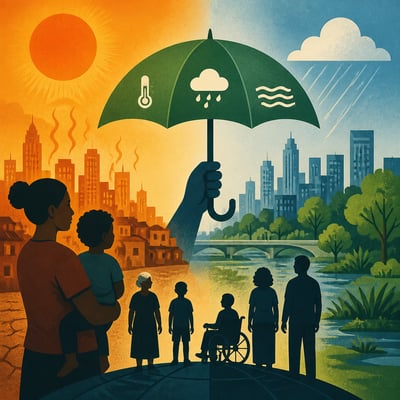
Europe’s increasingly severe heatwaves are driving a broader adaptation response, from targeted air conditioning in hospitals and care homes to cooling centres, heat-health alerts, urban trees, shaded streets, reflective surfaces, and climate shelters.
The debate weighs the health benefits of mechanical cooling against higher electricity demand, emissions, refrigerant risks, and urban heat effects. The reporting also highlights an adaptation gap: vulnerable residents face the greatest risks, while funding, building design, public services, and access to protective measures remain uneven.
The story now places more emphasis on targeted, practical adaptation measures and on who gets access to them, especially hospitals, care homes, schools, and other vulnerable groups. It also sharpens the equity frame by highlighting that climate protection may deepen existing inequalities if funding and access remain uneven.
The story has shifted from a broad account of heatwaves and adaptation to a more specific emphasis on Europe’s 2026 heatwaves exposing concrete infrastructure and public-health weaknesses, with EU-level adaptation efforts now more prominent. The updated framing also adds a stronger sense that implementation and funding are lagging behind the scale of risk.
- June-July 2026 heatwaves damaged roads and railways.
- Heat restricted outdoor work and disrupted power services.
- European Commission now features in adaptation and renovation coordination.
- Adaptation funding and implementation are lagging behind needs.
- Infrastructure standards are beginning to shift for higher temperatures.
The story has broadened from general urban heat adaptation to a sharper focus on simultaneous system stress: record heat is now explicitly disrupting transport, infrastructure, and emergency services while intensifying debate over cooling access. It also adds a clearer policy contrast between durable adaptation models, like France’s heat plan and Barcelona’s climate shelters, and the limits of air conditioning alone.
The story has broadened from a Europe-centered heatwave crisis into a wider climate-adaptation agenda spanning heat, flooding, energy reliability, and equity. It now emphasizes longer-term planning tools and justice concerns rather than mainly emergency heat response.
- Flood adaptation is now discussed alongside heat adaptation.
- Energy resilience is presented as a central adaptation issue.
- Adaptation focus expands to the United States and India.
- Neighborhood-level data and scenario modeling are highlighted as planning tools.
- Justice outcomes are explicitly tied to market-based adaptation tools.
The story has sharpened from broad adaptation pressure into a more acute Europe-wide crisis, with new emphasis on deaths, emergency disruption, and heat pushing systems past practical thresholds. The framing now stresses immediate harm and faster-moving adaptation needs rather than just sustained strain.
- Record temperatures and excess deaths are now explicitly mentioned.
- Transport operators in Central Europe are newly identified as affected actors.
- Climate shelters appear as a named adaptation measure.
- The narrative now highlights crossing multiple practical temperature thresholds.
- Longer-term urban redesign is now emphasized in policy debate.
The story has shifted from a broad account of urban climate adaptation to a denser, Europe-centered account of repeated extreme heat stressing multiple systems at once. Heat is now framed as an ongoing operational problem for cities, health services, agriculture, and infrastructure, not just a vulnerability-mapping challenge.
- European heatwaves are causing alert-level conditions and operational disruption.
- Cities are using cooling centers, heat plans, shade, and schedule changes as routine measures.
- Heat is straining electricity grids and constraining nuclear cooling in warm rivers.
- Agriculture faces drought, pest pressure, and policy debates over adaptation tools.
- Historic districts and prestige venues are especially hard to cool.
The story has broadened from general urban heat and flood adaptation to include energy resilience as a distinct climate-risk issue, with New York City emerging as a new case study. The framing also becomes more explicit that adaptation tools and metrics can themselves reproduce inequality if they ignore vulnerable communities.
Urban climate adaptation is increasingly framed around unequal exposure to heat, flooding, and water stress, with cities testing warning systems, hazard models, and neighborhood-scale planning that explicitly address vulnerable groups.