Energy Security Turns Toward ElectricityEnergy Security Turns Toward ElectricityCoverage from Los Angeles Times, WFAE, and others
00/00/0000
DailyWeekly
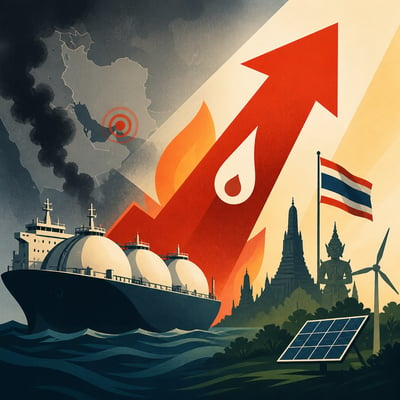
Disruptions to oil and LNG flows associated with the Iran conflict, particularly around the Strait of Hormuz, have increased fuel-price volatility, supply uncertainty, and costs for import-dependent economies.
Governments, financiers, and businesses are responding through greater investment in solar power, battery storage, electric vehicles, and in some cases renewable hydrogen, although other countries are extending coal, gas, or LNG use to manage near-term shortages. The pattern links clean-energy deployment not only to emissions reduction but also to reducing exposure to concentrated fossil-fuel supply routes.
It presents the strongest concrete case that war-related financing, shipping, and project delays can impede near-term renewable deployment.
OilPrice.com
Key Issues
01
Persistent fossil-fuel chokepoint exposure
Hormuz-related disruption continues to expose import-dependent economies and gas-heavy power systems to elevated oil and LNG costs, supply uncertainty, and broader economic damage. Developing countries face especially disproportionate burdens from the shock.
Stable
Drawn from 4 articles
02
Clean energy is gaining resilience value
Renewables, storage, and electrification are increasingly being treated as energy-security assets because they reduce exposure to imported-fuel shocks after deployment. Solar and EV adoption is expanding across China, Africa, Pakistan, and Southeast Asia, with existing capacity already avoiding some fossil-fuel imports.
Strengthening
Drawn from 4 articles
03
Near-term responses remain strategically divided
Energy-security responses continue to diverge rather than converge on one transition pathway. Renewable power and electrification are advancing alongside coal restarts, hydropower reliance, and other fossil-fuel measures used to manage immediate shortages and reliability risks.
Stable
Drawn from 4 articles
04
China combines relative insulation with clean-tech leverage
China’s renewable buildout and electrification are reducing its exposure to the fuel shock while its solar, battery, and EV exports support adoption in other markets. Record clean-tech exports are increasing China’s influence over how other economies respond to energy insecurity.
Strengthening
Drawn from 3 articles
05
Clean-energy resilience has its own constraints
The clean-energy response remains limited by concentrated component and materials supply chains, higher freight and financing costs, and war-related project delays. High fossil-fuel prices improve medium-term renewable economics, but near-term deployment can still be slowed by capital and logistics pressures.
Stable
Drawn from 3 articles
Key Numbers
0.2%
year-over-year change in global greenhouse-gas emissions
global · first half of 2026
“Global greenhouse-gas emissions rose just 0.2% year over year during the first half of 2026, according to an early Climate Trace analysis.”
Los Angeles Times and 1 other article
150% percent
year-over-year increase in overseas sales of Chinese electric vehicles and plug-in hybrids
July
“In July, Chinese carmakers sold more than 500,000 electric vehicles and plug-in hybrids overseas, about 150% more than a year earlier.”
Energy Connects
five consecutive months
duration of China's record clean-tech export performance
record clean-tech exports in dollar terms
“It recorded five consecutive months of record clean-tech exports in dollar terms, according to BloombergNEF.”
Energy Connects
$330 billion USD
extra fossil-fuel import costs
global fossil-fuel importers · since the war began on Feb. 28
“Global fossil-fuel importers have paid more than $330 billion in extra costs since the war began on Feb. 28, according to the Centre for Research on Energy and Clean Air. Economies that had already reduced their fossil-fuel dependence have weathered the crisis better. China’s renewable-energy projects added since 2020 helped it avoid nearly $8 billion in fossil-fuel imports between March and July.”
Los Angeles Times
nearly $8 billion USD
avoided fossil-fuel imports
China; renewable-energy projects added since 2020 · between March and July
“Global fossil-fuel importers have paid more than $330 billion in extra costs since the war began on Feb. 28, according to the Centre for Research on Energy and Clean Air. Economies that had already reduced their fossil-fuel dependence have weathered the crisis better. China’s renewable-energy projects added since 2020 helped it avoid nearly $8 billion in fossil-fuel imports between March and July.”
Los Angeles Times
Contested Issue
1 open dispute
Does the Hormuz-linked energy shock primarily accelerate the clean-energy transition, or does it impede near-term renewable deployment and increase reliance on fossil fuels?
The corpus contains materially different assessments of the shock's near-term effects. Some evidence reports faster renewable, solar, and electric-vehicle adoption and lower fossil-fuel exposure, while other evidence documents financing, supply-chain, and project-delivery constraints that delay renewable deployment and encourage temporary coal or LNG use.
Transition acceleration
4 articles · across 3 publications
The shock is strengthening the economic and strategic case for renewables, electrification, and clean-technology deployment by exposing the costs and security risks of imported fossil fuels.
Near-term deployment constraints
4 articles · across 4 publications
The immediate shock is constraining or delaying renewable rollout through higher financing, freight, and equipment costs, while affected systems rely more heavily on coal, LNG, or other thermal capacity for short-term reliability.
Looking Back
182 Day Timeline
Articles published over time. Hover any bar for the period and its article count.
Mar 20
Apr 17
May 15
Jun 19
Jul 17
Aug 14
Sep 11
The Story So Far
Clarification
The fossil-fuel shock does not produce the feared near-term coal surge
Early evidence indicates that renewable expansion outpaced coal during the disruption: global greenhouse-gas emissions were nearly flat in the first half of 2026, while clean-energy adoption accelerated in several emerging markets. The result shows that the energy shock is driving some substitution away from fossil fuels, although financing pressures still threaten clean-power deployment.
Previously
Disruptions to oil and LNG flows associated with the Iran conflict, particularly around the Strait of Hormuz, have increased fuel-price volatility, supply uncertainty, and costs for import-dependent economies. Governments, financiers, and businesses are responding through greater investment in solar power, battery storage, electric vehicles, and in some cases renewable hydrogen, although other countries are extending coal, gas, or LNG use to manage near-term shortages. The pattern links clean-energy deployment not only to emissions reduction but also to reducing exposure to concentrated fossil-fuel supply routes.
History
09/03/2026
The story now places greater emphasis on China’s clean-technology exports and the link between concentrated fossil-fuel routes and energy-security decisions. It also broadens the identified participants and affected geography, while largely confirming the previously established pattern of uneven clean-energy and fossil-fuel responses.
08/31/2026
The story now has stronger quantitative evidence of the shock’s economic effects and clean-energy benefits, while broadening into fertilizer, food security, and alternative hydrogen supply chains. The transition response is more clearly measurable, but short-term fossil substitution remains constrained.
The Iran conflict raised global fossil-fuel import costs after February 28, 2026, while renewable energy and electric vehicle adoption expanded across China, Africa, and Asia.
During 2025, energy supply shocks linked to Middle East conflict led Asian and African countries to expand solar, batteries, and electric vehicle adoption to reduce imported oil and gas dependence.
Michael Liebreich says a prolonged closure of the Strait of Hormuz could accelerate global clean-energy investment and reduce long-term fossil fuel dependence.
Strait of Hormuz disruptions during the Iran conflict increased global oil and LNG prices, with countries having clean electricity and electrified transport described as more resilient.
During Strait of Hormuz disruptions tied to the Iran war, China and Pakistan relied on prior solar and EV buildouts to reduce exposure to fuel price shocks.
Robinson Meyer says the Iran war and Strait of Hormuz uncertainty intensified competition between global oil-and-gas and electricity-and-batteries systems, especially driven by China’s clean-tech supply chains.
International Energy Agency reporting of 800 gigawatts of renewable additions coincides with Iran war risks to clean-energy financing and metal and solar-material supply chains.
Rystad Energy forecasts three-to-12-month renewable project delays in Middle East markets due to conflict-driven supply chain disruptions and financing risk premiums.
Following the Strait of Hormuz blockade starting in early March, multiple countries reported fuel shortages and reviewed energy transitions toward renewables, nuclear, and electrification.
Thailand faces higher LNG costs after the Iran conflict reduces LNG availability, prompting policy shifts toward accelerated solar and other renewables ahead of the next Power Development Plan.
A Hormuz Strait energy disruption is expected to accelerate Asian electrification and nuclear investment while increasing short-run coal use across the region.
4/8/2026 • Economy, Business & Innovation • General
A Strait of Hormuz chokepoint disruption in 2026-era markets is driving Morocco, Egypt, and steel and fertilizer buyers toward green hydrogen, green ammonia, and hydrogen-DRI corridors.
6/29/2026 • Economy, Business & Innovation • General
During Middle East conflict-related fuel disruptions, countries in Asia and Africa accelerate solar, batteries, and electric vehicle adoption to reduce imported oil and natural gas dependence.
Iran war disruptions around the Strait of Hormuz are linked to higher global fossil-fuel costs, influencing energy transition decisions in the US, China, and Japan.
Renewables with battery storage and grid flexibility are presented as a way to reduce fossil-fuel-linked electricity price spikes during geopolitical disruptions.
International Energy Agency said a Hormuz-related supply disruption amid the US-Israel war against Iran drove fuel and fertilizer price increases while renewables costs fell.
Analysts link Iran war-driven fuel price shocks to larger European power price increases in gas-dependent systems and greater stability in renewable-heavy Albania.
After Strait of Hormuz disruption and US subsidy rollbacks for solar, wind, and EVs, multiple countries see renewed renewables and EV demand while some shift toward coal and face fertilizer-driven food risks.
4/15/2026 • Clean Energy & Emissions • General
IET Renewable Power Generation / Farid Salehi-Moorkani64
Asian governments in the 2020s implemented fuel-tax suspensions and subsidy programs after Gulf supply shocks raised fuel prices, while energy transition toward renewables accelerated.
Iran war is credited with accelerating solar, wind, and EV adoption outside the United States through renewed energy security and market-shifting effects.
Multiple countries in Asia and Africa increased solar, batteries, and electric vehicle adoption after conflict-driven oil and LNG supply disruptions raised prices and risk.
Fuel price increases from the Iran war since Feb. 28 boosted rooftop solar installations and inquiries in the Philippines, alongside record Chinese solar exports in March.
Amid US-Israeli strikes on Iran and Strait of Hormuz supply disruption, commentary highlights that wind and solar generation is less affected by fossil fuel price volatility after build-out.
The International Energy Agency described Iran-linked conflict as a major oil supply disruption, prompting countries in late-April Colombia talks to accelerate renewable energy and electrification.
Energy Transitions Commission flags that Hormuz-related fossil price volatility increases energy security risks and recommends accelerating renewables and electrification.
After the Iran war began in late February, fuel-price spikes in the Philippines increased rooftop solar installations and inquiries while Chinese solar exports rose in March.
Geopolitical disruptions near the Strait of Hormuz are driving energy policy changes worldwide, with renewables, batteries, EVs, and nuclear investment expanding as fossil exposure falls.
During the Iran war and Strait of Hormuz disruption, countries dependent on Middle East oil and LNG accelerate renewable, battery, and EV adoption while China expands grid and clean-energy supply.
Meghan O'Sullivan and Richard Goldberg discuss how US-Iran de-escalation could affect oil transit through the Strait of Hormuz while electrification reshapes energy security decisions.
Renewable energy transition is argued to reduce fossil-fuel geopolitics and economic disruption, alongside national and regional climate impacts, in contrast to reported US offshore wind rollback.
The International Renewable Energy Agency reports record renewable growth as Strait of Hormuz disruptions spur electrification and conservation in Asia and Europe.
China was assessed as most insulated in Asia from the Strait of Hormuz energy shock after the waterway’s near-closure following US and Israeli strikes.
Mahindra Group accelerates resort kitchen electrification in Asia as the IEA world energy investment report cites reduced fossil fuel import costs from electrification and efficiency.
During the Iran war, Middle East oil and LNG disruptions raised gasoline prices in the US, Europe, and Asia and highlighted constraints on energy dominance amid energy-transition supply-chain risks.
More than 30 governments adopted clean-energy and efficiency policies by September 9, 2026, as the Iran conflict increased fossil-fuel costs globally but emissions still rose slightly.
Six months into the U.S.-Israel war against Iran, oil and fertilizer price increases affected transport and food security while countries expanded electric vehicles and clean-energy plans worldwide.
Six months into the conflict, countries and consumers worldwide accelerated electrification and renewable-energy investment as disrupted oil supplies raised fuel and fertilizer costs.
Rising oil prices from Strait of Hormuz disruption in 2026, amid US-Iran tensions, may accelerate renewable deployment and reinforce China’s clean-energy manufacturing lead.
4/17/2026 • Economy, Business & Innovation • General
Amid Iran war-driven oil disruptions, Chinese EV, solar, battery, and wind exports have risen as countries pursue energy security during trade talks in Beijing.
5/14/2026 • Economy, Business & Innovation • General
IEA emergency reserves totaling 400 million barrels are authorized after Strait of Hormuz disruption, while clean energy scaling and Africa electricity-access programs are highlighted amid record heat.
China and multiple Asian economies respond to Iran-war-linked energy stress with oil stockpiling, demand limits, expanded power supply, and longer-run investment in solar, batteries, nuclear, and electrification.
Following US-Iran interim talks and continued regional disruptions, countries in 2026 accelerated electrification and renewable deployment to reduce fossil fuel import risk.
Energy security pressures from Middle East oil and LNG disruptions are pushing Asia and Africa to deploy solar, batteries, and electric vehicles, supported by Chinese exports.
During the Strait of Hormuz energy disruptions linked to the Iran conflict, analysts project lingering costs and supply-chain risk across Asia while China mitigates effects.
Energy Transitions Commission cites the Iran conflict as a driver for faster renewable and storage investment due to reduced exposure to fossil supply disruptions.
Energy Transitions Commission executives including Adair Turner cite Iran-linked oil disruptions as rationale for faster renewable deployment in energy-transition investments.
After the Feb. 28 start of the Iran war, higher fuel costs increased rooftop solar installations in the Philippines while China boosted clean technology exports in March.
IRENA, through a 24/7 renewables report, says battery storage cost declines support round-the-clock solar and wind power to improve energy security amid Strait of Hormuz disruptions.
The IEA forecasts $3.4 trillion in global energy investment for 2026, citing Hormuz Strait closure risks that redirect spending toward grids, storage, and low-emissions capacity.
The International Energy Agency describes the Hormuz crisis as a major oil-supply disruption in March, driving transport demand cuts and renewables and EV acceleration policies across multiple countries.
IEA executive director Fatih Birol said Middle East conflict and the Strait of Hormuz standoff will drive durable renewables and nuclear policy shifts worldwide.
An AP report in March 2026 links Iran conflict-driven Strait of Hormuz oil and LNG disruption to higher energy prices and renewed momentum for renewable energy deployment across Asia, Europe, and Africa.
Higher fuel costs after the Iran war increase rooftop solar installations in the Philippines during February to April, while China expands solar exports across Asia and Africa.
The International Energy Agency links Iran-war fuel-price and supply risks to emergency clean energy actions in nearly 40 countries, accelerating renewables, batteries, and electric vehicles.
UNFCCC climate officials and government leaders cite Iran-war oil and gas disruptions as a driver of renewables deployment and electric vehicle growth while some countries increase coal use, amid fossil fuel phaseout talks in Colombia.
BloombergNEF, Wood Mackenzie, and other analysts report that rising energy prices tied to conflict are changing generation fuel economics, with some coal rebounds and faster cleantech momentum in multiple countries.
War disruptions near the Strait of Hormuz in the Middle East have raised oil prices, driving different renewable energy transition pathways across exporting and importing countries.
Iran conflict intensified exposure of oil and LNG chokepoints, and renewable deployment is presented as a resilience and price-stability strategy alongside critical-mineral supply-chain upgrades.
Middle East conflict and Strait of Hormuz LNG disruption drive higher fossil fuel prices, leading multiple Asian and African countries to expand solar, batteries, and EV deployment.
BloombergNEF projects oil demand plateaus in the early 2030s while natural gas demand rises through mid-century, and clean energy investment must double for net zero by 2050.
Europe and Asia are shifting faster toward Chinese-made solar, batteries, wind equipment, and grid infrastructure as Strait of Hormuz oil shocks affect energy security amid the U.S.-Iran conflict.
During the first six months of the U.S.-Israel conflict with Iran, oil and fertilizer disruptions accelerated clean-energy measures worldwide while raising transport and food costs.
The U.S.-Israel conflict with Iran raised oil, jet-fuel, and fertilizer costs in 2026 while accelerating electric-vehicle adoption and clean-energy measures across affected economies.
The U.S.-Israel war against Iran raised global oil, jet-fuel, and fertilizer costs in 2026 while encouraging renewable-energy and electric-vehicle expansion across several countries.
The Iran conflict raised oil and fertilizer prices across global markets during its first six months, disrupting aviation and food security while accelerating clean-energy investment.
The U.S.-Israel conflict with Iran raised oil and fertilizer prices in 2026, prompting countries across energy-importing markets to accelerate electric vehicles, renewable energy, nuclear research, and domestic energy investment.
The United States-Israel conflict with Iran has disrupted Gulf fuel flows, accelerating clean-energy investment and raising transport and fertilizer costs worldwide six months into the war.
The Iran war disrupted Gulf energy infrastructure and shipping from February 28, 2026, raising import costs worldwide while accelerating renewable energy and electric-vehicle adoption.
The U.S.-Israel conflict with Iran raised oil and fertilizer costs worldwide in 2026 while countries accelerated electric-vehicle, solar, and other clean-energy investments.
Six months into the U.S.-Israel conflict with Iran, Strait of Hormuz disruptions increased global fuel and fertilizer costs while accelerating clean-energy investment worldwide.
Six months into the United States-Israel conflict with Iran, Persian Gulf disruptions raised oil and fertilizer costs while encouraging clean-energy investment worldwide.
Six months into the Iran conflict, disrupted oil and fertilizer supplies raised global costs while countries expanded electric vehicles and clean-energy measures across Asia, Africa, and elsewhere.
The Iran conflict in 2025 disrupted Persian Gulf energy flows, raising fossil-fuel costs and prompting countries worldwide to accelerate renewable power, nuclear research, and electrification.
The Iran conflict raised oil and fertilizer prices in 2026 while countries including Singapore, New Zealand, and Colombia accelerated electric-vehicle and clean-energy adoption.
The United States-Israel conflict with Iran raised global oil and transport costs during 2026 while prompting countries in the Persian Gulf and elsewhere to accelerate electric-vehicle, solar and nuclear plans.
The Iran conflict accelerated electric vehicle, renewable energy, solar, and nuclear investment in 2026 while higher fuel and fertilizer prices increased food-security risks worldwide.
The U.S.-Israel conflict with Iran in 2026 disrupted Persian Gulf energy flows, raising oil and fertilizer costs while accelerating clean-energy measures worldwide.
The United States-Israel-Iran conflict raised oil and fertilizer prices over six months, accelerating electrification measures worldwide and worsening food-security risks in Asia and Africa.
Six months into the U.S.-Israel war with Iran, disruptions in the Strait of Hormuz raised oil and fertilizer prices while accelerating clean-energy measures worldwide.
The United States-Israel conflict with Iran disrupted oil and fertilizer supplies in 2026, raising prices and prompting governments worldwide to accelerate clean-energy investment.
Countries dependent on Persian Gulf oil expanded renewable energy, nuclear research, and electrification six months after war between the United States, Israel, and Iran disrupted regional energy supplies.
The Centre for Research on Energy and Clean Air estimated that conflict between the United States, Israel, and Iran increased global fossil fuel import bills by up to $330 billion between March and August.
The IEA World Energy Investment report projects rising fossil fuel investment and stagnant clean energy investment amid geopolitical instability and energy price volatility.
5/28/2026 • Economy, Business & Innovation • General
After the Iran war, Europe and Asia accelerate clean-energy electrification, while China-dominated solar, battery, EV, and wind supply chains raise security and trade concerns.
4/19/2026 • Economy, Business & Innovation • General
Qatar helium shutdown and Iran-linked supply disruptions in Bahrain and the UAE raise aluminum and semiconductor input costs for solar and wind manufacturing as oil prices remain volatile.
5/4/2026 • Economy, Business & Innovation • General
During an Iran war disruption to Strait of Hormuz oil and LNG exports, import-dependent countries in Asia, Europe, and Africa faced energy price pressure that renewed focus on renewable energy scaling.
During the Iran conflict, analysis links fossil-fuel shipping risks through the Strait of Hormuz to faster solar and wind deployment despite critical-mineral supply constraints.
Oil and LNG export disruption through the Strait of Hormuz escalated fuel costs in Asia, Europe, and Africa, increasing pressure for faster renewable energy deployment and electrification.

 AI Governance
 Data Centers
 Drones
 Climate
 Privacy
 2026 Maine Senate
 Bob Dylan