
 AI Governance
 Data Centers
 Drones
 Climate
 Privacy
 2026 Maine Senate
 Bob Dylan
El Niño Raises Global Heat Risks
Coverage from The Conversation, Jimehansen, and others
What's Going On
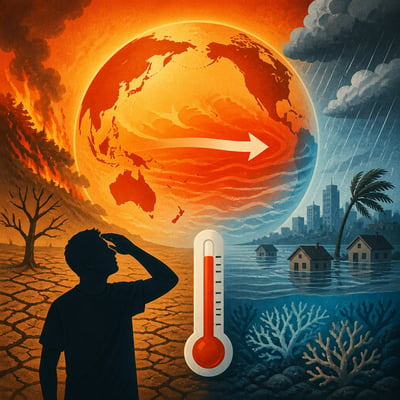
Forecasts indicate a high likelihood of a very strong El Niño, with a possible peak in late 2026 or early 2027.
Where It Stands
The forces this coverage keeps returning to, and which way each has moved.
El Niño is moving toward exceptional intensity
StrengtheningThe 2026–27 event is already unusually strong and continues to intensify, with observations and forecasts indicating a substantial possibility of record intensity. Evidence also supports persistence into 2027, extending the period of elevated climate risk.
El Niño is adding near-term heat to an already warmer climate
Ocean heat released by El Niño is expected to raise global temperatures on top of approximately 2.5°F of human-caused warming. Forecasts indicate broad heat exposure and a meaningful possibility that 2027 could set a new global temperature record.
Rainfall disruption is highly regional and uneven
Forecasts point to drier conditions and weaker monsoon rainfall across India, parts of Australia and other climate-sensitive regions, increasing risks to crops, water supplies and hydropower. Elsewhere, El Niño may bring heavier rain, flooding and storms, while the Indian Ocean Dipole and other regional factors add uncertainty.
The event is translating into cascading social, ecological and economic exposure
Projected effects extend beyond short-term weather anomalies to acute food insecurity, coral bleaching, Amazon ecosystem stress, economic losses and longer-term health impacts. These risks can compound across already vulnerable food, health, ecological and economic systems.
Start Here
A few articles that between them cover the whole topic, picked by the role each one plays.
If you read one thing
Stronger El Niño May Bring Record Heat and Extreme WeatherIt clearly introduces the event’s exceptional intensity, added heat on a warmer baseline, and the evidence behind both claims.
Best explainer
How a Record-Strength El Niño Could Affect New Zealand and the WorldIt explains how El Niño shifts rainfall and releases ocean heat while connecting those mechanisms to global and regional risks.
The evidence
Preparing for a Potentially Record-Breaking 2026–27 El NiñoIt adds distinct quantified evidence on food insecurity, economic losses, health, coral bleaching, and ecosystem exposure.
The local angle
IMD Forecasts Below-Normal Monsoon As El Nino Risk RisesIt shows how the broader forecast could translate into below-normal monsoon rainfall and concrete food and water risks in India.
Key Numbers
Figures the coverage reports, each traced back to the sentence it came from.
roughly 1,000 years
length of the reconstructed El Niño record
“Cole and colleagues reconstructed past El Niño events using coral skeletons from the Galápagos, whose annual growth records past environmental conditions. Comparing roughly 1,000 years of records with modern observations, they found that modern El Niños are significantly stronger than those of the preindustrial era.”
36% percent
estimated increase in the strength of current El Niño events relative to preindustrial events
“Cole estimates that current events are about 36% stronger, suggesting that strong El Niños are a consequence of a warmer world.”
2.2C to 2.3C above average
Niño 3.4 sea-surface temperature anomaly
“Senior climatologist Felicity Gamble said sea surface temperatures in the Niño 3.4 region were likely 2.2C to 2.3C above average in August, higher than any previous August since 1950. Forecasts indicate they could peak above 3C, exceeding the previous record of 2.6C in January 1983.”
more than 2C temperature change
Niño 3.4 warming between February and July
“The region warmed by more than 2C between February and July, a six-month change not seen in the historical record. Gamble said the event could set records for its strength, rate of warming and duration.”
six times likelihood multiplier
Increase in likelihood of an El Niño of this magnitude due to climate change
“Preliminary research from scientists at the University of Melbourne found that climate change had made an El Niño of this magnitude six times more likely. The researchers compared historical records and climate models with and without the influence of greenhouse gas emissions. The study has been submitted for peer review.”
The Story So Far
How the framing has shifted since the last time this topic was analysed.
The new articles reiterate the existing outlook for an exceptionally strong El Niño, climate-amplified warming and broad regional risks without establishing a material new development.
Previously
A strong El Niño is developing in the tropical Pacific and is forecast to intensify through late 2026, potentially continuing into early 2027. Forecasts point to elevated global temperatures and shifting rainfall patterns, with higher risks of drought, wildfire and food stress in parts of Asia, Australia, Africa and the Americas, alongside heavier rain and flooding in other regions. Governments and international agencies are urging earlier preparation for impacts on health, water, agriculture, energy and disaster response, although the event’s eventual strength and regional effects remain uncertain.
History
The update largely confirms the earlier forecast while broadening the explicitly affected geography and adding greater caution about attribution and regional uncertainty. Australia’s meteorological agency and the Indian Ocean Dipole now feature as relevant actors and influences.
The forecast is now more explicitly tied to a possible record-warm 2026 or 2027, while regional impacts are framed with greater specificity rather than broad global risks.