
 AI Governance
 Data Centers
 Drones
 Climate
 Privacy
 2026 Maine Senate
 Bob Dylan
El Niño Raises Global Heat Risks
El Niño Raises Global Heat RisksCoverage from The Conversation, Jimehansen, and others
00/00/0000
What's Going On
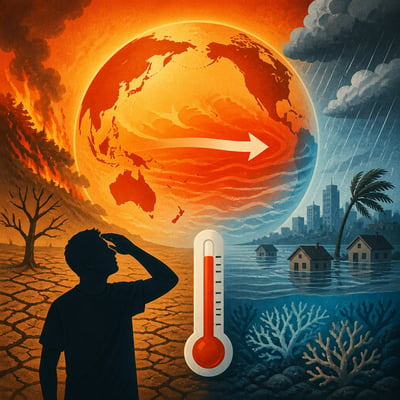
Forecasts indicate a high likelihood of a very strong El Niño, with a possible peak in late 2026 or early 2027.
History
The update largely confirms the earlier forecast while broadening the explicitly affected geography and adding greater caution about attribution and regional uncertainty. Australia’s meteorological agency and the Indian Ocean Dipole now feature as relevant actors and influences.
The forecast is now more explicitly tied to a possible record-warm 2026 or 2027, while regional impacts are framed with greater specificity rather than broad global risks.
The outlook has intensified from a strengthening El Niño to a potentially record-strength event, with a clearer peak window and broader humanitarian consequences. New involvement from NOAA, WHO and WFP emphasizes preparedness for food, health and disease risks alongside weather hazards.
- El Niño may reach record intensity during late 2026 or early 2027.
- Peak conditions are projected between November 2026 and January 2027.
- International agencies are planning for food, water, energy and disease risks.
- Potential impacts include acute hunger and coral bleaching in vulnerable regions.
- NOAA, WHO and WFP are newly identified as involved organizations.
A strengthening El Niño is expected to raise temperatures and alter rainfall patterns across many regions from late summer into the following months. Forecasts point to heightened risks of heatwaves, drought, wildfires, flooding and marine heat, with India’s monsoon among the most closely watched systems. UN and WMO officials are urging governments to expand heat-health plans, early warnings, cooling access and other protective measures while reducing fossil-fuel use.