
 AI Governance
 Data Centers
 Drones
 Climate
 Privacy
 2026 Maine Senate
 Bob Dylan
Egypt Pairs Renewables With Storage
Coverage from Daily News Egypt, AGBI, and others
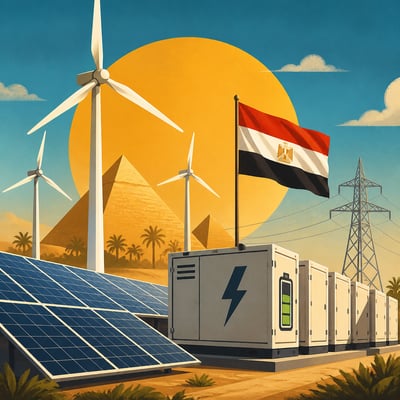
Egypt is advancing a large portfolio of solar and wind projects paired with battery storage through long-term power purchase agreements and partnerships with developers including Masdar, Scatec, AMEA Power, Infinity Power, and Hassan Allam.
Announced and reviewed projects span the Gulf of Suez, Ras Shukeir, Benban, Minya, Qena, Aswan, and the Western Desert, with storage increasingly used to shift renewable generation toward periods of higher demand. The program is intended to reduce fossil-fuel dependence and support Egypt’s goal of raising renewables to 45% of electricity by 2028, while timely construction and grid connection remain central implementation issues.
If you read one thing
Egypt and Masdar Advance Renewable Projects for 2028 TargetIt provides the clearest broad overview of Egypt’s renewable and storage expansion and its 2028 target.
Best explainer
Egypt, EU Back €690M Grid Upgrade for Renewable IntegrationIt explains how EU-backed grid investment is intended to enable large-scale renewable integration.
The evidence
Egypt Boosts Fuel Supply Planning as Summer Power Demand RisesIt adds the near-term reliability and fuel-supply pressures that renewable deployment and storage must address.
Renewable generation and storage are scaling up
Egypt is expanding utility-scale solar and wind through private-sector agreements, including a reported 5.6 GW portfolio with substantial battery capacity. Storage is being deployed both alongside renewable projects and as standalone capacity to improve flexibility and support the target of a 45% renewable electricity share by 2028.
Grid modernization is the critical integration constraint
Egypt is pairing renewable procurement with transmission expansion, storage deployment, and closer oversight of project connection and implementation schedules. EU-backed financing and government-directed grid upgrades are intended to enable much larger renewable volumes, making grid readiness a central condition for meeting the 2028 and 2030 ambitions.
Reliability remains tied to peak-demand and fuel planning
Egypt continues to manage renewable deployment alongside conventional fuel coordination and grid-quality measures because rising electricity demand still creates near-term reliability requirements. Renewable and storage expansion is therefore supplementing, rather than yet replacing, fuel-supply and system-management planning.
The new member repeats existing reporting on Egypt’s cooperation with Masdar to accelerate utility-scale renewables, battery storage, private investment, and grid integration toward the 2028 target, without establishing a further material real-world development.
Previously
Egypt is advancing a coordinated electricity strategy that combines grid strengthening, solar and wind integration, battery storage and continued fuel-supply planning. The government is pursuing a higher renewable share while managing rising summer demand and the reliability risks exposed by earlier power shortages. EU financing and clean-power agreements for major port operations add international and commercial support to the transition.
The story now identifies additional commercial and grid-sector participants, including Infinity Power, Hassan Allam Utilities, and the Egyptian Electricity Transmission Company. It also highlights unresolved inconsistencies in reported capacities, locations, and development status, especially around Ras Shukeir and Gulf of Suez projects.
Egypt’s renewable strategy has moved from planning toward a signed, large-scale project portfolio, while local equipment and battery manufacturing adds an industrial dimension. Execution and grid-connection timelines are now the central risks to achieving the 2028 target.