
 AI Governance
 Data Centers
 Drones
 Climate
 Privacy
 2026 Maine Senate
 Bob Dylan
Egypt Pairs Renewables With Storage
Coverage from Daily News Egypt, AGBI, and others
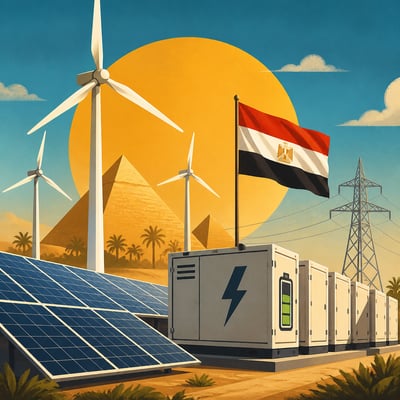
Egypt is advancing a large portfolio of solar and wind projects paired with battery storage through long-term power purchase agreements and partnerships with developers including Masdar, Scatec, AMEA Power, Infinity Power, and Hassan Allam.
Announced and reviewed projects span the Gulf of Suez, Ras Shukeir, Benban, Minya, Qena, Aswan, and the Western Desert, with storage increasingly used to shift renewable generation toward periods of higher demand. The program is intended to reduce fossil-fuel dependence and support Egypt’s goal of raising renewables to 45% of electricity by 2028, while timely construction and grid connection remain central implementation issues.
The story now identifies additional commercial and grid-sector participants, including Infinity Power, Hassan Allam Utilities, and the Egyptian Electricity Transmission Company. It also highlights unresolved inconsistencies in reported capacities, locations, and development status, especially around Ras Shukeir and Gulf of Suez projects.
Egypt’s renewable strategy has moved from planning toward a signed, large-scale project portfolio, while local equipment and battery manufacturing adds an industrial dimension. Execution and grid-connection timelines are now the central risks to achieving the 2028 target.
- Egypt signed agreements covering approximately 5.6 GW of renewable generation and storage.
- The signed portfolio includes 900 MW of wind, 2 GW of solar, and 2,000 MWh of storage.
- The government is closely reviewing private developers’ construction and grid-connection schedules.
- Plans now include local renewable-equipment and battery manufacturing.
- A proposed Scatec-linked battery investment could reach $1.8 billion.
The story has shifted from active project execution to a more integrated framing that ties grid upgrades and renewables to energy security, emissions reduction, and Egypt’s regional trade role. The biggest new element is the explicit commercial link through the port electricity deal, alongside a slightly more cautious description of the EU package as proposed.
The story has shifted from a general renewable buildout to a more urgent near-term reliability and fuel-supply challenge, with summer demand stress now driving grid, storage, and LNG coordination. It also adds clearer execution milestones, including a large EU-backed transmission package and an operating solar-plus-storage project.
- Summer electricity demand is expected to rise 8% above the previous record peak.
- About 105 grid-reinforcement projects are now underway.
- Obelisk has connected 500 MW solar and 200 MWh battery storage.
- EU-backed package totals €690 million for transmission upgrades.
- Suez Canal Container Terminal estimates 30,000 tonnes annual emissions avoidance.
The story now places stronger emphasis on financing, procurement, and commercial use cases for Egypt’s clean-power buildout, especially through EU-backed lending and industrial/port demand. It also broadens from grid-and-generation planning into a more explicit competitiveness and trade-compliance narrative.
- EU institutions and EBRD are now central financing players.
- Industrial and port users are adopting clean electricity to stay competitive.
- East Port Said becomes a named clean-power procurement focus.
- Battery storage is tied to evening peak supply and stability.
- Some references now extend to 2030 targets.
The story has sharpened from a general renewable buildout into a more coordinated implementation push that explicitly links generation, storage, and transmission upgrades. It also adds new project and leadership detail, with 2027-2028 delivery targets now central to the narrative.
The story now adds a clearer policy and target-setting layer: Egypt’s renewable buildout is tied more explicitly to official 2028 and 2030 clean-energy goals, while still centered on contracted, execution-stage projects. It also slightly broadens the actor set by naming Mahmoud Esmat and Abdel Fattah Al-Sisi in the policy framing.
Egypt is advancing a large renewable power buildout built around long-term PPAs, private developers, and grid-scale battery storage. The strongest signal is execution: new solar and wind projects are being contracted, reviewed, and supported by financing and regulatory assistance. Storage appears increasingly tied to grid reliability and peak-demand management rather than treated as a separate add-on. The topic is coherent and fairly dense, with little historical noise and a strong current implementation focus.