
 AI Governance
 Data Centers
 Drones
 Climate
 Privacy
 2026 Maine Senate
 Bob Dylan
Climate Warming Reshapes Polar Phytoplankton
Coverage from MIT News, Rutgers, and others
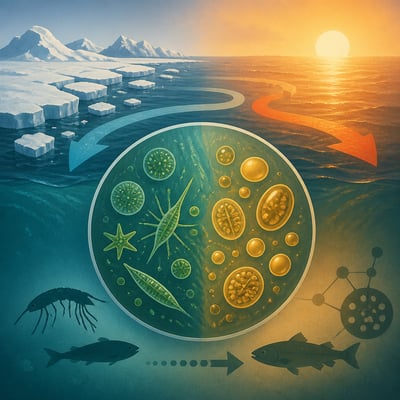
Research indicates that warming, declining sea ice, and shallower or more strongly stratified surface waters are changing polar phytoplankton physiology and distribution.
Long-term Antarctic observations show increased protective pigment production and productivity, while modeling studies project shifts toward more carbohydrate- and lipid-rich cells with lower protein content in some polar regions. These changes could alter carbon uptake and the quality of food available throughout marine ecosystems, although the wider ecological effects remain uncertain.
The story is slightly more specific about Antarctic observations and adds a new ecological linkage to southern Iceland, but the core conclusion remains the same: warming is altering polar phytoplankton and potentially reshaping marine food webs and carbon uptake.
The story has shifted from a broad description of polar phytoplankton chemistry changes to a more specific, evidence-backed picture that also includes productivity and carbon-uptake effects. New long-term observations from the West Antarctic Peninsula and a clearer emphasis on circulation-driven nutrient changes strengthen the case, while uncertainty about higher-trophic-level impacts remains.