
 AI Governance
 Data Centers
 Drones
 Climate
 Privacy
 2026 Maine Senate
 Bob Dylan
AMOC Collapse Risk Rises
Coverage from Yale E360, ScienceDaily, and others
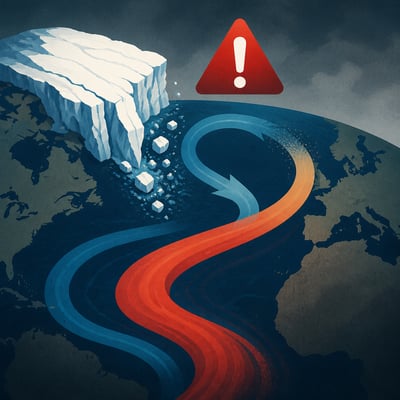
Research indicates that human-driven ocean warming, Greenland meltwater, and the pace of atmospheric warming could weaken the Atlantic Meridional Overturning Circulation and potentially push it toward a tipping point.
Modeling studies report risks ranging from substantial weakening to possible collapse, with consequences for European temperatures, rainfall, sea levels, storms, and marine ecosystems. The timing and likelihood remain contested because observations are limited, models differ, and studies use different definitions of collapse.
The story now emphasizes that AMOC stability may depend not only on cumulative warming and Greenland meltwater, but also on how rapidly atmospheric CO2 and temperatures rise. It also adds more concrete probability estimates and direct-monitoring limitations, while highlighting broader regional and ecosystem impacts.
The story has shifted from broad concern about a weakening AMOC to a more urgent framing that recent studies see collapse risk as a near-term possibility, not just a distant one. The new emphasis is on model-based probabilities, Greenland meltwater, and planning gaps rather than on general debate over whether weakening is occurring.