
 AI Governance
 Data Centers
 Drones
 Climate
 Privacy
 2026 Maine Senate
 Bob Dylan
Climate Coverage Falls as Concern Persists
Coverage from Carbon Brief, Yale Program on Climate Change Communication, and others
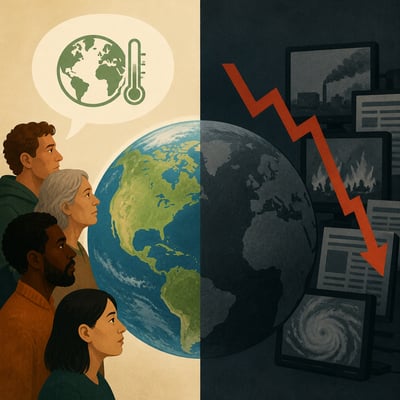
Climate-change news coverage has declined from its 2021 peak even as surveys continue to show substantial public concern and recognition of human-caused warming.
The material highlights a widening gap between public interest and media attention, alongside sharper partisan divisions over climate risks, health effects, trusted institutions, and policy responses. In the United States, these communication divides coincide with efforts by the Trump administration to weaken climate regulation, reduce scientific capacity, and limit climate-related policymaking.
The story now places greater emphasis on the Trump administration as an active policy driver, not just a source of pressure, linking weaker climate communication to concrete efforts to roll back regulation and federal science capacity. It also sharpens the framing around trust and health: concern remains high, but partisan divides and institutional distrust are now more central.
The story has shifted from a broad concern-and-media-gap narrative to a more specific picture of fragmentation: partisan divides, weakened federal science capacity, and a new emphasis on climate misperceptions and behavior effects. It also adds a sharper policy-messaging angle, with politics moving toward affordability framing rather than explicit climate language.