
 AI Governance
 Data Centers
 Drones
 Climate
 Privacy
 2026 Maine Senate
 Bob Dylan
Climate Coverage Falls as Concern Persists
Coverage from Carbon Brief, Yale Program on Climate Change Communication, and others
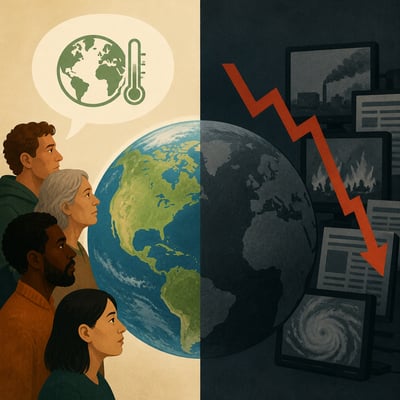
Climate-change news coverage has declined from its 2021 peak even as surveys continue to show substantial public concern and recognition of human-caused warming.
The material highlights a widening gap between public interest and media attention, alongside sharper partisan divisions over climate risks, health effects, trusted institutions, and policy responses. In the United States, these communication divides coincide with efforts by the Trump administration to weaken climate regulation, reduce scientific capacity, and limit climate-related policymaking.
The story now places greater emphasis on the Trump administration as an active policy driver, not just a source of pressure, linking weaker climate communication to concrete efforts to roll back regulation and federal science capacity. It also sharpens the framing around trust and health: concern remains high, but partisan divides and institutional distrust are now more central.
The story has shifted from a broad concern-and-media-gap narrative to a more specific picture of fragmentation: partisan divides, weakened federal science capacity, and a new emphasis on climate misperceptions and behavior effects. It also adds a sharper policy-messaging angle, with politics moving toward affordability framing rather than explicit climate language.
- Climate reporting fell 14% in 2025 and 38% from its 2021 peak.
- Federal climate-science capacity faces reported political pressure.
- Experiments show correcting misperceived public support rarely changes behavior.
- Political messaging is shifting toward affordability over explicit climate language.
- Americans increasingly recognize climate-related health risks.
The story now places more weight on a widening mismatch between sustained public concern and a sharper decline in climate visibility, while adding evidence that US climate governance and research capacity are weakening. It also shifts from a general media-politics narrative to a more specific emphasis on federal rollbacks, institutional strain, and climate-health framing.
The story has become more specific about the mechanisms behind climate attention loss: it now emphasizes fragmented political and media coverage, plus weaker attribution of extreme weather to climate change. Public belief remains strong, but the framing is less about a broad attention decline and more about how awareness is being diluted despite persistent risks.
The main shift is a stronger emphasis that the climate story is no longer just about falling attention: the new version adds clearer evidence of widening perception gaps, higher trust in scientists than in politicians or media, and more explicit pressure on federal climate science capacity. It also broadens the physical-risk picture with concrete hazards like heat, smoke, drought, and water stress.
The story is now framed less as a general decline in climate attention and more as a sharper political communication problem: concern and risk remain high, but Democrats are pulling back on climate messaging while the Trump administration is weakening climate governance. That makes the gap between public concern and institutional response feel more immediate and consequential.
The story shifts from broad evidence of declining climate attention to a more explicit framing of why: political messaging and media incentives are increasingly pulling climate out of the center of public debate. The updated version also adds clearer U.S. federal politics context, especially affordability-based messaging and climate rollback dynamics.
The story now emphasizes that climate concern is increasingly filtered through partisan polarization and pessimism about government response, not just reduced media attention. It also adds a stronger backdrop of worsening physical climate signals and weaker institutional follow-through.
Public concern about climate change remains high in the United States, but climate coverage has declined across major media outlets since 2021. Surveys show most Americans accept human-caused warming, while trust is much higher for scientists than for politicians. The main tension is between sustained concern and a weaker information environment.