
 AI Governance
 Data Centers
 Drones
 Climate
 Privacy
 2026 Maine Senate
 Bob Dylan
Climate Change Shifts Malaria Risk
Coverage from Nature, Met Office, and others
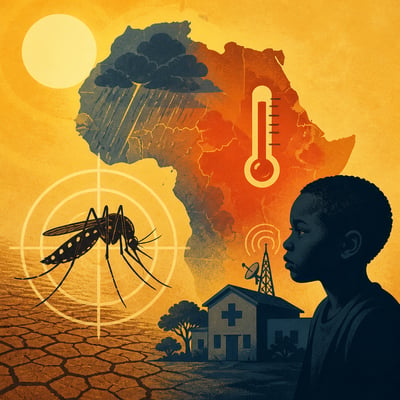
Research indicates that climate change is shifting malaria risk across sub-Saharan Africa rather than producing a uniform increase.
Warming may reduce transmission in some already-hot parts of West Africa while increasing suitability in cooler highland and southern regions, and floods and other extreme events can disrupt bed-net distribution, surveillance, diagnosis, treatment, housing, and health services. The findings highlight the importance of locally targeted malaria control, climate-resilient health infrastructure, early-warning systems, and broader emissions reductions.
The story now adds a quantified, model-dependent estimate of potentially severe malaria impacts from extreme-weather disruption and emphasizes emissions reductions alongside localized adaptation. Historical attribution evidence also sharpens the conclusion that climate change has a modest average effect but substantial regional redistribution.
The story is reframed more narrowly around malaria in sub-Saharan Africa, with stronger emphasis on localized climate effects and operational disruptions rather than broader infectious-disease impacts. It also adds new evidence that health-system capacity and nonclimate factors may shape malaria burden as much as climate change itself.
The story broadens from a set of climate-health impacts to a more explicit, evidence-backed picture of how climate variability is redistributing malaria and dengue risk while stressing adaptation systems. The new version also adds a stronger operational focus on early-warning, surveillance, and resilient health infrastructure as the main responses.
- Malaria suitability is shifting toward cooler, higher-elevation East and southern Africa.
- Extreme-weather disruption may outweigh ecological warming in malaria burden through 2050.
- Dengue transmission concerns now include urban areas in Asia and Latin America.
- Waterborne disease projections add rainfall, drought, and sanitation-driven transmission changes.
- Climate-health data integration and early-warning systems are now central responses.
The story now frames climate-health impacts more broadly as disruption to disease-control systems and livelihood security, not just shifting infection timing and flood-related distress. It also adds a sharper emphasis on uneven Cryptosporidium outcomes and on practical prevention tools like early-warning systems and dengue vaccine development.
The story now places more weight on specific, quantified projections and a broader set of climate-sensitive diseases, not just malaria and dengue. It also adds concrete evidence of psychological harm after flooding and frames adaptation as a package of health-system responses.
- 123 million additional malaria cases projected in Africa by 2050
- 532,000 additional malaria deaths projected under one scenario
- Cryptosporidium risk varies by local African temperature and water access
- Lagos flood survivors report persistent psychological distress
- Dengue transmission extends beyond India’s traditional monsoon period
The story now emphasizes a stronger operational and geographic shift: dengue is described as extending beyond its earlier pattern in India, while malaria risk is increasingly framed through concrete program disruption and uneven regional hotspots. It also adds secondary harms like flooding-related mental health and livelihood damage.
- Dengue is now appearing earlier or outside the monsoon in India.
- Los Angeles County is added as a recent dengue transmission example.
- Flooding is linked to mental health and livelihood harms.
- Nigeria and Kenya are newly named in the geographic risk picture.
- Observed outbreaks are now emphasized alongside projections.
The story broadens beyond malaria-centered climate disruption to a stronger, more explicit dengue and water-related disease framing. It now emphasizes that climate shocks are not just increasing exposure, but directly undermining surveillance, vector control, and treatment systems across multiple countries.
The story has broadened from Africa-centered malaria vulnerability to a wider climate-health framing that now explicitly includes recent dengue outbreaks in Peru and Los Angeles County. The main interpretive shift is toward implementation: how control systems fail under extreme weather, and what operational resilience is needed.
Recent coverage is dominated by climate-sensitive disease risk in Africa, especially malaria, where extreme weather and disrupted health services matter more than warming alone in near-term projections. The material also extends to climate-linked dengue outbreak risk and long-run heat stress across Africa, with repeated emphasis on adaptation capacity, surveillance, and resilient health infrastructure.