
 AI Governance
 Data Centers
 Drones
 Climate
 Privacy
 2026 Maine Senate
 Bob Dylan
China Species Face Climate-Driven Range Shifts
Coverage from PubMed, Nature, and others
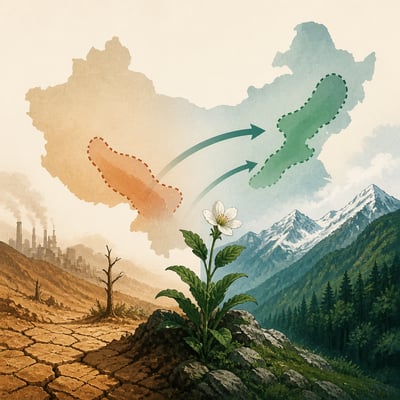
Species distribution studies project substantial changes in the areas suitable for trees, tree ferns, and other plants across China as climate conditions change.
Responses vary by species: some endangered taxa face contraction and fragmentation, while others, including several Taxus taxa, Xanthium strumarium, and many urban tree species, may gain suitable areas or shift northward. The findings support conservation prioritization, invasive-species management, and adjustments to urban tree selection, but remain dependent on climate scenarios and modeling assumptions.
The story now places much more emphasis on specific species-level outcomes and quantified projections, especially the strong contraction of Cyatheaceae and the measured expansion of Xanthium strumarium. It also adds a clearer urban-forestry update, with most Yangtze River Delta tree species projected to gain suitable climate area.
The story broadens beyond endangered Chinese plants to include urban forestry and an invasive species, while keeping the core climate-driven range-shift theme intact. The most notable new angle is that projections are now being used for practical decisions in urban tree selection, invasive-species assessment, and conservation planning.
- Urban tree species in the Yangtze River Delta show region-specific gains and losses.
- Xanthium strumarium is projected to expand across parts of China.
- Microbiome traits may aid Xanthium strumarium establishment in disturbed habitats.
- Seed banks are now part of the recommended conservation response.
- Projections are being used for urban landscape and forestry selection.
The story is now more specific about the modeled taxa and conservation implications, adding Taxus and Cyatheaceae as the main biological focus while sharpening the role of scenario severity. It also strengthens the claim that lower-emissions pathways could partially recover habitat, whereas higher-emissions pathways drive sharper fragmentation.
Recent research uses species distribution models to project how climate change will reshape the habitats of rare and endangered plant taxa in China. The strongest pattern is climate-linked range contraction or poleward shift, with temperature and human disturbance repeatedly emerging as major constraints.