
 AI Governance
 Data Centers
 Drones
 Climate
 Privacy
 2026 Maine Senate
 Bob Dylan
China Pushes New Proteins for Food Security
Coverage from Yahoo, VegOut, and others
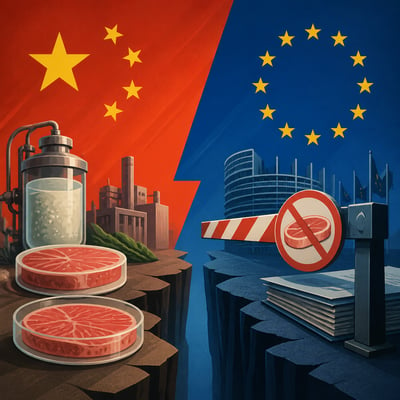
China is positioning alternative proteins, including cultivated meat, microbial proteins and fermentation-derived ingredients, as strategic components of national food security.
Its approach links state-backed research, industrial investment, regulatory support and demand creation to reduce exposure to imported feed and supply-chain disruption. The reporting contrasts this direction with the EU’s continued reliance on imported high-protein feed and its more restrictive approach to cultivated-meat labeling, while highlighting potential consequences for major soy, meat and dairy exporters.
The story is now framed less as a China-only protein strategy and more as a broader biotechnology and supply-chain resilience issue, with the EU's own biotech policy debate and food-system exposure emphasized. The current version also adds a more explicit caution that consumer adoption may not scale as quickly or uniformly as technology-led analogies suggest.
The story now frames China’s alternative-protein push as a broader industrial-policy strategy with possible global market consequences, not just a food-security response. It also adds clearer emphasis on EU meat-term restrictions and on the exporters most exposed if Chinese production scales up.
The core story is largely unchanged, but the current version adds a clearer policy-mechanism angle: China is now described as using a broader state-led toolkit, while the EU’s Biotech Act II is framed more concretely as a possible response. The current version also tightens the soy-import claim with a quantified forecast, while noting it remains only a projection.
This topic centers on a widening policy split between China and the EU over food security, new proteins, and the future of feed and meat supply chains. China is treating cultivated meat, microbial proteins, and biomanufacturing as national priorities, while the EU is still debating how to support domestic capacity and faces criticism for restrictive labeling rules on cultivated meat. The issue matters because climate shocks, war, and import dependence are exposing the vulnerability of livestock-heavy food systems and could reshape global agricultural trade.