
 AI Governance
 Data Centers
 Drones
 Climate
 Privacy
 2026 Maine Senate
 Bob Dylan
Climate-Driven Food Security Risk
Coverage from VegOut, International Institute for Environment and Development, and others
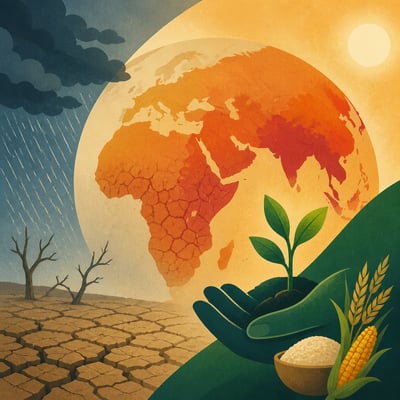
Recent coverage links climate change to worsening food security through crop losses, nutritional decline, higher food prices, and stronger pressure on vulnerable regions.
The strongest signal comes from repeated modeling and review work showing risks at 1.5C to 2C, plus longer-range projections that extend hunger risk into wealthy countries and global breadbaskets. Small islands, South Korea, Europe, and parts of Africa and Asia appear as recurring exposure points. Adaptation themes repeat across the material: early-warning social protection, resilient storage and supply chains, crop breeding, water management, and broader food-system planning. The topic is coherent and fairly dense, with a mix of near-term observed stress and structural climate-food risk that remains ongoing rather than episodic.
The story broadens from general climate-linked hunger risk to a more specific global food-system framing, adding wealthy-country exposure, breadbasket synchronization, and food-trade vulnerability. It also sharpens the adaptation picture around supply chains, storage, and policy coordination.
The story has broadened from a general climate-food insecurity risk assessment into a more specific account of how climate shocks damage nutrition, crop functioning, and even public health. The framing now puts greater emphasis on heat, diet quality, and cardiometabolic consequences while still reinforcing that deep mitigation and adaptation can reduce harm.