
 AI Governance
 Data Centers
 Drones
 Climate
 Privacy
 2026 Maine Senate
 Bob Dylan
Canada Plans Major Grid Expansion
Coverage from Global Renewable News, The Energy Mix, and others
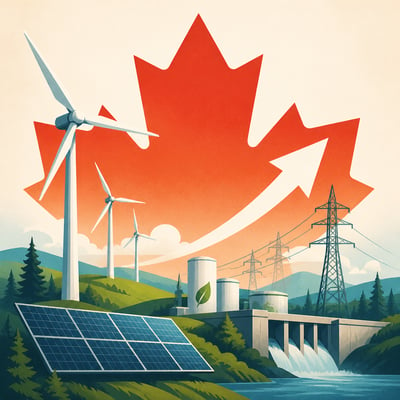
Canada is advancing a large-scale electricity expansion agenda centered on doubling the national grid by 2050, increasing renewable generation and storage, and improving transmission to serve industrial and household demand.
Federal funding, Ontario procurement, and Quebec’s planned wind additions indicate renewed momentum, but permitting delays, interconnection queues, workforce shortages, provincial policy differences, and uncertain financing could slow delivery. The strategy also leaves room for natural gas and carbon capture, making the transition broader than a purely renewable buildout.
The story is now more concrete on near-term execution and financing: Ontario and Quebec have clearer procurement and wind-buildout plans, while industry estimates suggest the expansion could unlock substantial clean-energy investment. At the same time, the implementation risks remain the same, especially permitting, transmission, workforce, and policy fragmentation.
The story now includes concrete implementation details and a clearer provincial divergence: Ontario has resumed procurement with specific project results, while Alberta’s approval restrictions are highlighted as a continuing obstacle. Federal and provincial leadership is also more explicitly named, and Indigenous participation is framed as more central.
- Ontario selected 14 renewable projects totaling 1,315 MW.
- Alberta’s approval restrictions are creating uncertainty for renewables.
- Prime Minister Mark Carney announced the grid-doubling strategy.
- Minister Tim Hodgson is overseeing federal clean-energy investments.
- Demand growth now explicitly includes data centers and manufacturing.
The story has shifted from a general clean-power delivery challenge to a more concrete national electricity expansion agenda with explicit 2050 grid-doubling targets, major funding, and named provincial implementation efforts. It now emphasizes scale, investment potential, and specific policy execution rather than only bottlenecks.
- Federal strategy targets doubling Canada’s electricity grid by 2050.
- Construction costs are expected to exceed C$1 trillion.
- Ontario has restarted major renewable procurement.
- Quebec is planning substantial wind and transmission additions.
- Federal funding supports interprovincial transmission and workforce development.
The story has shifted from a general clean-energy buildout to a sharper competitiveness and investment narrative: Canada’s clean power gap is now being described as a constraint on industrial growth and capital allocation. The current version also places more emphasis on delivery bottlenecks and operational readiness, not just long-run policy ambition.
- Clean power is being linked to industrial investment flows and competitiveness.
- Provinces are described as underbuilding generation and transmission for demand growth.
- Workforce shortages and supply chain pressure are named as bottlenecks.
- Indigenous governments are now central project partners.
- CCUS is positioned mainly as support for hard-to-decarbonize sectors.
The story has broadened from a general clean-energy investment and delivery challenge into a more explicit federal clean electricity buildout agenda led by Mark Carney, with CCUS, gas, nuclear, and efficiency now included alongside renewables. The emphasis also sharpens on uneven provincial policy conditions, especially stronger signals in Ontario and Quebec versus more uncertainty in Alberta.
- Mark Carney is now identified as driving the federal clean electricity strategy.
- The strategy explicitly includes CCUS, limited gas, nuclear, and efficiency.
- Ontario is reopening room for new renewable procurement.
- The policy environment is described as uneven across provinces, especially Alberta.
- Grid doubling and electrification are now framed as long-run priorities.
Canada’s clean energy sector is being framed around whether it can convert policy interest into operating projects on schedule. A CanREA report argues that more than $200 billion in investment could flow over the next decade if permitting, interconnection, transmission, and procurement become more predictable. Recent procurement activity in Ontario, larger wind ambitions in Quebec, and targeted federal funding for CCUS and renewables all point to continued momentum, but delivery constraints remain central.