
 AI Governance
 Data Centers
 Drones
 Climate
 Privacy
 2026 Maine Senate
 Bob Dylan
Brazil Renewables Face Grid Curtailment
Coverage from Reuters, Global Energy Alliance for People and Planet, and others
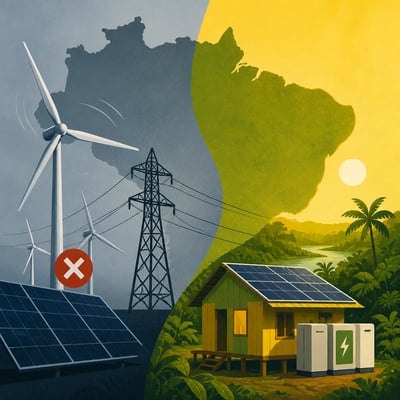
Brazil’s rapid growth in wind and solar generation is being constrained by grid limits and periods of weak demand, leading operators to cut output, reduce workforces and pause new projects.
The resulting losses have weakened project finances and increased pressure for compensation, transmission upgrades and clearer rules for storage integration. Brazil’s first grid-scale battery auction and solar-battery microgrid initiatives indicate that storage is becoming part of the response, although their effects will take time to materialize.
The main shift is that Brazil’s renewable-power constraint is now framed more explicitly as a mix of grid limits and weak demand, with storage and microgrids presented as a slower-moving response rather than a near-term fix. The story also adds clearer regulatory and implementation detail around the battery auction and compensation rules.
The biggest update is that Brazil has now moved from discussing storage rules to formally publishing the regulatory framework for its first grid-scale battery auction, signaling real implementation. At the same time, Atlas’s investment pause and reported revenue hit make the curtailment problem look more financially damaging than before.
- Atlas reported about 25% revenue losses at some facilities.
- Atlas paused about $1 billion in planned Brazilian investment.
- Brazil published rules for its first grid-scale battery auction.
- Two procurement rounds are planned for December 2026.
- Contracts are expected to begin in August 2028.
The story has shifted from a broad description of curtailment and battery-policy uncertainty to a more concrete picture of operational damage and policy response. New details show deeper cutbacks by multiple renewable companies, while Brazil has now moved from planning to approving storage rules and setting the first battery auction timetable.
- Atlas reports 15%-25% curtailment at some projects.
- Voltalia and Newave Energia are cutting operations and jobs.
- Compensation depends on regulations for a law passed by Congress.
- Aneel approved storage regulations for the battery auction.
- Hybrid microgrids are actively reducing diesel subsidies and emissions.
Brazil’s curtailment story has moved from a general grid-flexibility problem to an implemented policy response: battery storage auctions are now formally set, with an execution timeline. At the same time, the investment pullback has become more concrete, led by Atlas’s large-scale pause, while Amazon microgrids are being deployed rather than just discussed.
- Brazil published rules for its first grid-scale battery storage auction.
- Two procurement rounds are scheduled for December 2026.
- Atlas Renewable Energy paused about $1 billion in planned Brazil investment.
- Storage contracts will run 15 years for systems of at least 30 MW.
- Solar-and-battery microgrids are being deployed in remote Amazon communities.
The story has shifted from general concern about curtailment and storage policy toward a more concrete policy and market response: Congress has now passed a retroactive compensation law, while implementation rules still lag. It also adds a clearer operational dimension, with distributed rooftop solar and Amazon hybrid systems emerging as separate flexibility challenges and solutions.
- Congress passed a retroactive compensation law.
- Implementation rules for compensation are still pending.
- Rooftop solar growth is creating a separate grid-visibility challenge.
- Renewable companies have cut staffing in response to curtailment.
- Solar-and-battery hybrids are expanding in Amazon isolated systems.
The story has shifted from a general description of curtailment and weak storage rules to a more concrete policy phase, where regulators are actively building battery-storage auctions and grid-flexibility measures. It also broadens the operational picture by showing that grid stress is now affecting finances, investment, and staffing, not just output.
- Brazil is formalizing its first grid-scale battery storage auction.
- Curtailment is affecting financing, investment, and workforce decisions.
- High renewable output and weak demand can trigger emergency grid management.
- Regulators are building storage rules to support market confidence.
The story is more explicit about the regulatory and operational pressure on Brazil's main-grid renewables, while the Amazon off-grid rollout remains the parallel growth story. The biggest shift is that battery storage is now framed as more tightly constrained by underregulation, making grid flexibility a clearer bottleneck.
Brazil is seeing two linked energy transitions at once: wind and solar projects face curtailment and financial strain from grid limits, while remote Amazon communities gain solar-plus-battery systems that replace diesel generation.