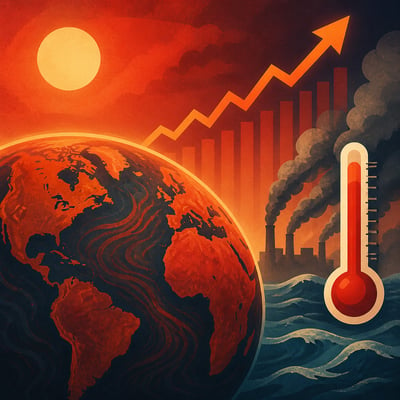
Global Warming Accelerates Toward 1.5°CCoverage from Health Policy Watch, Times of India, and others
00/00/0000
DailyWeekly
Multiple analyses indicate that global warming has proceeded faster since the mid-2010s than during the preceding decades, with human activity remaining the dominant long-term driver.
Recent studies estimate warming rates of roughly 0.27°C to 0.35°C per decade, while scientists continue to debate how much recent heat reflects declining aerosol pollution, natural variability, or possible cloud feedbacks. If the higher rates persist, long-term warming could exceed the Paris Agreement’s 1.5°C threshold before 2030, increasing pressure for rapid emissions cuts and stronger adaptation.
Looking Back
210 Day Timeline
Articles published over time. Hover any bar for the period and its article count.
Jan 7
Feb 11
Mar 18
Apr 22
May 20
Jun 24
Jul 29
History
07/22/2026
The story has sharpened from a general warning about faster warming into a more quantified and contested claim: recent studies now estimate a higher post-2015 warming rate and explicitly argue that 1.5°C could be breached before 2030 if it persists. The emphasis is also more interpretive, with fresh debate over whether aerosol cuts, natural variability, or cloud feedbacks explain the acceleration.
06/16/2026
The story shifts from broad confirmation of rising warming to a stronger emphasis on acceleration, with new attention to adaptation pressure and the fragility of the observation systems underpinning these conclusions. It also broadens the source base with additional datasets and institutions, reinforcing the warning that the 1.5°C window is closing fast.

 AI Governance
 Data Centers
 Drones
 Climate
 Privacy
 2026 Maine Senate
 Bob Dylan