
 AI Governance
 Data Centers
 Drones
 Climate
 Privacy
 2026 Maine Senate
 Bob Dylan
Clean Energy Advances Amid Federal Pushback
Coverage from Resources for the Future, Nature Index, and others
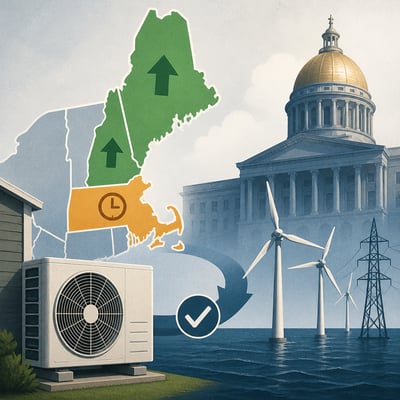
Clean-energy activity is continuing in parts of the United States despite federal efforts to reduce support for renewables, with states such as Maine, Massachusetts, Maryland, and California advancing heat pumps, solar, geothermal systems, and decarbonization policies.
Offshore wind is the clearest area of retreat: project cancellations, permitting uncertainty, and rising costs have weakened investor confidence even as the Northeast expects electrification to increase demand for new power. The broader transition is therefore advancing unevenly, shaped by state action and market conditions but limited by grid capacity, skilled labor shortages, local opposition, and unequal access to clean technologies.
The story now puts more emphasis on solar and battery storage as active substitutes for clean power growth, while offshore wind is framed as even more weakened by cancellations, costs, and investor pullback. It also broadens slightly with California’s role and adds more explicit concern about community-level distributional impacts.
The story broadens from a Northeast-focused heat pump and offshore wind policy narrative into a wider clean-energy transition story that includes rising electricity demand, geothermal workforce bottlenecks, and Asia’s policy moves. The biggest new development is that federal reversals and project cancellations are now described as directly weakening offshore wind investment confidence, while Maine’s heat pump growth is shown to be ahead of schedule.