
 AI Governance
 Data Centers
 Drones
 Climate
 Privacy
 2026 Maine Senate
 Bob Dylan

Climate: Featured Story
Coverage from Free Malaysia Today, BGNES: Breaking News, Latest News and Videos, and others
WHO Says Climate Measures Could Save 1.6 Million Lives
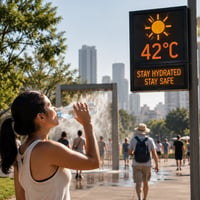
A World Health Organization report released ahead of COP31 identifies six climate and health measures, including heat warnings, resilient water and sanitation systems, cleaner household energy and improved fossil fuel pricing. The WHO estimates that implementing them could save nearly 1.6 million lives annually while reducing emissions and generating fiscal and economic benefits, but notes that the projections rely on ambitious scenarios and are subject to data gaps and uncertainty.
If you read one thing
AFP’s concise overview covers the six measures, headline projections and the WHO’s caveat about ambitious scenarios and uncertainty.
Best explainer
Explains how the proposed measures address different health risks and details the projected benefits of fossil-fuel pricing and other actions.
The evidence
Adds specific assumptions and limitations behind the projections, including unassessed reform costs and uncertainty around the fossil-fuel pricing estimates.
The coverage presents the WHO estimates as a case for putting health measures into climate policy, while emphasizing that the headline benefits depend on large-scale implementation and uncertain assumptions.
The six proposed measures combine health protections—such as heat alerts and safe water, sanitation and hygiene—with cleaner household energy and more effective fossil-fuel pricing.
Fossil-fuel pricing accounts for the largest projected contribution: WHO attributes about 1.2 million prevented deaths and $5.4 trillion in annual fiscal gains to the policy, under its modelled scenario.
The report also projects roughly $3.9 trillion in annual economic welfare benefits; for five measures, coverage reports an estimated average return of about $24 per dollar invested, with heat-warning systems singled out for especially high returns.
The estimates are conditional rather than guaranteed: coverage notes ambitious implementation assumptions, data gaps and uncertainty. One account says the $3.9 trillion is a gross benefits figure and that costs of fossil-fuel price reform, including possible support for affected households and transport operators, were not assessed.
1.6 million deaths annually
The WHO estimates that scaling up the six climate and health measures globally could prevent about 1.6 million deaths each year; the figure is a projection.
16.7 billion tonnes of carbon dioxide emissions annually
Estimated emissions avoided by implementing the six measures; some coverage rounds this to 17 billion tonnes.
US$3.9 trillion per year
Estimated economic welfare benefits from scaling up the six measures globally, as reported from the WHO assessment.
US$5.4 trillion per year
Estimated fiscal benefits or government revenue gains from the six measures, as reported from the WHO assessment.
US$24.80 in benefits per US$1 invested
Euronews reports this as the WHO’s estimated average return across the five measures other than fossil fuel pricing; other coverage rounds the return to US$24.
US$835 in benefits per US$1 invested
Estimated return for heat-health warning systems, described as a particularly high return among the interventions.
1.2 million deaths annually
Estimated deaths prevented by efficient fossil-fuel pricing policies, including removing inefficient subsidies and appropriately taxing fossil fuels.
US$3 trillion per year
Estimated economic welfare benefits from efficient fossil-fuel pricing policies.
Around 1 in 40 deaths
The projected 1.6 million lives saved is described as approximately one in every 40 deaths globally.
Approximately 250,000 premature deaths per year from 2030 to 2050
Euronews reports this estimate for selected climate-related health risks—including undernutrition, malaria, diarrhoea and heat stress—without additional intervention.
3.6 billion people
Estimated number of people living in areas particularly vulnerable to climate change and its health risks.
Coverage published on November 4 introduced the WHO report’s central projection: scaling six climate-and-health measures—from heat warnings and resilient water and sanitation to cleaner household energy and fossil-fuel pricing—could prevent about 1.6 million deaths annually while reducing emissions and bringing large economic and fiscal benefits. Reports also highlighted the especially large projected contribution of fossil-fuel pricing and the high estimated return from heat warnings. Coverage published November 5 continued to explain the proposals and their expected gains, while also making the limits of the projections more explicit: they depend on ambitious implementation scenarios, and one account noted that the aggregate benefit figure does not deduct all costs and that key assumptions and estimates remain uncertain. These are modelled projections, not reported outcomes.