AI Governance
 Data Centers
 Drones
 Climate
 Privacy
 Bob Dylan

Climate Quick Briefing
2026-11-19
Clean-Power Progress Outpaces Evidence of Climate-Risk Protection
of Play
Australia’s record renewable construction commitments add momentum to the clean-power pipeline, but operating capacity, storage and fossil-fuel displacement remain the decisive tests. New Pacific health evidence makes the adaptation-finance gap more tangible without showing that it has been closed. Polar researchers’ warning reinforces the importance of long-term risk planning, but does not establish that tipping points have been crossed.
What's New?
Clean-power expansion still depends on delivery
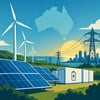
Renewable projects are advancing, but their emissions benefit depends on construction, grid and storage delivery, and displacement of fossil generation. India’s infrastructure needs and Australia’s construction pipeline illustrate this continuing distinction between commitments and operating power.


Physical risks and adaptation costs remain unevenly managed
Researchers warn that polar tipping processes may already be underway, although the report does not establish that a tipping threshold has been crossed. Meanwhile, Pacific health facilities face unfunded upgrades, and California’s wildfire mitigation costs fall substantially on ratepayers.

What's Changed?
Australia’s renewable construction commitments reached a quarterly record
The Australian Renewable Energy Scorecard reports 2.4 GW committed to construction in the third quarter of 2026, including 1.5 GW of wind. Utility-scale batteries also advanced, while household battery installations fell 44% after federal rebate cuts. These are construction and installation indicators, not proof of a sustained emissions decline.
Pacific health evidence sharpens the adaptation-finance gap
New reporting specifies upgrade costs of $150,000–$250,000 each for two Fiji health centres and describes a Fiji–Solomon Islands fellowship linking facility assessments to government planning. This adds practical detail to the previously identified finance-access problem, but does not demonstrate that the upgrades are funded or completed.
What Matters?
Construction momentum does not settle the infrastructure question
Australia’s record quarter strengthens the case that clean-power investment is advancing, but it does not resolve the earlier concern that storage and grid delivery determine usable generation and fossil-fuel displacement. The reported fall in household battery installations after rebate cuts also illustrates the sensitivity of deployment to incentives.
Adaptation planning is not equivalent to protection
The Pacific cases narrow the prior finance concern to a concrete delivery problem: facilities can have assessed needs and costed upgrades without evidence of funding or completion. Separately, California’s ratepayer-funded mitigation shows that spending alone does not establish affordable protection.
What's Next?
Track projects through to reliable generation
Watch whether Australian construction commitments and India’s clean-power pipeline translate into operating generation, sufficient storage and measurable fossil-power displacement. Delivery would strengthen the transition assessment; persistent bottlenecks would weaken it.
Test whether adaptation finance reaches facilities
Watch whether the costed Fiji health-centre upgrades obtain funding, are completed and improve resilience. The existing adaptation-finance watchpoint remains unresolved; planning and peer learning alone do not establish delivery.
Clarify the climate-liability litigation pathway
Whether state climate-damages claims can proceed, and how broadly federal preemption applies, remains an important unresolved question. The supplied current evidence does not verify the relevant case’s procedural status.