
 AI Governance
 Data Centers
 Drones
 Climate
 Privacy
 Bob Dylan

Climate Quick Briefing
2026-10-28
Climate Risks Mount as Infrastructure and Adaptation Delivery Lag
of Play
Grid integration remains a constraint on turning renewable capacity into usable clean power, while physical risks and the costs of managing them remain substantial. New reporting strengthens the evidence of growing exposure to water extremes and identifies a possible agricultural vulnerability, but does not establish a change in the global emissions trajectory or prove that adaptation responses are effective.
What's New?
Grid integration remains a clean-power constraint
The previously identified integration gaps in India and Southeast Asia remain relevant. Renewable capacity, usable generation and fossil-fuel displacement are distinct tests; the available evidence does not show that grid constraints have been resolved.


Adaptation must address both exposure and affordability
Water extremes are increasing, while existing adaptation costs can fall heavily on households. California’s wildfire mitigation costs, for example, are largely recovered from ratepayers; protection alone is therefore not a sufficient measure of resilience.
What's Changed?
New assessment strengthens evidence of growing water extremes
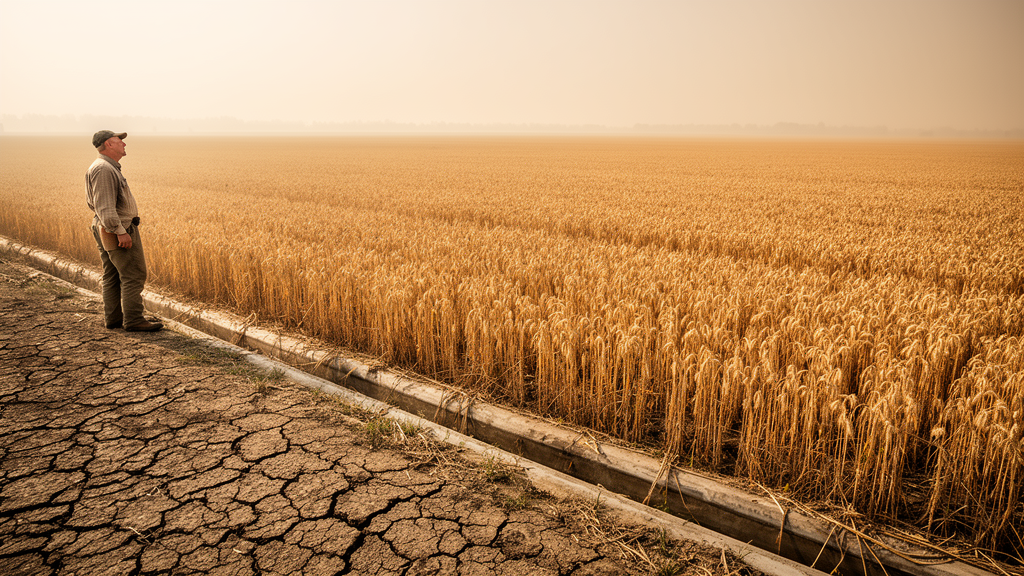
The Lancet Countdown reports that the pace of land exposure to extreme drought accelerated by about 700% relative to the decade before the Paris Agreement, while the share hit by very extreme rainfall rose from 14.8% to 17.2% across the compared periods. This broadens the prior assessment of water-related risk beyond its regional examples; it is not evidence of a new event today.
Study identifies a possible nonlinear crop-water vulnerability
Research across China’s Songhua River Basin found that cropland water-use efficiency declined more steeply above an estimated atmospheric dryness breakpoint. The finding adds a potential mechanism to the prior water-risk assessment, but local thresholds varied and the associations do not establish a universal threshold or isolated causal effect.
What Matters?
Capacity additions do not establish emissions reductions
Persistent grid bottlenecks reinforce the prior distinction between building renewables and delivering clean electricity that displaces fossil generation. Without evidence on connections, utilization and displacement, the supplied record cannot establish a changed global emissions pathway.
Rising exposure increases the importance of practical adaptation
Broader exposure to both drought and extreme rainfall strengthens the case for testing whether adaptation protects services and livelihoods without shifting unaffordable costs to households. The Songhua study suggests that drying air may also make agricultural water management harder, though its wider applicability remains uncertain.
What's Next?
Test whether grid investment delivers displacement
Watch for commissioned connections and flexibility, reduced curtailment, and measurable fossil-generation displacement in India and Southeast Asia. Progress on these outcomes would strengthen the case that integration bottlenecks are easing; capacity announcements alone would not.
Look for adaptation outcomes, not just expenditure
Watch whether measures reduce disruption and losses without imposing unaffordable costs on households. Further validation of crop-water thresholds and evidence that they improve water-management decisions would also clarify the practical value of the new research.