
 AI Governance
 Data Centers
 Drones
 Climate
 Privacy
 2026 Maine Senate
 Bob Dylan
School Districts Pull Back Student AI
Coverage from K-12 Dive, New York Post, and others
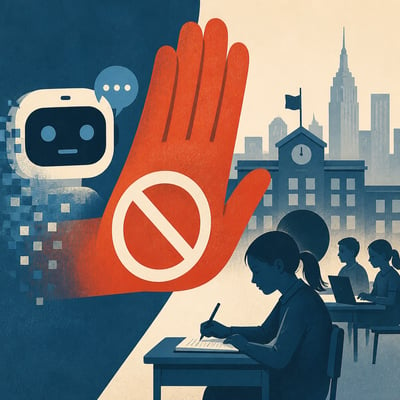
New York City and Los Angeles Unified are limiting student access to generative AI during the 2026-27 school year.
New York City is imposing a one-year moratorium through eighth grade, banning companion chatbots across all grades, and allowing supervised high-school pilots, while Los Angeles Unified has blocked student access to generative AI on district devices. The policies pair restrictions with AI literacy and review processes, but enforcement, acceptable classroom uses, and longer-term standards remain unsettled.
If you read one thing
It provides the clearest overview of New York City's age-tiered restrictions, supervised high-school pilots, and AI literacy approach.
The local angle
It shows how Los Angeles Unified is applying a comparable precautionary policy while developing safeguards for future classroom use.
The evidence
It adds the important governance and enforcement context, including the limits of district restrictions when students can access AI at home.
Age-tiered student restrictions
New York City is maintaining a broad one-year moratorium on most student-facing generative AI through eighth grade and banning companion chatbots across all grades. Los Angeles Unified has adopted a comparable precautionary posture by blocking student access to generative AI on district devices.
Controlled high-school experimentation
Student access is being limited rather than eliminated entirely: New York City permits selected, teacher-supervised high-school pilots and specified educational uses, alongside recurring AI literacy instruction. The approach remains structured around safeguards instead of unrestricted classroom adoption.
Unresolved enforcement and governance
District restrictions are being paired with policy reviews, safeguards, and contested questions about authority and transparency, but their practical reach is constrained when students access AI outside district networks. Durable classroom standards and enforcement mechanisms therefore remain unsettled.
The new articles repeat the existing findings that New York City and Los Angeles Unified are restricting student access to generative AI; they add no material change to the Topic.
Previously
New York City is imposing a one-year moratorium on most student-facing generative AI tools for public-school students through eighth grade and banning companion chatbots across all grades. The policy limits high-school use to specified educational purposes, adds recurring AI literacy instruction, and permits teacher-supervised pilots involving selected students. It also sets boundaries on teacher use, but enforcement remains uncertain because students may access AI outside school networks and a previous ChatGPT block was withdrawn.
The story expands from a New York City policy to a broader district-level response, with Los Angeles Unified blocking student access to generative AI on district devices for 2026-27. This adds a concrete implementation example and strengthens the significance of district restrictions as an emerging education-policy pattern.