
 AI Governance
 Data Centers
 Drones
 Climate
 Privacy
 2026 Maine Senate
 Bob Dylan
U.S. States Advance Frontier AI Oversight
Coverage from Ars Technica, Foreign Policy, and others
U.
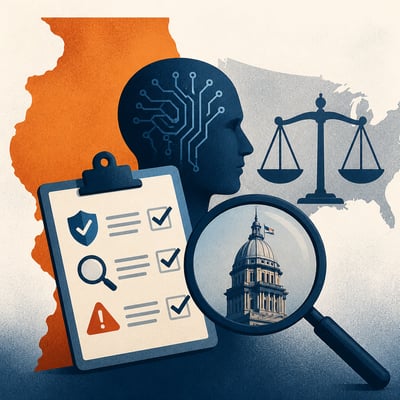
S. states are turning frontier-AI safety expectations into enforceable requirements for risk disclosures, incident reporting, independent audits, and internal accountability. Illinois has enacted the most operationally detailed regime in this set, while California is accelerating oversight infrastructure and considering stronger emergency controls amid unresolved federal policy.
The story has broadened from Illinois and California frontier-model rules to a more fragmented, multi-state oversight system. California is moving from legislation toward implementation and possible emergency controls, while state requirements increasingly cover broader AI risks amid unresolved federal preemption.
The story is now more concrete and compliance-focused: Illinois has defined who is covered, imposed specific reporting deadlines and penalties, and scheduled implementation, while California's auditor-oversight requirements are more clearly specified.
The story has broadened from Illinois’s standalone frontier-AI law into a developing multi-state oversight system, with California adding auditor and verification infrastructure and New York pursuing parallel rules. This shifts the central issue toward fragmented implementation, voluntary versus mandatory audits, and unresolved national standards.
- California enacted AB 1405 establishing an AI auditor registry and related integrity requirements.
- California enacted SB 813 creating an independent AI compliance verification framework.
- Most California independent audits remain voluntary despite new auditor infrastructure.
- New York is developing parallel frontier-AI transparency and incident-reporting requirements.
- Implementation is expected to extend through 2027-2029, leaving audit standards unsettled.
The current version adds a newly identified industry critic and specifies incident-response disclosures, but otherwise mainly confirms the prior account of Illinois’s law.
The law’s timeline is clearer: it was signed July 6, 2026, with most requirements beginning January 1, 2028, resolving earlier uncertainty. The story is also framed more explicitly as part of expanding state-level regulation while federal legislation remains stalled.
The update mainly clarifies the law’s enforcement and compliance mechanics, especially by adding that the Illinois attorney general will enforce civil penalties and that the audit regime hinges on independent third-party auditors with no financial conflicts. It also broadens the state-policy context by explicitly bringing New York into the comparison with California.
Illinois SB 315 has moved from a pending proposal to enacted law, making frontier AI safety obligations immediately more concrete and enforceable. The updated framing adds specific compliance mechanics, penalties, and support or pushback from industry, while also sharpening the comparison with other state rules.
- Illinois SB 315 has been enacted into law.
- Civil penalties can reach $1 million initially and $3 million for later violations.
- OpenAI and Anthropic publicly supported the Illinois measure.
- California is enforcing generative AI provenance, detection, and labeling requirements.
- Reported effective dates conflict between January 1, 2027 and January 1, 2028.
Illinois has moved from proposed frontier-AI oversight to enacted law, making safety audits, disclosures, incident reporting, and whistleblower protections enforceable for qualifying developers. The broader story also now includes a more concrete federal preemption fight and a sharper split among states, with Colorado narrowing and California remaining more executive-driven.
- Illinois SB 315 has been enacted.
- Illinois now includes civil penalties and attorney general enforcement.
- The FRONTIER Act would temporarily preempt covered state rules.
- Colorado narrowed its AI framework to consequential-decision notice.
- California’s framework is mainly executive-order based.
The story now more explicitly identifies additional implementation actors, including Connecticut state agencies, hosting services, and device manufacturers. Federal incident reporting is also framed more specifically around the Department of Commerce, but the underlying policy debate remains largely unchanged.
The story broadened from Illinois-only frontier AI oversight to a wider U.S. regulatory push that now includes federal incident-reporting proposals plus enacted or phased-in rules in Connecticut and California. The main new development is that implementation questions and federal preemption have become more central as states move from proposals to concrete compliance obligations.
- Proposed federal AI Incident Reporting Act would mandate seven-day Commerce notifications.
- Connecticut enacted AI disclosure and safety requirements.
- California phased in provenance and labeling rules for AI content.
- Federal preemption is now a central dispute.
- Auditor licensing and certification standards remain unresolved.
The story is now more specifically about an enforceable state AI regime: Illinois’ bill has been refined into a clearer set of disclosure, incident-reporting, and annual audit obligations, while also gaining explicit industry backing and a sharper preemption fight with Congress. The current version also broadens the context by tying Illinois to a wider state-level regulatory pattern.
Illinois has moved toward becoming the first state to require major AI developers to publish safety frameworks, undergo independent third-party audits, and report serious incidents to state authorities. The legislation reflects a broader state-level push to fill gaps left by limited federal AI regulation. It has also become part of a larger debate over whether AI oversight should be set by states or through a uniform national framework.