U.S. AI Preemption Versus State…U.S. AI Preemption Versus State RulemakingCoverage from AP News, ABC News, and others
00/00/0000
DailyWeekly
U.
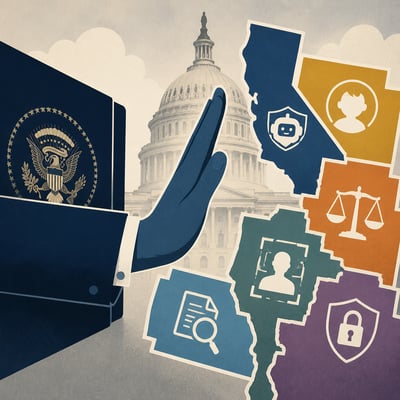
S. states continue expanding targeted AI rules while the White House and congressional allies pursue federal preemption and a more uniform national framework. State measures increasingly address child-facing chatbots, consequential automated decisions, frontier-model safety, synthetic-media provenance, healthcare, employment, and data-center impacts. Congress has not produced a comprehensive federal statute, leaving executive actions, voluntary standards, procurement rules, agency proposals, and state attorneys general enforcement to shape near-term obligations.
Looking Back
95 Day Timeline
Articles published over time. Hover any bar for the period and its article count.
May 20
Jun 5
Jun 23
Jul 9
Jul 25
Aug 12
Aug 28
History
08/31/2026
The story has broadened from a state-versus-federal preemption dispute into a wider governance landscape, with state enforcement and data-center regulation emerging alongside federal executive and administrative tools. The scale of state activity is now quantified, while comprehensive federal legislation remains absent.
08/04/2026
The story is now framed less as a broad state-versus-federal AI governance clash and more as a concrete push toward targeted rules on chatbots, consequential decisions, and content provenance. It also adds a more specific federal compromise pathway: temporary override of some state rules in exchange for child-protection and anti-deepfake measures, though that deal is not law.
U.S. states advanced chatbot, employment, and transparency AI laws as federal AI regulation remained stalled after a Trump executive order signaled limits on state measures.
6/14/2026 • Legislation & Regulatory Policy • General
State legislatures expand AI disclosure and child-safety laws while a Trump executive order targets state rules considered more than minimally burdensome.
6/14/2026 • Legislation & Regulatory Policy • General
J. D. Vance advances a federal preemption plan for AI governance, emphasizing one national standard, worker protection, and human accountability for security decisions.
6/21/2026 • Legislation & Regulatory Policy • General
The White House released the National AI Policy Framework in Washington on March 20, 2026, recommending federal AI standards, regulatory sandboxes, and preemption of conflicting state laws.
8/29/2026 • Legislation & Regulatory Policy • General
The White House released the National AI Policy Framework on March 20, 2026, and negotiated federal AI preemption with Congress in Washington alongside child-safety legislation.
8/22/2026 • Legislation & Regulatory Policy • General
US states expanded AI privacy governance through comprehensive privacy laws and targeted requirements during 2026, addressing automated decisions, biometric data, health information, and consumer disclosures.
8/1/2026 • Legislation & Regulatory Policy • General
Epstein Becker Green / Eleanor Chung, Jean-Claude Velasquez, and Julia Thayer72
Epstein Becker Green reports expanded enacted state AI laws in 2026, increasing multistate compliance duties for healthcare and workplace AI deployments.
7/22/2026 • Legislation & Regulatory Policy • General
The FTC proposed an AI policy statement for public comment through July 31, addressing consumer deception risks from undisclosed ideological distortion of AI outputs amid state law challenges.
7/16/2026 • Legislation & Regulatory Policy • General
After a December 11, 2025 executive order launched an AI Litigation Task Force, U.S. states continued passing frontier-safety, high-risk discrimination, and chatbot laws through 2026.
7/7/2026 • Legislation & Regulatory Policy • General
By July 1, 2026, more than half of US states passed 100-plus AI laws as a Trump executive order targeted state AI policymaking through litigation and potential BEAD funding pressure.
7/6/2026 • Legislation & Regulatory Policy • General
US states in 2026 introduced and passed AI bills shifting from broad risk frameworks toward use-specific requirements for startups, including chatbot and frontier model rules.
6/25/2026 • Legislation & Regulatory Policy • General
The White House seeks federal AI preemption by chaining it to the Kids Online Safety Act ahead of a congressional recess, amid House-Senate version conflicts and Senate vote uncertainty.
6/15/2026 • Legislation & Regulatory Policy • General
Harrisburg, Pennsylvania: Multiple US states enacted new AI laws on chatbot interactions, employment AI disclosure, and advanced model safeguards after a Trump executive order urged restraint on state regulation.
6/14/2026 • Legislation & Regulatory Policy • General
The White House is negotiating a youth online safety legislative package in Congress to address state AI rule preemption, involving KOSA and age-verification terms.
6/12/2026 • Legislation & Regulatory Policy • General
Regulators and legislators at US privacy and security events emphasize sensitive data and children's AI risks while coordinated state enforcement expands and federal preemption remains unlikely.
5/20/2026 • Legislation & Regulatory Policy • General
In 2024-2026, state attorneys general coordinated AI investigations using existing consumer, civil rights, and privacy statutes to expand immediate compliance risk for companies.
Reps. Jay Obernolte and Lori Trahan introduced the Great American AI Act of 2026 as US states expand AI disclosure, safety, and automated decision-making rules.
6/22/2026 • Legislation & Regulatory Policy • General
203 state lawmakers asked Congress on Tuesday to reject a three-year AI regulatory preemption proposal, warning that broad federal override could constrain state protections.
6/16/2026 • Legislation & Regulatory Policy • General
The Trump administration uses executive actions, voluntary advanced-model review, export control discussions, and federal procurement rules to shape AI governance amid stalled Congressional lawmaking.
6/18/2026 • Legislation & Regulatory Policy • General
The Federal Trade Commission is considering federal regulation of ideological bias in artificial intelligence under Section 5, potentially overriding state rules such as Colorado's AI Act in the United States.
8/10/2026 • Legislation & Regulatory Policy • General
Epstein Becker Green / Eleanor T. Chung, Julia Rioux Thayer, and Jean-Claude Velasquez66
State legislatures enacted 2026 AI laws across the United States requiring employers to address transparency, health care oversight, hiring, audits, and discrimination risks.
7/31/2026 • Legislation & Regulatory Policy • General
US CIOs face a growing state-by-state AI compliance patchwork as more than 30 states regulate, with disparate impact risk concentrated in deployed hiring and marketing decisions.
7/27/2026 • Legislation & Regulatory Policy • General
Florida, led by DeSantis and Attorney General Uthmeier, saw its Senate-passed AI bill of rights blocked in the House while litigation and data-center governance measures targeting AI deployment continued.
6/11/2026 • Legislation & Regulatory Policy • General
US state legislatures expanded AI compliance requirements during 2026 sessions, with California, Colorado, Utah, Illinois, Connecticut, and New York imposing new health care and employment obligations.
7/31/2026 • Legislation & Regulatory Policy • General
The White House, before the midterms, met with advocates and industry to advance an AI preemption bill package tied to the Kids Online Safety Act across US House and Senate committees.
6/12/2026 • Legislation & Regulatory Policy • General
Multiple U.S. states and Congress introduced 21 new AI bills in late May 2026, alongside newly signed laws on automated decision-making, education, healthcare, and government AI use.
5/28/2026 • Legislation & Regulatory Policy • General
White House support for a combined KOSA and AI preemption package has reportedly created uncertainty about which Kids Online Safety Act version will advance in Congress.
6/15/2026 • Legislation & Regulatory Policy • General
The White House National Policy Framework for Artificial Intelligence, released in March, proposes federal preemption while US apparel and textile suppliers expand AI adoption.
7/4/2026 • Sector-Specific AI Regulation • General
U.S. states advanced AI laws in 2024-2025 on child chatbots and employment use as federal AI regulation stalled and White House preemption threats surfaced.
6/14/2026 • Legislation & Regulatory Policy • General
In Washington, Congress debate on federal AI preemption centers on frontier model oversight and state transparency conflicts, with litigation likely after passage.
6/13/2026 • Legislation & Regulatory Policy • General
White House officials met with kids safety groups and major AI companies in Washington, D.C., to negotiate a kids safety package that could drive AI state-law preemption, potentially including KOSA and age verification.
6/11/2026 • Legislation & Regulatory Policy • General
Ron DeSantis contests a Trump administration AI executive order that could preempt Florida state AI laws, after Florida proposed an Artificial Intelligence Bill of Rights in 2025.
6/11/2026 • Legislation & Regulatory Policy • General
President Donald Trump and members of Congress advance federal AI oversight through model review and mandatory audits, with preemption of state AI development rules creating policy conflict.
6/10/2026 • Legislation & Regulatory Policy • General
Senate removed a 10-year AI rule preemption proposal in 99-1 vote as Stanford tracked rapid state AI legislation and defense directives targeted Anthropic.
6/6/2026 • Legislation & Regulatory Policy • General
Across the United States, state AI and privacy laws through June 2026 expand transparency and opt-out duties for AI training, automated decision-making, and AI-enabled liability.
6/26/2026 • Legislation & Regulatory Policy • General
OpenAI CEO Sam Altman met US lawmakers on Capitol Hill after President Trump signed an advanced AI executive order that proposes a 30-day federal model review.
6/3/2026 • Legislation & Regulatory Policy • General
Hawaii Governor Josh Green signed AI deepfake and AI companion bills as Congress and the Senate consider catastrophic-risk measures including an AI kill switch proposal.
7/24/2026 • Legislation & Regulatory Policy • General
On June 10, 2026 in Washington, D.C., Future of Privacy Forum convened officials and industry to discuss AI governance and the SECURE Data Act with centralized enforcement goals.
6/24/2026 • Legislation & Regulatory Policy • General
Alabama lawmakers and AI experts discussed state regulation of chatbot and conversational AI for minors in Montgomery, emphasizing age verification and company accountability.
6/24/2026 • Sector-Specific AI Regulation • General
Michael Kratsios told National Association of Realtors stakeholders in Washington, D.C. to adopt AI now and previewed federal beyond-visual-line-of-sight drone rules.
6/16/2026 • Legislation & Regulatory Policy • General
White House and US political leaders debate a uniform national AI governance framework as state officials oppose preemption and model vetting proposals.
5/26/2026 • Legislation & Regulatory Policy • General
A column links a Trump administration executive order and a March legislative plan to a national AI framework meant to curb state regulatory fragmentation and support U.S. competitiveness.
6/17/2026 • Legislation & Regulatory Policy • General

 AI Governance
 Data Centers
 Drones
 Climate
 Privacy
 2026 Maine Senate
 Bob Dylan