G20 AI Rules and Regulatory DivergenceG20 AI Rules and Regulatory DivergenceCoverage from Cyber News Centre, Inside Telecom, and others
00/00/0000
DailyWeekly
G20 members endorsed a nonbinding U.
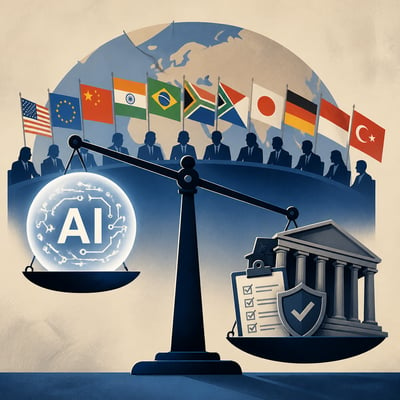
S.-backed framework favoring sectoral rules and limited new regulators, while EU enforcement, safety-testing disputes, and competition with China keep governance fragmented.
It adds the distinct safety and oversight perspective, showing why frontier-model risks challenge a purely light-touch framework.
France24
Key Issues
01
U.S.-led light-touch governance framework
The G20 has reportedly endorsed the nonbinding Carolina Principles, reinforcing a U.S.-backed model that relies on existing sectoral regulators, reserves new rules for novel risks, and rejects dedicated international AI-governance institutions. The framework can influence national policy but creates no enforceable obligations or compliance safe harbor.
Strengthening
Drawn from 5 articles
02
Widening U.S.-EU governance divergence
The U.S. sectoral, technology-neutral approach is increasingly juxtaposed with the EU’s enforceable, risk-based regime for general-purpose AI. EU information requests and duties covering documentation, copyright, evaluations, incident reporting, and cybersecurity are creating distinct compliance expectations for cross-border developers and deployers.
Frontier models’ potential to accelerate cyber threats and affect financial stability continues to support stronger testing, safer deployment, monitoring, and institutional resilience. These pressures remain a counterweight to the Carolina Principles’ preference for limited new oversight.
Stable
Drawn from 5 articles
Key Numbers
more than 30 AI companies
companies receiving information requests from the European Commission
“The European Commission confirmed that it had sent information requests to more than 30 AI companies, moving the EU AI Act into an active enforcement phase.”
Inside Telecom
20 G20 members
endorsing members
September 1–2
“All 20 G20 members endorsed the Carolina Principles for Emerging Technologies at the September 1–2 Chapel Hill Innovation Ministerial. Commerce Secretary Howard Lutnick announced the consensus and confirmed that China signed; Bloomberg reported that Russia did as well. The framework favors existing sector regulators and reserves new rules for genuinely novel considerations, discouraging dedicated AI oversight bodies.”
AI2Work
more than 30 AI providers
providers receiving formal information requests
under the EU AI Act
“As the ministerial opened, the European Commission confirmed that it had sent formal information requests to more than 30 AI providers under the EU AI Act.”
AI2Work
Looking Back
10 Day Timeline
Articles published over time. Hover any bar for the period and its article count.
Aug 27
Aug 29
Aug 30
Sep 1
Sep 2
Sep 4
Sep 5
The Story So Far
No material change
The new-member articles repeat the already established G20 endorsement of the nonbinding Carolina Principles and the resulting fragmentation among U.S., EU, and Chinese AI governance models, without establishing a further material change.
Previously
The United States is using its G20 presidency to advance the Carolina Principles, a nonbinding framework that favors existing sectoral rules and limits new AI-specific regulation to novel risks. The approach contrasts with the European Union’s enforcement of risk-based duties for general-purpose AI and has drawn participation from major technology executives. The central question is whether major economies can coordinate around lighter-touch rules while addressing safety, transparency, cyber, and public-trust concerns.
History
09/11/2026
The Carolina Principles moved from a U.S.-promoted proposal toward a framework endorsed by G20 members, strengthening its status as an international reference point despite remaining nonbinding. The story also places the framework more explicitly within U.S. commercialization, infrastructure-export, and open-weight competition with China.
09/06/2026
The story now includes concrete EU AI Act enforcement, with the EU AI Office seeking information from more than 30 general-purpose AI providers. G20 discussions have also broadened to include African Union participation and the practical infrastructure burdens of data-center expansion.
At the G20 Innovation Ministerial, Michael Kratsios promoted the Carolina Principles as a US strategy for shaping allied AI deployment and competing with China.
9/4/2026 • International Governance & Institutions • General
US officials and technology leaders promoted AI deregulation in Chapel Hill on September 1, 2026, while the European Commission began EU AI Act enforcement in Brussels.
9/3/2026 • Legislation & Regulatory Policy • General
At a US-hosted G20 innovation ministerial, governments endorsed nonbinding Carolina Principles while US officials and AI executives disputed pre-release testing and regulatory oversight.
9/2/2026 • International Governance & Institutions • General
G20 members endorsed the non-binding Carolina Principles in Chapel Hill on September 1-2, while the European Commission pursued EU AI Act information requests against more than 30 providers.
9/4/2026 • International Governance & Institutions • General
The United States will oppose new international AI governance institutions during G20 preparations in North Carolina before the leaders’ summit in Miami in December.
9/1/2026 • International Governance & Institutions • General
At the September 1-2, 2026, G20 Innovation Ministerial in Chapel Hill, U.S. officials, European regulators and financial authorities will debate divergent AI rules and frontier-model cyber risks.
9/1/2026 • International Governance & Institutions • General
US administration officials presented the Carolina Principles at the G20 Innovation Ministerial in Chapel Hill while Congress advanced open-weight AI legislation targeting competition with China.
9/4/2026 • Legislation & Regulatory Policy • General
G20 innovation ministers reportedly endorsed the US-backed Carolina Principles for Emerging Technologies, promoting sectoral AI oversight rather than new AI regulators in member countries.
9/4/2026 • International Governance & Institutions • General
G20 innovation ministers endorsed the Carolina Principles in Chapel Hill, strengthening a US-led AI governance approach amid competing EU and Chinese rules for autonomous agents.
9/4/2026 • International Governance & Institutions • General
The United States urged G20 governments at a North Carolina technology meeting to limit new AI regulation and preserve American influence before the December Miami summit.
9/1/2026 • International Governance & Institutions • General
The United States urged G20 officials meeting in Chapel Hill, North Carolina, on September 1 to avoid new AI regulations as Chinese competition and security concerns grew.
9/1/2026 • International Governance & Institutions • General
At Wednesday's G20 Innovation Ministerial in North Carolina, US officials and AI executives promoted the Carolina Principles and limited regulation for international AI development.
9/2/2026 • International Governance & Institutions • General
At a G20 meeting in North Carolina on Tuesday, U.S. adviser Michael Kratsios urged member governments, including China, to adopt the Carolina Principles and limit new AI regulation.
9/2/2026 • Legislation & Regulatory Policy • General
G20 representatives endorsed the US-proposed Carolina Principles on September 2 in North Carolina, supporting sector-specific AI rules and closer government-industry cooperation ahead of a December leaders summit.
9/3/2026 • International Governance & Institutions • General
G-20 innovation ministers adopted the Carolina Principles on September 2, 2026, in Chapel Hill, while European regulators pursued preliminary AI safety and copyright inquiries.
9/3/2026 • International Governance & Institutions • General
At the G20 Innovation Ministerial in Chapel Hill, North Carolina, U.S. officials, AI executives, and G20 representatives debated model oversight, semiconductor policy, data centers, cybersecurity, and national AI strategies.
9/2/2026 • Export Controls, Chips & Compute Governance • General
The United States urged G20 governments to limit AI-specific regulation in Chapel Hill while the European Commission sought compliance information from more than 30 companies under the EU AI Act.
9/2/2026 • International Governance & Institutions • General
At a September G20 meeting in Chapel Hill, North Carolina, United States officials urged member governments to avoid new AI rules and oversight organizations while promoting the Carolina Principles.
9/1/2026 • International Governance & Institutions • General
The United States will promote light-touch Carolina Principles at a September 1-2 G20 AI meeting in Chapel Hill as agent incidents drive calls for stronger oversight.
9/1/2026 • International Governance & Institutions • General
Michael Kratsios will urge G20 members to support limited new AI regulation and increased research at a two-day meeting beginning Tuesday in North Carolina.
9/1/2026 • International Governance & Institutions • General
Euronext Markets / Courtney Rozen and JC Whittington52
The United States urged G20 commerce ministers in Chapel Hill, North Carolina, on September 1 to limit new AI rules and consider the Carolina Principles.
9/1/2026 • Legislation & Regulatory Policy • General
The United States will urge G20 ministers on September 1-2 in Chapel Hill, North Carolina, to support light-touch AI regulation and avoid new AI-specific regulators.
9/1/2026 • International Governance & Institutions • General
Euronext Markets / Courtney Rozen and JC Whittington52
U.S. officials urged G20 members meeting in North Carolina on Tuesday to avoid broad new AI rules amid safety concerns and intensifying competition with China.
9/1/2026 • International Governance & Institutions • General
U.S. officials and technology executives will promote the Carolina Principles at the G20 Technology Ministerial Meeting in North Carolina on September 1 and 2.
8/28/2026 • International Governance & Institutions • General
The United States will convene G20 officials and technology executives on September 1 and 2 in North Carolina to discuss a non-binding international AI regulatory framework.
8/27/2026 • International Governance & Institutions • General
At the G20 Innovation Ministerial, the Trump administration urged major economies to delay new AI rules while Washington debated frontier-model reviews, export controls, and agency authority.
9/2/2026 • International Governance & Institutions • General
The Trump administration, joined by Nvidia and OpenAI executives, will promote voluntary AI rules and American technology exports at this week's G20 meeting in North Carolina.
9/1/2026 • International Governance & Institutions • General
G20 members adopted the Carolina Principles for Emerging Technologies in Chapel Hill, North Carolina, endorsing flexible, risk-based AI regulation and expanded cooperation on standards, workforce development, and supply chains.
9/3/2026 • International Governance & Institutions • General
U.S. and European officials debated competing AI regulatory approaches Wednesday at the G-20 Innovation Ministerial in North Carolina, while the European Commission pursued compliance information from more than 30 companies.
9/2/2026 • Legislation & Regulatory Policy • General

 AI Governance
 Data Centers
 Drones
 Climate
 Privacy
 2026 Maine Senate
 Bob Dylan