
 AI Governance
 Data Centers
 Drones
 Climate
 Privacy
 2026 Maine Senate
 Bob Dylan
G20 AI Rules and Regulatory Divergence
Coverage from Cyber News Centre, Inside Telecom, and others
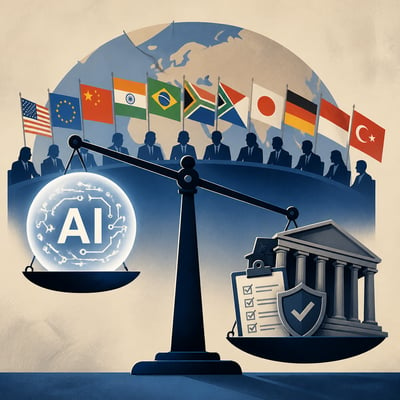
G20 members endorsed a nonbinding U.
S.-backed framework favoring sectoral rules and limited new regulators, while EU enforcement, safety-testing disputes, and competition with China keep governance fragmented.
The Carolina Principles moved from a U.S.-promoted proposal toward a framework endorsed by G20 members, strengthening its status as an international reference point despite remaining nonbinding. The story also places the framework more explicitly within U.S. commercialization, infrastructure-export, and open-weight competition with China.
The story now includes concrete EU AI Act enforcement, with the EU AI Office seeking information from more than 30 general-purpose AI providers. G20 discussions have also broadened to include African Union participation and the practical infrastructure burdens of data-center expansion.
The policy debate remains substantively unchanged, but the current version places greater emphasis on open-weight models, export pathways, and the unresolved status of any G20 endorsement or implementation.
The story remains largely stable, with current reporting adding a claim that China may support the principles and highlighting uncertainty over the December summit’s reported location.
The story now emphasizes systemic cybersecurity, critical-infrastructure, and financial risks from frontier AI, complicating the case for the Carolina Principles’ light-touch approach.
The main new element is concrete European enforcement of AI Act transparency rules, making Europe’s competing regulatory model more operational rather than merely conceptual. The U.S. proposal, timeline, and central innovation-versus-safety debate otherwise remain largely unchanged.
The United States is using its G20 presidency to promote the non-binding Carolina Principles, which would limit new AI-specific regulators, reserve intervention for genuinely novel risks, and favor sector-specific rules and joint government-industry testing. The proposal brings major technology executives into international policy discussions as governments weigh innovation, public trust, safety oversight, and competition with China and Europe. Concerns about autonomous AI agents and calls for independent pre-release testing expose the tension between lighter regulation and stronger safeguards.