EU AI Act Mandates AI TransparencyEU AI Act Mandates AI TransparencyCoverage from Future of Privacy Forum, Computerworld, and others
00/00/0000
DailyWeekly
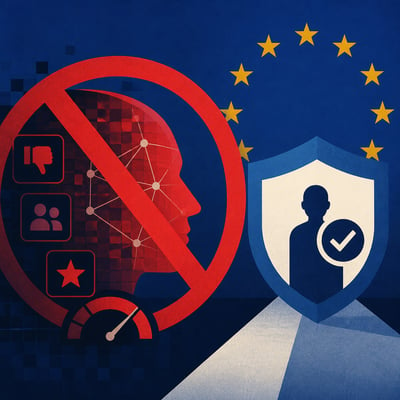
The EU AI Act is moving from a broad risk-based framework into active enforcement, requiring disclosure of AI interactions, machine-readable marking of generated content, and notices for certain biometric, emotion-recognition, and deepfake uses.
The European AI Office and national authorities share enforcement responsibilities, while prohibited manipulative practices, untargeted facial-image scraping, and some non-consensual synthetic media face restrictions. High-risk system obligations and conformity requirements remain phased through 2027 and 2028, reflecting both implementation delays and continuing legislative changes.
Looking Back
189 Day Timeline
Articles published over time. Hover any bar for the period and its article count.
Feb 11
Mar 11
Apr 15
May 13
Jun 10
Jul 15
Aug 12
History
09/09/2026
The current version mainly sharpens the Act’s operational allocation of responsibilities, especially the AI Office’s investigative role over general-purpose AI providers, and adds a stronger focus on workplace emotion-recognition and worker-monitoring risks. The core restrictions, enforcement trajectory, and phased high-risk timetable remain unchanged.
08/24/2026
The story has shifted from interpreting Article 5 red lines to documenting active transparency enforcement and institutional oversight. At the same time, high-risk compliance deadlines have been delayed, while lawmakers are adding restrictions on non-consensual sexualized AI content.
Workplace emotion AI using facial, voice, and biometric inference is criticized for scientific weakness, biased outcomes, and privacy risks, with EU bans and U.S. state actions following.
European Parliament votes to amend the EU AI Act, postponing high-risk AI deadlines and delaying machine-readable AI-generated-content labeling until 2 December 2026.
6/16/2026 • Regulation, Law & Enforcement • General
The EU AI Act, effective from August 2024 across the European Union, imposes risk-based data governance and documentation duties on AI providers and deployers, including non-EU firms.
2/11/2026 • Regulation, Law & Enforcement • General
European lawmakers agreed to ban AI nudification tools and postpone high-risk EU AI Act enforcement until December 2027, pending EU country and European Parliament approval.
5/7/2026 • Regulation, Law & Enforcement • General
EU AI Act Article 5(1)(h) bans real-time biometric identification in public spaces for law enforcement, permitting narrow exceptions only with prior authorization and safeguards.
The EU AI Act restricts biometric categorization systems from inferring sensitive traits such as race and sexual orientation from biometric data when used for individual-level categorization.
The European Commission Guidelines interpret the EU AI Act ban on emotion recognition in workplace and education settings as limited to biometric-data inferred emotions.
EU regulators and AI providers in the European Union apply prohibitions on subliminal and manipulative AI techniques under the AI Act to protect autonomy and data rights.
2/24/2026 • Privacy Technology & AI • General
Privacy and Data Security Insights / Jordan Jennings53
The European Commission's AI Office and EU Member State authorities began enforcing EU AI Act transparency requirements on August 2, 2026, across applicable European Union AI activities.
8/18/2026 • Regulation, Law & Enforcement • General
In the EU, the AI Omnibus adopted in June and published in July 2026 delays AI Act high-risk deadlines and adds a GDPR-compliant bias detection and correction exception.
7/28/2026 • Regulation, Law & Enforcement • General
The Digital Omnibus on AI starts EU AI Act Article 50 transparency and general-purpose AI penalty enforcement on August 2, 2026, with high-risk duties delayed to 2027-2028.
7/10/2026 • Regulation, Law & Enforcement • General
The European Union is enforcing AI Act privacy and transparency obligations from 2025, including synthetic-content labeling, biometric restrictions, and penalties for providers.
8/3/2026 • Regulation, Law & Enforcement • General

 AI Governance
 Data Centers
 Drones
 Climate
 Privacy
 2026 Maine Senate
 Bob Dylan