
 AI Governance
 Data Centers
 Drones
 Climate
 Privacy
 2026 Maine Senate
 Bob Dylan
EU AI Act Mandates AI Transparency
Coverage from Future of Privacy Forum, Computerworld, and others
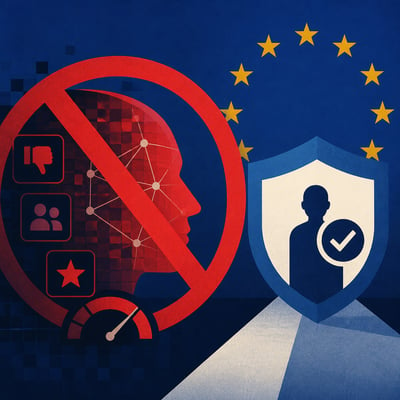
The EU AI Act is moving from a broad risk-based framework into active enforcement, requiring disclosure of AI interactions, machine-readable marking of generated content, and notices for certain biometric, emotion-recognition, and deepfake uses.
The European AI Office and national authorities share enforcement responsibilities, while prohibited manipulative practices, untargeted facial-image scraping, and some non-consensual synthetic media face restrictions. High-risk system obligations and conformity requirements remain phased through 2027 and 2028, reflecting both implementation delays and continuing legislative changes.
The current version mainly sharpens the Act’s operational allocation of responsibilities, especially the AI Office’s investigative role over general-purpose AI providers, and adds a stronger focus on workplace emotion-recognition and worker-monitoring risks. The core restrictions, enforcement trajectory, and phased high-risk timetable remain unchanged.
The story has shifted from interpreting Article 5 red lines to documenting active transparency enforcement and institutional oversight. At the same time, high-risk compliance deadlines have been delayed, while lawmakers are adding restrictions on non-consensual sexualized AI content.
- Transparency enforcement began on August 2, 2026.
- The European AI Office now has a central enforcement role for general-purpose AI providers.
- Penalties for prohibited practices may reach 7% of worldwide turnover.
- High-risk compliance deadlines extend to December 2027 and August 2028.
- Lawmakers added proposed bans on AI-generated non-consensual intimate content and child sexual abuse material.
The story shifts from a broad account of EU AI Act enforcement timing and related privacy restrictions to a more precise legal map of Article 5 prohibitions. The current version emphasizes how specific prohibited uses are defined by cumulative conditions, with clearer distinctions between banned, permitted, and high-risk systems.
The story has shifted from general EU AI Act privacy limits to a more operational enforcement phase, with staged deadlines, penalties, and labeling duties now front and center. It also newly foregrounds synthetic media and nudification bans as a separate, concrete enforcement thread.
- Enforcement dates now extend into December 2026, December 2027, and August 2028.
- The European AI Office is identified as the penalty body for general-purpose AI.
- EU lawmakers are moving to ban non-consensual synthetic intimate content generation.
- AI outputs may require labeling or watermarking under the new rules.
Recent EU AI Act guidance is tightening privacy limits on AI uses that infer sensitive traits, manipulate users, or enable biometric surveillance. The strongest signal is a detailed framework of prohibited practices, narrow exceptions, and enforcement rules that overlap with GDPR and sector-specific law.