Last Update: 09/22/2026 at 11:34 PM EST

Apple’s Glasses Bet Meets Consent

Coverage from TechTarget, Eweek, and others
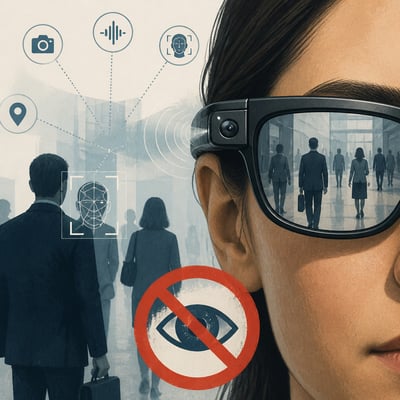
Apple’s Glasses Bet Meets Consent topic image

Apple is reportedly delaying its first smart glasses while refining how cameras, AI processing, recording controls, and captured data will be handled.

Proposed safeguards include on-device processing, visible recording indicators, limits on storing or using footage for AI training, and avoiding facial recognition. The approach reflects wider concerns about unnoticed recording, biometric collection, human review of footage, and restrictions on camera-equipped eyewear in sensitive public settings.

Key Articles5 of 43 articles

If you read one thing

It provides the clearest broad introduction to Apple’s privacy-by-design challenge as it enters the smart-glasses market.

Startup Fortune / Janet Harrison

Best explainer

It explains how ambient capture and cognitive inference can undermine consent beyond the wearer’s intended use.

The Cognitive Privacy Project / Timothy Cook

The counter-case

It presents the contested case that local processing and design controls may still fail to protect bystanders from recording and surveillance.

Tech Times

The evidence

It shows how smart-glasses data can create concrete enterprise, healthcare, cloud-transmission, and AI-training risks after capture.

TechTarget

The local angle

It grounds the broader privacy debate in emerging US laws and venue restrictions addressing camera-equipped eyewear.

Atlantic Council / Trisha Ray
Key Issues

Apple is trading speed for privacy-by-design

Apple's reported smart-glasses launch remains aimed at 2027 while the company refines on-device processing, constrained sensing, recording indicators, and limits on facial recognition, video capture, and AI-training use of captured footage. Camera-less or less capable configurations remain under consideration.

Stable

Drawn from 5 articles

Ambient capture still outpaces practical consent

Camera- and microphone-equipped glasses can capture bystanders and conversations without clear awareness, while recording indicators may be overlooked or bypassed. Consent, notice, and public trust therefore remain persistent barriers to routine use.

Stable

Drawn from 4 articles

Downstream data exposure remains a core weakness

After capture, smart-glasses data may be transmitted to third-party clouds, retained in voice or image systems, used for AI training, or exposed to human reviewers. Sensitive workplace, healthcare, financial, and personal content therefore remains vulnerable even when recording is visible.

Stable

Drawn from 4 articles

Governance is fragmented across laws and venues

Existing privacy rules leave gaps around bystander-generated audiovisual and biometric data, while responses are emerging piecemeal through proposed recording-indicator laws, courthouse bans, and workplace or healthcare restrictions. Protection and deployment rules therefore vary by setting rather than forming a uniform standard.

Stable

Drawn from 4 articles

Contested Issue

Can visible recording indicators and related device controls provide sufficient protection for bystander consent?

Some reporting presents recording indicators, constrained sensing, and privacy-by-design controls as measures intended to reduce covert recording and improve social acceptability. Other evidence says indicators can be missed, misunderstood, removed, or bypassed, and that at least one court system found them insufficient for camera-equipped eyewear.

Controls can mitigate covert recording

3 articles · across 3 publications

Visible recording indicators combined with restricted recording, on-device processing, and limits on downstream data use can reduce privacy exposure and support consent.

Indicators are insufficient

3 articles · across 3 publications

Recording lights and similar visible cues do not reliably establish consent because bystanders may not notice or understand them, and users or researchers may bypass or disable them.

Looking Back
193 Day Timeline
Feb 22Apr 5May 3Jun 14Jul 12Aug 23
The Story So Far
No material change

The new article raises biometric privacy concerns about a proposed Apple smart home display, but does not materially change the topic’s focus on smart-glasses privacy, recording safeguards, and consent.

Previously

Apple is reportedly delaying its first smart glasses while refining how cameras, AI processing, recording controls, and captured data will be handled. Proposed safeguards include on-device processing, visible recording indicators, limits on storing or using footage for AI training, and avoiding facial recognition. The approach reflects wider concerns about unnoticed recording, biometric collection, human review of footage, and restrictions on camera-equipped eyewear in sensitive public settings.

History
08/25/2026

The story adds more concrete detail about Apple’s privacy architecture, including potentially keeping routine camera data off Apple’s servers and avoiding storage. It also indicates that venue restrictions have moved from emerging concerns to implemented 2026 rules, while the broader narrative remains largely confirmatory.

08/04/2026

The main change is a sharper privacy-specific redesign story for Apple’s smart glasses: the project is now framed as being delayed while Apple tests additional safeguards, including more restrictive camera and data-use controls. The current version also adds a clearer operational constraint, with courts and sensitive venues increasingly restricting eyewear use.

All Articles43 articles
Important22 articles · CI Score 60 and above
TechTarget
Smart glasses expose businesses, hospitals, government facilities, and regulated organizations to covert recording and third-party transmission risks in sensitive workplaces.
8/12/2026 • Data Collection & Surveillance Practices • General
Eweek / Aminu Abdullahi
Meta, Google, Samsung, and Apple smart glasses face US and EU privacy rules on biometric identification and wearable recording as of 2026.
7/2/2026 • Data Collection & Surveillance Practices • General
The Cognitive Privacy Project / Timothy Cook
Meta camera glasses raise privacy concerns by enabling ambient collection and cognitive inference from bystanders without consent, with chilling-effect risks discussed in 2026 reporting.
6/14/2026 • Data Collection & Surveillance Practices • General
CNET / Jason Chun
A privacy-focused report warns that camera-equipped smart glasses can enable covert public recording, including an alleged London case, where limited regulation leaves social norms as safeguards.
7/8/2026 • Data Collection & Surveillance Practices • General
The Verge / Victoria Song
Netflix and Meta smart glasses receive privacy scrutiny as covert recording risks affect consent and trust in public and assisted-living settings.
7/6/2026 • Data Collection & Surveillance Practices • General
CNET / Jason Chun
Smart glasses demos at Augmented World Expo raise privacy concerns after London reports of undisclosed recording and social media posting by a wearer.
6/17/2026 • Data Collection & Surveillance Practices • General
Search CIO / Grant Hatchimonji
Workplace use of smart glasses enables covert recording and cloud transmission, creating GDPR and HIPAA privacy and data-leak liability risks.
3/23/2026 • Data Collection & Surveillance Practices • General
Atlantic Council / Trisha Ray
During the 2020s, smart-glasses companies including Meta and Google are expanding AI-enabled eyewear in the United States while state laws leave recorded bystanders unevenly protected.
8/10/2026 • Regulation, Law & Enforcement • General
Gizmodo / James Pero
EssilorLuxottica and Meta reported strong smart-glasses growth in the second quarter and 2025 while privacy concerns intensified in the United States, Sweden, and South Korea.
7/30/2026 • Data Collection & Surveillance Practices • General
PCMag / Jibin Joseph
Apple delayed camera-equipped smart glasses for WWDC 2027 amid privacy concerns about undisclosed recording and plans for on-device processing and restricted data use.
7/27/2026 • Privacy Technology & AI • General
Tech Times
Apple delayed smart glasses N50 from late 2026 to WWDC June 2027, citing privacy design changes and aiming to limit captured visual data exposure.
7/27/2026 • Privacy Technology & AI • General
AppleInsider / Malcolm Owen
Mark Gurman reports Apple may announce smart glasses at WWDC 2027 and ship later, adjusting camera and AI design to address consumer privacy concerns sparked by Meta.
7/26/2026 • Privacy Technology & AI • General
WeLiveSecurity
Harvard University research and company practices around smart glasses and AI raise privacy and security risks for bystanders in the USA.
5/11/2026 • Privacy Technology & AI • General
CNET / Alex Valdes
Apple reportedly delays smart glasses development to address privacy concerns, including likely on-device AI and avoided facial recognition, ahead of a WWDC June unveiling.
7/27/2026 • Privacy Technology & AI • General
Gizmodo / Mike Pearl
Apple smart glasses reportedly delayed to late 2027 as privacy safeguards are developed following Meta smart glasses exposure and facial recognition controversies.
7/26/2026 • Privacy Technology & AI • General
Built In / Brooke Becher
Smart glasses in the USA and EU raise privacy concerns because always-on audio and video capture can be difficult for bystanders to detect and enforce.
3/25/2026 • Data Collection & Tracking • General
Digital Trends / Sudhanshu Kumar Mangalam
Apple is expected to debut smart glasses codenamed N50 at WWDC in June 2027 after a privacy-focused design delay tied to camera use and AI training restrictions.
7/26/2026 • Data Collection & Surveillance Practices • General
Purdue Global Law School
Manufacturers are producing fashion-forward AI smart glasses that capture biometric data, prompting legal and workplace privacy assessments in the United States in the 2020s.
1/1/1900 • Data Collection & Surveillance Practices • General
CNET / Jason Chun
In London, a consent-free smart-glasses recording was uploaded online, highlighting growing privacy risks as wearable camera adoption increases.
6/24/2026 • Data Collection & Surveillance Practices • General
Yahoo / Moz Farooque Acca
Apple is reportedly delaying AI smart glasses to add on-device processing, facial recognition avoidance, scanning limits, and a ban on training from customer recordings ahead of WWDC.
7/27/2026 • Privacy Technology & AI • General
Rocketnews
Mark Gurman reports Apple is preparing smart glasses for a June developer event, targeting end-2027 availability with on-device processing and reduced recording features to address privacy scrutiny.
7/26/2026 • Privacy Technology & AI • General
Ogletree Deakins / Jennifer Monrose Moore, Brandon R. Sher, and Maja Veselinovic
Retailers managing smart glasses face privacy and employment-law constraints, especially around audio-video recording, facial recognition capture, and ADA accommodation processes.
3/28/2026 • Privacy Technology & AI • General
Interesting18 articles · CI Score 45–59
Yahoo Tech / Andy Boxall
On May 19 in Ireland, committee officials pressed for smartglasses privacy and consent regulation after Cork reports of camera recording in workplaces and medical emergencies.
5/21/2026 • Regulation, Law & Enforcement • General
Android Police
Irish officials discussed May 19 smartglasses with cameras, citing non-consensual recording allegations and calling for tighter privacy rules in Ireland.
5/21/2026 • Regulation, Law & Enforcement • General
Mashable / Chance Townsend
Apple is reportedly delaying smart-glasses plans until WWDC 2027 to develop privacy protections addressing covert recording and data processing concerns in the consumer wearable market.
7/29/2026 • Consumer Privacy & Digital Rights • General
RochesterFirst / Gio Battaglia
Amanda Irons-Rindfleisch discusses wearable smart glasses privacy risks in public spaces, in the present, with Monroe County and Niagara County authorities.
3/4/2026 • Data Collection & Surveillance Practices • General
Aviation A2Z / Natalia Shelley
Southwest Airlines, based near Dallas Love Field, restricts employee use of wearable recording devices during work hours.
3/1/2026 • Data Collection & Surveillance Practices • General
PetaPixel / Matt Growcoot
Apple reportedly considers camera-free or restricted smart glasses and limited sensing to reduce privacy exposure, following Meta Ray-Ban glasses privacy scandals involving contractor review in Kenya.
7/27/2026 • Privacy Technology & AI • General
Yahoo / Faizan Farooque
Apple plans a privacy-focused smart glasses launch, with safeguards like no facial recognition and restricted recording-based AI training targeted for end of 2027 after a WWDC unveiling next June.
7/27/2026 • Privacy Technology & AI • General
Notebookcheck / Hannes Brecher
Apple reportedly delayed a smart-glasses launch planned for WWDC 2027 after privacy concerns about covert recording and data handling influenced feature and timing decisions.
7/27/2026 • Privacy Technology & AI • General
MacObserver / Rajat Saini
Apple aims to unveil smart glasses codenamed N50 at WWDC 2027, prioritizing privacy via on-device processing and recording safeguards.
7/27/2026 • Privacy Technology & AI • General
Welcome.AI
Lingverse plans iKairos presales later this year, marketing a voice-triggered, snapshot-based wearable for AI-generated images with stated deletion controls.
7/23/2026 • Privacy Technology & AI • General
Boulder Daily Camera
U.S. Department of Homeland Security proposes funding smart glasses for immigration enforcement biometric recognition as privacy groups raise consent and access concerns.
5/5/2026 • Privacy Technology & AI • General
Aicerts News
EU regulators and researchers document privacy risks from smart glasses, citing doxxing demonstrations, cloud reviewer access, and weak face anonymization under GDPR and EU AI Act.
3/27/2026 • Privacy Technology & AI • General
The Verge / Terrence O'Brien
Apple plans to preview smart glasses at WWDC next June, targeting an end-of-2027 launch while reportedly restricting recording, facial recognition, and AI training use.
7/26/2026 • Privacy Technology & AI • General
TechCrunch / Anthony Ha
Mark Gurman reports Apple shifted its smart glasses unveiling to June 2027 at WWDC amid consumer privacy concerns over recording and AI training practices.
7/26/2026 • Privacy Technology & AI • General
Forbes
A review of Bee, Plaud, Limitless, and Omi finds AI conversation recording wearables generate searchable summaries but show unreliable speaker identification.
7/24/2026 • Privacy Technology & AI • General
AppleInsider / Andrew O
Apple may launch a smart home display in late 2025 or early 2027 with facial recognition that personalizes and protects household widget data.
9/2/2026 • Personal Data & Identity • General
Tech Times / Shannon Harwood
Apple is reportedly preparing a 2026 Home Hub in Cupertino with local AI processing and biometric ambient sensing designed to reduce household data exposure.
8/25/2026 • Privacy Technology & AI • General
TechRepublic / Aminu Abdullahi
Apple is reportedly preparing a facial-recognition smart home hub for release between October 2026 and early 2027, potentially expanding biometric identification in homes.
7/29/2026 • Privacy Technology & AI • General
Additional3 articles · CI Score below 45
The Week
Meta faces privacy scrutiny over smart glasses with built in camera and proposed facial recognition in the United States.
3/10/2026 • Privacy Technology & AI • General
Startup Fortune / Janet Harrison
Apple plans smart glasses sales in 2027 while privacy controls for camera-enabled wearables are highlighted amid facial recognition concerns involving Meta and EssilorLuxottica.
5/31/2026 • Privacy Technology & AI • General
Spokesman
Apple is developing smart-home and wearable products with facial recognition, visual AI, and camera-free environmental monitoring for planned launches beginning September 9 and extending through 2028.
9/4/2026 • Privacy Technology & AI • General