Last Update: 09/22/2026 at 11:33 PM EST

Bob Dylan’s “Murder Most Foul”

Coverage from RTÉ Brainstorm, Untold Dylan, and others
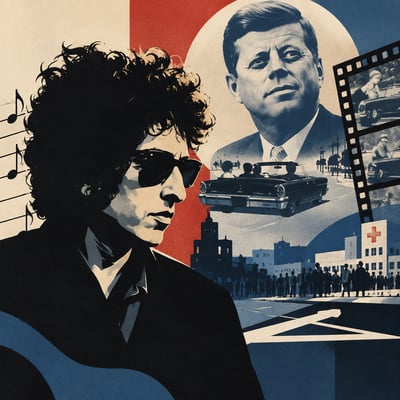
Bob Dylan’s “Murder Most Foul” topic image

Released in 2020, “Murder Most Foul” is Bob Dylan’s extended meditation on John F.

Kennedy’s assassination and the damaged cultural memory surrounding it. Its documentary-like opening at Dealey Plaza expands into a collage of Oswald, Jack Ruby, classic songs, musicians, literary references, conspiracy imagery, and episodes of American violence. Critics and Dylan scholars have read the song through Hamlet, Dylan’s earlier work, civil-rights history, and the isolation of the pandemic era. The song’s significance lies in how it turns a historical trauma into an open-ended reflection on memory, popular culture, political violence, and moral renewal.

Key Articles4 of 24 articles

If you read one thing

It offers the clearest broad introduction to the song’s unresolved national trauma, extended form, and central interpretive arguments.

RTÉ Brainstorm / Jack Campbell

Best explainer

It explains how the song’s sparse long-form design and dense musical and literary allusions fit within Dylan’s late-career work.

Dylanology / Eyolf Østrem

The evidence

It adds a distinct political reading that connects the song’s historical imagery to American violence, power, and myth.

New Politics / Jordy Cummings

The evidence

It provides focused analysis of the song’s murder-ballad, cinematic, and intertextual construction.

Untold Dylan / Jochen Markhorst
Key Issues

Unresolved national trauma

The dominant interpretation treats Kennedy’s assassination as an enduring American trauma rather than a closed historical event. Dylan’s circular structure, dispersed voices, and limited attention to Oswald are read as shifting the focus toward collective responsibility, memory, and moral failure.

Drawn from 4 articles

Cultural memory built from musical and literary allusion

The song is understood as a cultural collage in which musical references, murder-ballad conventions, cinema, and literary echoes mediate the assassination’s meaning. These allusions create mythic distance and ambiguity rather than a straightforward historical account.

Drawn from 4 articles

Long-form late-career epic

The song’s exceptional scale and nonconventional structure remain central to its significance: a roughly 17-minute, highly extended narrative that prioritizes cadence, accumulation, and stream-of-consciousness movement over a standard song form. Commentary places that design within Dylan’s late-career artistic identity and the wider architecture of Rough and Rowdy Ways.

Drawn from 5 articles

Critique of systemic violence and power

A substantial strand of interpretation reads the assassination as a symbolic entry point into broader American systems of violence, racism, political distrust, capitalism, and concealed power. The song’s historical imagery is therefore treated as social and political criticism, not only elegy.

Drawn from 4 articles

Key Numbers

11 members

size of Dylan’s backing band

1978 large-scale revue

After visiting Diamond’s Las Vegas show, Dylan adopted a large-scale revue style with loose-fitting shirts, an 11-piece backing band, three backing singers, and makeup. He also hired Diamond’s manager, Jerry Weintraub.

Untold Dylan

three singers

number of backing singers

1978 large-scale revue

After visiting Diamond’s Las Vegas show, Dylan adopted a large-scale revue style with loose-fitting shirts, an 11-piece backing band, three backing singers, and makeup. He also hired Diamond’s manager, Jerry Weintraub.

Untold Dylan

17-minute minutes

duration of the song’s narrative

The song ends with one final request to Wolfman Jack: “play Murder Most Foul.” This creates an infinite loop. The song begins with the assassination, moves through its 17-minute narrative and returns to the request that starts it again.

RTÉ Brainstorm

160 lines

total song lines

“Murder Most Foul”

Lee Harvey Oswald receives only two of the song’s 160 lines, and Dylan suggests that the so-called assassin did not act alone.

RTÉ Brainstorm

two lines

number of lines given to Lee Harvey Oswald

out of the song’s 160 lines

Lee Harvey Oswald receives only two of the song’s 160 lines, and Dylan suggests that the so-called assassin did not act alone.

RTÉ Brainstorm

Looking Back
2359 Day Timeline
2020Jan 1Mar 4May 27Jul 29Oct 21Dec 232021Jan 1Mar 5May 28Jul 30Oct 22Dec 242022Jan 1Mar 5May 28Jul 30Oct 22Dec 242023Jan 1Mar 5May 28Jul 30Oct 22Dec 242024Jan 1Mar 4May 27Jul 29Oct 21Dec 232025Jan 1Mar 5May 28Jul 30Oct 22Dec 242026Jan 1Mar 5May 28Jul 30Oct 22Dec 24
The Story So Far
No material change

The new article reiterates existing interpretations of “Murder Most Foul” as a meditation on Kennedy, American violence, cultural memory, and unresolved national corruption; it does not establish a material change in the Topic.

Previously

Bob Dylan's "Murder Most Foul" remains a sustained subject of analysis as a nearly 17-minute meditation on the Kennedy assassination, American cultural memory, political violence, and the traditions of popular music. Later commentary connects its sparse, extended form and dense allusions to Rough and Rowdy Ways, Dylan's late-career songwriting, and earlier works such as "Desolation Row."

All Articles24 articles
Important16 articles · CI Score 60 and above
RTÉ Brainstorm / Jack Campbell
In 2020, Bob Dylan used Murder Most Foul to examine John F. Kennedy's 1963 assassination in Dallas as an enduring American trauma.
8/27/2026 • Songs & Songwriting • General
RTÉ Brainstorm / Jack Campbell
Bob Dylan addressed John F. Kennedy's assassination in 2020 through Murder Most Foul, a 17-minute song portraying unresolved trauma in the United States.
8/27/2026 • Songs & Songwriting • General
Untold Dylan / Jochen Markhorst
Jochen Markhorst analyzes Bob Dylan's Murder Most Foul, showing how recurring John F. Kennedy references unify its shifting cultural imagery in a song about the 1963 Dallas assassination.
9/18/2026 • Songs & Songwriting • General
New Politics / Jordy Cummings
Dylan is analyzed for Desolation Row and Murder Most Foul within American political and cultural contexts across the 1960s to the 2020s.
7/13/2020 • Dylan Studies • General
Untold Dylan / Jochen
An essay links Bob Dylan's Murder Most Foul with Oliver Stone's Nixon through shared depictions of political menace and violence in Texas and the United States.
9/4/2026 • Songs & Songwriting • General
From the Pen of Chris Gregory / Chris Gregory
Chris Gregory interprets Bob Dylan's Murder Most Foul as a meditation on Kennedy's assassination and American violence through Dallas settings and cultural references.
9/2/2026 • Songs & Songwriting • General
Untold Dylan / Jochen Markhorst
Bob Dylan's 2020 Murder Most Foul connects to Phil Ochs's The Highwayman, recorded for I Ain't Marching Any More, through a recurring murder-ballad phrase.
8/31/2026 • Songs & Songwriting • General
Untold Dylan / Jochen Markhorst
Bob Dylan's 2020 song Murder Most Foul fictionalizes John F. Kennedy's assassination in American cultural memory while referencing John Lennon, Nick Cave, and popular song traditions.
8/25/2026 • Songs & Songwriting • General
From the Pen of Chris Gregory
In 2020, Bob Dylan used Murder Most Foul to connect Kennedy's assassination with American music, violence, religion, and cultural memory.
9/10/2026 • Songs & Songwriting • General
Shadow Chasing / Graley Herren
63,400 pages related to the Kennedy and related assassinations were released by the National Archives on March 18, 2025, and A. O. Scott published a New York Times essay the following morning.
3/23/2025 • Dylan Studies • General
Life & Letters / Kaulie Watson
At UT Austin, classics professor Tom Palaima collaborates with Joe Goodkin to reinterpret Bob Dylan's Murder Most Foul in performances and a studio recording.
11/22/2023 • Songs & Songwriting • General
Dylanology / Eyolf Østrem
In March 2020, Dylan announced Murder Most Foul on Twitter, followed by False Prophet, I Contain Multitudes, and the album Rough and Rowdy Ways.
3/20/2025 • Songs & Songwriting • General
Dylagence / Pamela Brown
A Dylan focused essay published on dylagence.wordpress.com on Apr 9, 2020 analyzes Murder Most Foul and its sources.
4/9/2020 • Songs & Songwriting • General
Fonts In Use
Bob Dylan released Murder Most Foul through Columbia Records in 2020, connecting John F. Kennedy's assassination with American history and setting a record as Dylan's longest song.
8/30/2026 • Albums & Recordings • General
Just Poems
On 2020-06-28, Daniel O'Hara published a WordPress blog post comparing Bob Dylan's Murder Most Foul with John Milton's Lycidas.
6/28/2020 • Songs & Songwriting • General
Untold Dylan / Jochen Markhorst
In 2020, Bob Dylan's Murder Most Foul presented an opening verse that Markhorst interpreted as reflecting Neil Diamond's lyrical style.
9/7/2026 • Songs & Songwriting • General
Interesting8 articles · CI Score 45–59
Review Magazine
Bob Dylan released Murder Most Foul in 2020 on YouTube and streaming platforms, examining the John F. Kennedy assassination through historical, political, and cultural imagery.
8/21/2026 • Songs & Songwriting • General
Medium
A writer connects Bob Dylan's 2020 song Murder Most Foul to Hamlet and uses Timothy Hampton's poetics while recalling the JFK assassination.
7/25/2026 • Songs & Songwriting • General
Grunge
Bob Dylan released Murder Most Foul in early 2020 during the COVID-19 months, and the single hit No. 1 on Billboard Rock Digital Song Sales.
5/22/2026 • Songs & Songwriting • General
Shadow Chasing / Graley Herren
On 2020-03-27, Bob Dylan released Murder Most Foul, a 17-minute song about the Kennedy assassination.
4/4/2025 • Songs & Songwriting • General
FolkWorks / David Nigel Lloyd
Bob Dylan's Murder Most Foul is analyzed as a 17 minute ballad about the JFK assassination in Dallas on Nov 22, 1963.
11/1/2023 • Songs & Songwriting • General
voegelinview.com / Mark Connolly
Bob Dylan released Murder Most Foul, a seventeen minute ballad about Kennedy's assassination, on YouTube during the Covid-19 crisis.
4/27/2020 • Songs & Songwriting • General
Tone Deaf / Michael S. Genner
On Mar 27, 2020, Bob Dylan released Murder Most Foul worldwide, a 17 minute song about John F. Kennedy's assassination and American cultural history.
4/15/2020 • Songs & Songwriting • General
conradbrunstrom.wordpress.com / conrad brunstrom
On Mar 27, 2020, a blog post analyzes Bob Dylan's Murder Most Foul, focusing on Kennedy's death in Dallas.
3/27/2020 • Songs & Songwriting • General