Blood on the TracksBlood on the TracksCoverage from Mojo, Uncut, and others
00/00/0000
DailyWeekly
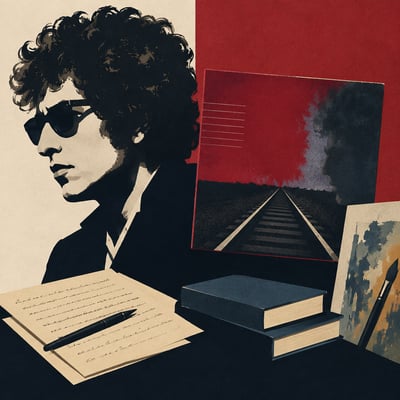
Blood on the Tracks is widely regarded as one of Bob Dylan’s defining albums, combining songs of betrayal, fate, longing, and self-reinvention with fragmented narratives and shifting points of view.
Tracks including “Tangled Up in Blue,” “Simple Twist of Fate,” and “Idiot Wind” have prompted enduring debate over the relationship between Dylan’s personal life and his art, while his studies with painter Norman Raeben are often linked to the album’s nonlinear storytelling. The work also has a distinctive production history, moving from New York sessions at A&R Studios to later re-recordings in Minnesota.
It uses Tangled Up in Blue’s changing versions and recording history to illuminate the album’s central process of revision.
John Nogowski / John Nogowski
Key Issues
01
Recording revision and competing versions
Blood on the Tracks is still defined by the contrast between the sparse New York sessions and the fuller Minneapolis re-recordings. Archival releases, session accounts, and newly surfaced drafts reinforce revision and reinterpretation as central to the album’s identity.
Drawn from 4 articles
02
Autobiography versus constructed narrative
Interpretation remains divided between reading the album as a breakup and marital-crisis document and treating it as a deliberately transformed work shaped by literary, painterly, and nonlinear narrative techniques. The evidence supports personal context as important, but not as a settled explanation of the songs.
Drawn from 5 articles
03
Tangled Up in Blue as the album’s interpretive center
Tangled Up in Blue remains the dominant song-level lens for understanding the album’s shifting perspectives, nonlinear time, unusual harmony, and iterative rewriting. Its studio, archival, and live versions are treated as evidence of Dylan’s continuing revisionist practice rather than a single definitive conception.
Drawn from 5 articles
04
Enduring canonical status
The album continues to function as a benchmark for breakup songwriting, confessional rock, and Dylan’s mid-1970s artistic reinvention. Current coverage is predominantly retrospective, treating its historical importance and influence as established rather than newly contested.
Stable
Drawn from 4 articles
Looking Back
4958 Day Timeline
Articles published over time. Hover any bar for the period and its article count.
Feb '13
Aug '15
Aug '17
Feb '20
Feb '22
Aug '24
Jul '26
The Story So Far
No material change
The new article adds a minor interpretation of the album’s closing blues-inflected serenity, literary allusion, and rustic imagery but does not materially change the established understanding of Blood on the Tracks.
Previously
Bob Dylan's Blood on the Tracks is being reassessed through newly surfaced drafts, session archives, competing New York and Minneapolis recordings, and close study of Tangled Up in Blue. The strongest signal treats the album as an evolving recording project rather than a fixed 1975 artifact, while debate continues over biography, literary construction, and which session best captures its songs.
Victoria Segal writes in MOJO about Bob Dylan's Blood on the Tracks, tracing how 1974 sessions in New York and Minnesota reflected marital and artistic upheaval.
A one-album set of outtakes, More Blood, More Tracks, reveals Bob Dylan's original 1974 Columbia acoustic sessions recorded in New York and later re-recorded in Minneapolis for the 1975 album Blood On the Tracks.
On Jan 20, 1975, Bob Dylan released Blood on the Tracks, later examined in a retrospective article for its enduring artistic and cultural significance.
The article revisits how Bob Dylan's album Blood on the Tracks, released on Jan 20, 1975, emerged from reworked New York and Minneapolis recording sessions.
John Nogowski analyzes Bob Dylan's Tangled Up in Blue, comparing Blood on the Tracks and Real Live while recounting related recording sessions and archival releases.
In this analytical article, Bob Dylan's late-1963 and early-1964 songs are examined to show evolving musical structures supporting shifting political and personal themes.
Bob Dylan released Tangled Up in Blue on Blood on the Tracks in 1975, presenting a nonlinear song shaped by Norman Raeben's influence and debated autobiographical meaning.
In this blog post, jmeshel.com examines Bob Dylan's 1974 album Blood on the Tracks and the song Tangled Up in Blue through recording and lyrical analysis.
Bob Dylan released influential albums, toured extensively, and shifted toward evangelical music during the 1970s, with Blood on the Tracks emerging as the decade's leading work.
More Blood, More Tracks is presented as a stripped acoustic account of Blood on the Tracks sessions, highlighting new perspectives on Idiot Wind and Simple Twist of Fate.
Bob Dylan developed the fragmented songwriting approach behind Blood on the Tracks after meeting Norman Raeben in New York City before the album's 1975 release.
Bob Dylan released Lily, Rosemary and the Jack of Hearts on Blood on the Tracks in January 1975, using playing-card symbolism to structure a crime narrative.
Dan Szczesny says a Buffalo State Dante course linking La Vita Nuova to Tangled Up in Blue turned Dylan into a lifelong songwriting and family-story focus.

 AI Governance
 Data Centers
 Drones
 Climate
 Privacy
 2026 Maine Senate
 Bob Dylan
 Christian's Music Musings