
 AI Governance
 Data Centers
 Drones
 Climate
 Privacy
 2026 Maine Senate
 Bob Dylan
Bob Dylan Covers and Catalog Reinterpretation
Coverage from nightly_moth, Luke McKernan, and others
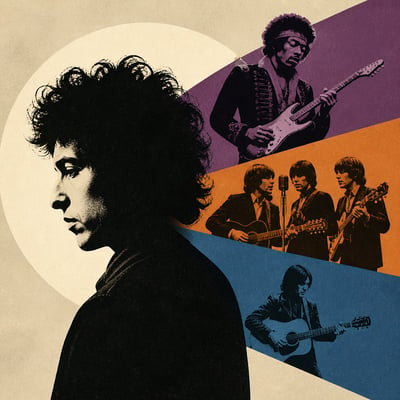
Bob Dylan's catalog is being revisited through a dense cycle of cover compilations, song-by-song criticism, and archival features.
Recent material emphasizes 1963–1970 recordings, arrangement changes, deep cuts, cross-genre reach, and the continued public life of canonical songs, while a smaller strand tracks Dylan's ongoing activity.
The story has shifted from broad retrospective discussion and political performance toward systematic curation of Dylan covers, arrangement-focused criticism, and archival recovery. This reframing makes the catalog’s ongoing reinterpretation—not a single new recording or controversy—the central development.
The story now places stronger emphasis on Dylan’s protest-song afterlife in live political settings, while broadening the framing to include commentary on whether modern artists still produce comparable public anthems. It also adds renewed attention to specific early-period recordings and named venues, making the historical arc feel more anchored and slightly wider in scope.
The framing has shifted slightly from a broad retrospective on Dylan’s catalog to a more explicit emphasis on protest-use, historical reassessment, and how specific songs travel across performance contexts. The new version also adds Joan Baez’s commentary on Dylan as a benchmark for political songwriting.
The story has shifted from a broad discussion of Dylan covers and self-interpretation to a more historically framed account of Dylan’s career turning points and the continuing political afterlife of specific songs. The new emphasis is on his folk-to-electric transition, apocalyptic imagery, and the modern reuse of his protest material in live demonstrations and large-scale performances.
The framing has broadened from a general discussion of Dylan covers into a more explicit comparison framework that highlights which reinterpretations become definitive reference versions. It also adds a few named benchmark covers and a slightly wider set of stylistic transformations.
The framing has shifted from Dylan's 1963-65 electric breakthrough and legacy coverage to a broader story about Dylan songs as adaptable cover material, including Dylan's own practice of covering others. That makes the topic less about one historical pivot and more about enduring reinterpretation across styles and eras.
- Dylan himself is portrayed as a frequent performer of others' songs.
- "The Times They Are A-Changin'" is used repeatedly in protest contexts.
- Cover versions are framed as transformation, not imitation.
- The topic now spans 2022 to 2026 coverage.
- International reinterpretations are now part of the story.
The story is now more explicitly anchored in Dylan’s canonical 1960s breakthrough, with stronger emphasis on specific touchstones like Like a Rolling Stone and Knockin' on Heaven's Door. It also broadens the reinterpretation angle by adding more cover-focused actors and retrospective sources, while remaining largely legacy-driven rather than event-driven.
This topic brings together Dylan's formative 1963-65 artistic shift and the long afterlife of his songs in cover versions, archival compilations, and reinterpretive projects. The strongest current signal is not new studio output but repeated re-use of Dylan material across genres, eras, and performance contexts. Historical pieces on the acoustic-to-electric transition remain important because they anchor how later coverage frames Dylan's legacy. The material is coherent but broad, with a stable core around song reinterpretation and a secondary historical layer around the mid-1960s breakthrough.