
 AI Governance
 Data Centers
 Drones
 Climate
 Privacy
 2026 Maine Senate
 Bob Dylan

George Harrison and Bob Dylan
Coverage from Far Out Magazine, American Songwriter, and others
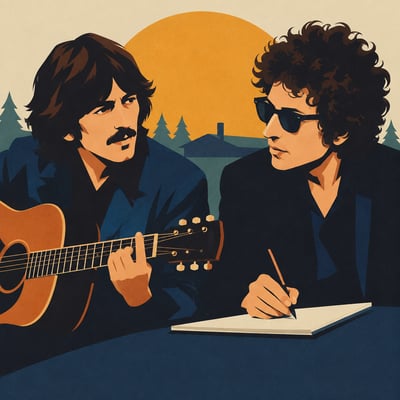
George Harrison and Bob Dylan’s creative relationship grew from songwriting and musical exchange, notably during their 1968 sessions in Woodstock.
Their shared work includes “I'd Have You Anytime,” which opened Harrison’s All Things Must Pass, and Harrison’s recording of Dylan’s “If Not for You,” performed by the musicians at the 1971 Concert for Bangladesh. Years later, they worked together in the Traveling Wilburys, where Harrison watched Dylan shape songs in the studio. Their collaborations offer a glimpse into how two distinctive songwriting approaches met across recordings, performances, and friendship.
If you read one thing
It introduces the relationship through the foundational Woodstock songwriting and the song that opened Harrison’s solo debut.
Best explainer
It broadens the story from songwriting into recordings, performances, and the Traveling Wilburys.
The evidence
It adds a focused account of Harrison’s recording of Dylan’s “If Not for You,” a distinct landmark in their musical exchange.
1968 Woodstock songwriting is the relationship’s foundation
Coverage centers the relationship on the 1968 Woodstock exchange and the co-written “I’d Have You Anytime,” framing it as both a personal bond and a creative turning point. The song’s place on Harrison’s solo debut keeps that collaboration central to accounts of their artistic connection.
Harrison’s recordings anchor their musical exchange
Harrison’s solo recordings make the relationship tangible beyond co-writing: “I’d Have You Anytime” opens All Things Must Pass, and his version of Dylan’s “If Not for You” became a durable part of the exchange. Coverage presents Harrison’s reinterpretation as a distinct contribution rather than simply a Dylan cover.
The collaboration extends into the Traveling Wilburys
The relationship is also understood as a longer creative arc, continuing from earlier songwriting and performances into shared studio work with the Traveling Wilburys. Dylan’s role on “Tweeter and the Monkey Man” is highlighted as an example of the group’s collaborative spontaneity.
No new articles entered the Topic, so there is no evidence of a material change in the documented Dylan–Harrison creative relationship.
Previously
Recent retrospectives revisit Dylan and Harrison's partnership through their 1968 Woodstock songwriting, Harrison's reinterpretations on All Things Must Pass, and later collaborations involving Concert for Bangladesh and the Traveling Wilburys.