
 AI Governance
 Data Centers
 Drones
 Climate
 Privacy
 2026 Maine Senate
 Bob Dylan
Dylan and the Beatles' Mutual Influence
Coverage from Literary Hub, bob-dylan.org.uk, and others
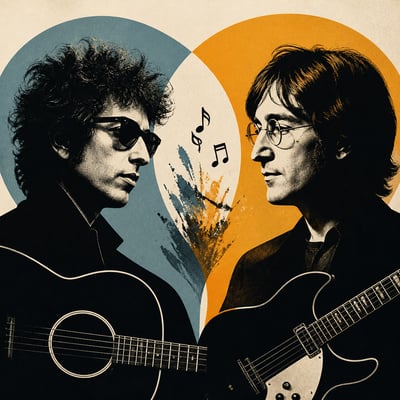
A 2026 wave of books, reviews, interviews, and related commentary reexamines Bob Dylan's reciprocal relationship with The Beatles.
The strongest recurring evidence concerns 1964–66 encounters and the Norwegian Wood–4th Time Around exchange, while some meeting details and causal influence claims remain disputed.
The story is now framed more narrowly as a 2026, book-led historical reassessment, with documented 1964–66 encounters and the Norwegian Wood–4th Time Around exchange treated as the strongest evidence. Uncertainty over meeting chronology, Royal Albert Hall attendance, and direct influence is more explicit.
The framing has shifted from a 2026 book-driven reassessment with scattered disputed details to a more settled historical interpretation centered on 1964–1966 interactions and reciprocal influence. The current version puts more emphasis on shared context, direct encounters, and the uncertainty of proving one-way influence.
The story has broadened from a general reassessment of Dylan-Beatles mutual influence into a 2026 book-centered, song-by-song reinterpretation that places Lennon at the center and adds Harrison, McCartney, and post-1960s afterlives. The emphasis is now on distinguishing documented exchanges from later myth while tightening the historical frame around specific songs, encounters, and performance changes.
- 2026 books, interviews, and reviews drive the current reassessment.
- George Harrison is newly foregrounded as Dylan's durable collaborator.
- Subterranean Homesick Blues is cited as a concrete influence example.
- The discussion extends to later Lennon, Harrison, and McCartney reflections.
- Older material now frames the story through psychedelic rock and Wings.
The story is reframed more explicitly around Jim Windolf’s new book as the current driver of attention, which turns the Dylan-Beatles relationship into a sustained creative dialogue rather than mainly a retrospective historical motif. The current version also adds unresolved factual questions about early meetings and the 1966 Royal Albert Hall episode, making the history feel less settled.
The story shifts from a broad, retrospective account of Dylan-Beatles influence to a more specific historical framing centered on mid-1960s exchanges, especially the Lennon-McCartney-Harrison triangle and canonical song pairings. The new version also adds later legacy references and a new named current figure, but the core interpretation remains stable.
The story is largely stable, but the current version sharpens its interpretive focus on contrasting creative methods and treats the relationship as a cohesive, retrospective account rather than an event-driven one.
The story has sharpened from a broad mutual-influence narrative into a more Lennon-centered account of rivalry, plagiarism disputes, and later-life reactions to Dylan. It also newly folds in Dylan’s 1979 Christian period as a lens for interpreting their relationship.
The story shifts from a general account of Dylan-Beatles influence to a more specific, better-anchored retrospective frame, adding named anecdotes and a new commentator. The current version also broadens the interpretive lens by emphasizing Dylan’s literary influences alongside the music exchange.
Current coverage revisits Bob Dylan's relationship with The Beatles as a durable story of mutual influence, rivalry, and song-level borrowing. The strongest signal is mid-1960s interaction around electric change, lyrical ambition, and closely linked songs such as Norwegian Wood, Fourth Time Around, and I'm A Loser. Recent pieces also frame this exchange through new books, interviews, and retrospective analysis rather than new archival discoveries.