Last Update: 09/22/2026 at 11:33 PM EST

Bob Dylan Song Reinterpretations

Coverage from Far Out Magazine, MusicRadar, and others
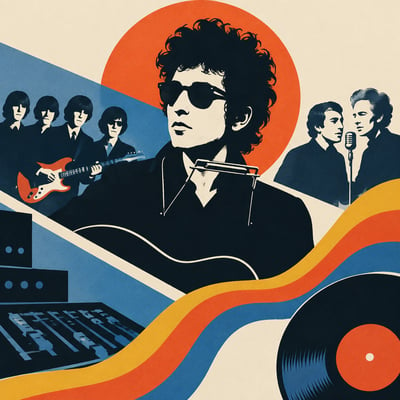
Bob Dylan Song Reinterpretations topic image

Bob Dylan’s songs became a foundation for reinterpretation as musicians recast them through electric instruments, new rhythms, harmonies, studio production, and distinctive performance styles.

The Byrds’ 1965 version of “Mr. Tambourine Man,” shaped by Roger McGuinn’s 12-string sound, helped define folk-rock and influenced Dylan’s own move toward electric music. Related examples include The Byrds’ readings of “My Back Pages” and “All I Really Want to Do,” as well as Manfred Mann’s hit version of “The Mighty Quinn.” Together, these stories show how Dylan’s songwriting circulated between artists, genres, recording practices, and changing cultural audiences.

Key Articles4 of 28 articles

If you read one thing

It provides the clearest broad introduction to how The Byrds transformed Dylan’s song into a chart-topping folk-rock crossover.

AOL.com / Isabella Torregiani

Best explainer

It directly explains how changes in arrangement and performance can reshape a song’s perceived meaning across decades of Dylan recordings.

Untold Dylan / Tony Attwood

The evidence

It adds a distinct example of Dylan’s songwriting gaining a broader afterlife through film exposure and contrasting cover versions.

Untold Dylan / Jochen Markhorst

The evidence

McGuinn’s interview connects the Byrds’ Dylan adaptations with the continuing performance and interpretive relationship between the two artists.

Music Connection / Harvey Kubernik
Key Issues

The Byrds’ cover as the canonical folk-rock crossover

The Byrds’ 1965 electrified adaptation of “Mr. Tambourine Man” remains the central reference point for how Dylan’s songwriting entered mass-market folk rock. Its altered arrangement, twelve-string sound, and chart success are repeatedly treated as both a commercial breakthrough and a template for genre change.

Drawn from 5 articles

Cover versions extend Dylan songs beyond their originals

The subject is defined by a recurring afterlife mechanism: other performers turn Dylan compositions into commercially visible or culturally renewed works. “The Mighty Quinn,” “The Man in Me,” and “Mr. Tambourine Man” show that reach is repeatedly produced through reinterpretation, film exposure, and contrasting arrangements rather than through Dylan’s original recordings alone.

Drawn from 4 articles

Arrangement and performance continually reframe meaning

Accounts spanning studio recordings and live performances treat instrumentation, meter, delivery, venue, and production as forces that can substantially alter how Dylan songs are heard without changing their lyrics. The comparison of versions from the 1960s through 2010 keeps interpretive transformation, rather than textual change, at the center of analysis.

Drawn from 4 articles

Roger McGuinn is the main bridge across the Dylan–Byrds afterlife

Retrospective coverage repeatedly uses Roger McGuinn to connect the Byrds’ Dylan adaptations with later Dylan-linked touring, collaborations, and creative history. This makes McGuinn less a secondary biographical figure than the principal connective agent in the topic’s account of reciprocal influence.

Drawn from 5 articles

Looking Back
1452 Day Timeline
2024Jan 1Mar 4May 27Jul 29Oct 21Dec 232025Jan 1Mar 5May 28Jul 30Oct 22Dec 242026Jan 1Mar 5May 28Jul 30Oct 22Dec 24
The Story So Far
No material change

No new member articles were supplied, so there is no evidence of a material real-world change in the topic since the prior state.

Previously

Bob Dylan's Mr. Tambourine Man anchors a heavily retrospective body of work about The Byrds' 1965 electric adaptation, its chart success, and its reported influence on Dylan's turn toward electric instrumentation. Related material traces changing live arrangements, McGuinn's later collaborations with Dylan, and the wider circulation of Dylan songs through covers, film, and other performers.

All Articles28 articles
Important11 articles · CI Score 60 and above
Far Out Magazine / Reuben Cross
Bob Dylan and The Byrds influenced each other's music during the 1960s, while a planned Self Portrait session failed after Columbia Records communication problems.
9/1/2026 • Collaborations & Other Artists • General
MusicRadar
The Byrds released a four-four, electrified version of Bob Dylan's Mr. Tambourine Man in 1965, topping charts in the United States and United Kingdom.
8/17/2026 • Collaborations & Other Artists • General
Something Else! / Beverly Paterson
Gene Clark described the Byrds' 1960s folk-rock songwriting process, including Dylan-based Mr. Tambourine Man, and explained the creation of Eight Miles High.
5/25/2026 • Collaborations & Other Artists • General
Flagging Down The Double E's / Ray Padgett
In an in-depth online interview, Roger McGuinn recounts Bob Dylan collaborations from the 1960s through Rolling Thunder Revue and later tours.
10/30/2025 • Collaborations & Other Artists • General
Flagging Down The Double E's / Ray Padgett
Three July shows requested by subscribers centered on Mr. Tambourine Man, with Version 1 in Blackbushe, England on July 15, 1978.
7/24/2025 • Live Performance • General
Untold Dylan / Jochen Markhorst
Bob Dylan's The Man in Me, recorded for New Morning in 1970, reached wider audiences after T Bone Burnett placed the song in The Big Lebowski in 1998.
8/30/2026 • Songs & Songwriting • General
Far Out Magazine / Tom Taylor
Bob Dylan's Mr. Tambourine Man helped define youthful cultural freedom in 1965, including through Paul McCartney's experience at London's Royal Albert Hall.
8/11/2026 • Songs & Songwriting • General
Music Connection / Harvey Kubernik
Roger McGuinn discusses Bob Dylan's songwriting influence on the Byrds during a 2026 interview connected with McGuinn's return to live performances.
8/21/2026 • Collaborations & Other Artists • General
AOL.com / Isabella Torregiani
The Byrds released a folk-rock version of Bob Dylan's Mr. Tambourine Man in 1965 in the United States, reaching No. 1 and broadening the song's influence.
8/6/2026 • Collaborations & Other Artists • General
Parade / Andrea Reiher
The Byrds' Mr. Tambourine Man single in April 1965 topped U.S. and U.K. charts, accelerating folk rock and coinciding with Dylan's 1965 electric shift.
6/21/2026 • Collaborations & Other Artists • General
Guitar Player / Andrew Daly
In a Guitar Player interview, Roger McGuinn discusses experiences with Bob Dylan, the Beatles, and Tom Petty across the United States and Europe.
10/10/2025 • Collaborations & Other Artists • General
Interesting17 articles · CI Score 45–59
AOL.com / Jacqueline Burt Cote
In 1968, Manfred Mann turned Bob Dylan's 1967 Basement Tapes song The Mighty Quinn into a chart-topping single in the United Kingdom and a U.S. Top 10 hit.
9/3/2026 • Songs & Songwriting • General
Parade / Jacqueline Burt Cote
Bob Dylan recorded The Mighty Quinn in 1967, and Manfred Mann released a chart-topping cover in 1968 in Britain and the United States.
9/3/2026 • Songs & Songwriting • General
Far Out Magazine / Tom Taylor
David Crosby praised Bob Dylan's Mr. Tambourine Man after The Byrds performed an electric version for Dylan in January 1965.
8/22/2026 • Songs & Songwriting • General
Untold Dylan / Tony Attwood
The article analyzes Bob Dylan's Mr. Tambourine Man and Chimes of Freedom through recordings from the 1964 Newport Folk Festival to a 2010 performance.
4/21/2025 • Songs & Songwriting • General
Chris Gregory / Chris Gregory
Dylan's Mr Tambourine Man is traced from its first public performance on May 17, 1964 to its final performance on June 28, 2010 in live settings.
7/22/2024 • Songs & Songwriting • General
American Songwriter / Clayton Edwards
Bob Dylan recorded Mr. Tambourine Man at Columbia Records studios in New York in June 1964; The Byrds later adapted the original recording into a 1965 US and UK No. 1.
6/9/2026 • Songs & Songwriting • General
Santa Barbara Independent / Josef Woodard
Roger McGuinn will perform Dylan-related songs and discuss the Rolling Thunder Revue at Santa Barbara's Lobero Theatre on September 12.
9/3/2026 • Collaborations & Other Artists • General
Grunge
Bob Dylan and the Byrds in Los Angeles released Mr. Tambourine Man into mainstream success, with the Byrds reaching US No. 1 in June 1965.
7/14/2026 • Collaborations & Other Artists • General
Parade / Jacqueline Burt Cote
Roger McGuinn, born July 13, 1942, helped popularize the Byrds' electric Mr. Tambourine Man and later collaborated with Bob Dylan on Pat Garrett and the Rolling Thunder Revue.
7/13/2026 • Collaborations & Other Artists • General
Guitar Player / Andrew Daly
Roger McGuinn describes Bob Dylan approving the Byrds cover of Mr. Tambourine Man after a World Pacific Studios recognition.
5/31/2026 • Collaborations & Other Artists • General
Far Out Magazine / Dale Maplethorpe
Roger McGuinn's arrangement work on The Byrds' cover of Bob Dylan's Mr Tambourine Man is linked to Dylan's turn to electric performance and later reunion discussions.
5/4/2026 • Collaborations & Other Artists • General
Far Out Magazine / Tom Taylor
Bruce Langhorne and Bob Dylan collaborated on early 1960s recordings in Greenwich Village, including Mr. Tambourine Man
3/14/2026 • Collaborations & Other Artists • General
American Songwriter
Roger McGuinn helped the Byrds reach Hot 100 No. 1 on June 26, 1965 with Mr. Tambourine Man, a Dylan song that supported a later Dylan shift toward electric guitar.
6/26/2026 • Collaborations & Other Artists • General
Upworthy
Paul McCartney discussed Bob Dylan's Mr. Tambourine Man during a BBC Tracks Of My Years appearance, recalling the 1965 song and wishing Dylan performed it live.
8/20/2026 • Songs & Songwriting • General
Far Out Magazine / Andrew Clayman
David Crosby recalled that The Byrds recorded Dylan’s unreleased Mr Tambourine Man in 1965, a number-one debut that helped define the folk-rock direction before Dylan’s own full shift.
6/14/2026 • Mentions & References • General
Far Out Magazine / Tom Taylor
Far Out evaluates Bob Dylan's 1965 Mr Tambourine Man as a 1960s cultural statement, citing Hunter S. Thompson, Paul McCartney, and David Crosby.
5/20/2026 • Songs & Songwriting • General
Guitar Player
In 1965, producer Tom Wilson secretly overdubbed The Sounds of Silence with session musicians including Dylan drummer Bobby Gregg, leading to a 1966 Billboard No. 1.
7/25/2026 • Collaborations & Other Artists • General