Dylan and the BeatlesDylan and the BeatlesCoverage from Literary Hub, bob-dylan.org.uk, and others
00/00/0000
DailyWeekly
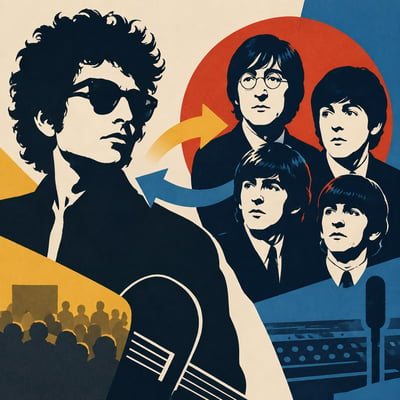
Bob Dylan and the Beatles shaped one another’s ideas about songwriting, experimentation, and what popular music could express.
Their relationship is traced through encounters in the 1960s, Dylan’s influence on songs such as John Lennon’s “You’ve Got to Hide Your Love Away,” Paul McCartney’s response to Dylan’s electric and brisker methods, and the borrowing dispute surrounding “Norwegian Wood” and “Fourth Time Around.” Retrospective books and criticism continue to examine how respect, competition, and contrasting recording practices connected two defining musical forces.
This broad review offers the clearest introduction to the reciprocal influence, song comparisons, and contrasting creative methods at the center of the Topic.
Its concrete account of meetings, listening sessions, performances, and later collaborations grounds the broader influence narrative in a sustained contact history.
Literary Hub / Jim Windolf
Key Issues
01
Reciprocal artistic influence
The dominant interpretation treats Dylan and the Beatles as mutual creative catalysts rather than a one-way influence story. Their relationship is framed through admiration, rivalry, borrowing, and contrasting approaches to songwriting, recording, and live performance.
Drawn from 5 articles
02
Borrowing and authorship remain contested
The recurring song-level focus is the disputed relationship between “Norwegian Wood” and “4th Time Around.” Coverage presents the songs as evidence of reciprocal influence, but also as a continuing question about imitation, response, credit, and artistic boundaries.
Drawn from 5 articles
03
Windolf’s book anchors current reception
A concentrated 2026 review and interview wave has made Jim Windolf’s Where the Music Had to Go the principal contemporary frame for discussing Dylan–Beatles influence. The book is repeatedly used to organize older encounters, songs, and recording decisions into a reciprocal relationship narrative.
Drawn from 5 articles
04
Repeated personal contact supplies the historical anchor
The relationship is sustained in coverage by a chain of encounters and exchanges: the 1964 meeting and listening sessions, later concerts and Get Back rehearsals, the 1966 Lennon–Dylan limousine encounter, and subsequent McCartney and Harrison connections. These episodes make the influence story concrete rather than purely retrospective.
Drawn from 4 articles
Contested Issue
1 open dispute
Do “Norwegian Wood” and “Fourth Time Around” primarily document Lennon’s borrowing from Dylan, or a more reciprocal and difficult-to-assign exchange of influence?
The supplied material agrees that the songs were connected in contemporary discussions, but differs in interpretation: some accounts present Dylan’s confrontation as an accusation that Lennon borrowed without credit, while others characterize the relationship as reciprocal adaptation and caution against simple one-way attribution.
Dylan-to-Lennon borrowing
3 articles · across 3 publications
The song pairing is best understood as Lennon drawing substantially on Dylan’s style in “Norwegian Wood,” prompting Dylan’s response in “Fourth Time Around” and a dispute over authorship or credit.
Reciprocal or indeterminate influence
3 articles · across 2 publications
The relationship between the songs should not be reduced to a one-way act of copying; the evidence is better read as reciprocal artistic exchange or as an influence relationship whose direction and degree cannot be assigned simply.
Looking Back
5523 Day Timeline
Articles published over time. Hover any bar for the period and its article count.
Jul '11
Jan '14
Jul '16
Jan '19
Jul '21
Jan '24
Jul '26
The Story So Far
No material change
No new-member articles were supplied, so there is no evidence of a material change in the topic.
Previously
Recent books and reviews revisit how Bob Dylan and the Beatles influenced one another, emphasizing 1960s songwriting exchanges, personal encounters, Dylan's electric transition, and the continuing interpretation of their shared legacy.
Paul McCartney’s 1964 praise for Bob Dylan and later Beatles and Dylan concert interactions are described, spanning New York, London, and the Get Back sessions.
4/20/2026 • Collaborations & Other Artists • General
Jan Barten from Breda presents a three-four 4th Time Around cover that is compared with Blonde on Blonde Nashville session takes and Daniel Lanois multirhythm debates.
Jim Windolf discusses Dylan-Beatles mutual influence, electric-era shifts, and Dylan political ambiguity in an interview tied to Paul McCartney comments about Desert Trip 2016.
5/27/2026 • Collaborations & Other Artists • General
Paul McCartney recounts Dylan studio influence, including New Morning’s quick completion, informing McCartney’s spontaneous Wild Life sessions around New York and Scotland.
5/27/2026 • Collaborations & Other Artists • General
Jim Windolf examines how Bob Dylan and the Beatles influenced each other’s music during the 1960s, including Dylan’s 1965 electric performance at Newport, Rhode Island.
7/29/2026 • Collaborations & Other Artists • General
Bob Dylan influenced John Lennon’s songwriting after their 1964 meeting, with Norwegian Wood and 4th Time Around reflecting shared ambiguity and reciprocal creativity.
8/21/2026 • Collaborations & Other Artists • General
Paul McCartney, speaking on The Rest is Entertainment in 2024 or 2025, said recent Bob Dylan concerts were hard to follow because songs were not identifiable to him.
Jim Windolf’s Where the Music Had to Go is reviewed as evidence that Bob Dylan and the Beatles used rivalry to generate reciprocal musical change amid publishing and songwriting disputes.
6/25/2026 • Collaborations & Other Artists • General
Jim Windolf's review highlights how Bob Dylan and the Beatles influenced each other through competition, media moments, and recording crossovers during the 1960s.
6/19/2026 • Collaborations & Other Artists • General
Glen Hansard said in Ballymun, Ireland, that discovering Bob Dylan's Greatest Hits redirected his troubled adolescence toward guitar playing and songwriting.
7/29/2026 • Collaborations & Other Artists • General
An analysis centers on Fourth Time Around and D. A. Pennebaker’s taxi-ride footage to frame Dylan and John Lennon’s rivalry as admiration with provocation.
John Lennon in 1979 recorded a critical dictaphone response to Bob Dylan's Gotta Serve Somebody, later linked to the Serve Yourself parody on the 1998 John Lennon Anthology.
Jim Windolf analyzes reciprocal influence between Bob Dylan and the Beatles in a book tied to disputed 1966 meeting details and studio-era songwriting dynamics.
6/1/2026 • Collaborations & Other Artists • General
Bob Dylan and John Lennon met at the May Fair Hotel in London on May 26, 1966, while Pennebaker filmed a limo ride tied to Norwegian Wood and Fourth Time Around influence claims.
4/4/2026 • Collaborations & Other Artists • General
In the mid-1960s, Bob Dylan's 'Like a Rolling Stone' influenced John Lennon and The Beatles, prompting Lennon to compose 'I Am The Walrus' as a competitive response.
11/7/2025 • Collaborations & Other Artists • General
Uncut gathers first-person musician accounts from the 1960s to the 2010s describing Bob Dylan meetings, sessions, and major tour eras including Rolling Thunder Revue.
6/5/2026 • Collaborations & Other Artists • General
Paul McCartney discussed a backstage meeting with Bob Dylan at Desert Trip at Coachella in a 2026 BBC Radio 2 interview, connecting Dylan and Beatles-era influence.
7/20/2026 • Collaborations & Other Artists • General
John Lennon’s attention to Bob Dylan reportedly declined after Dylan’s mid-1960s evolution, culminating in Lennon’s 1980 anti-sermon response to Slow Train Coming.
7/9/2026 • Collaborations & Other Artists • General
Bob Dylan influenced John Lennon's increasingly ambiguous songwriting between 1964 and 1966, while Norwegian Wood and 4th Time Around reflected reciprocal exchange in London and recorded music.
8/21/2026 • Collaborations & Other Artists • General
Christopher Bray reviews Jim Windolf's Where the Music Had to Go, describing how Dylan and the Beatles influenced each other while debating depth in musical analysis.
5/6/2026 • Collaborations & Other Artists • General
Rob Weinert-Kendt reviews Jim Windolf's Where the Music Had to Go, arguing that Dylan and the Beatles reshaped each other in 1960s songwriting and cultural direction.
5/22/2026 • Collaborations & Other Artists • General
Jim Windolf’s Dylan and Beatles history is used to interpret Paul McCartney’s ongoing touring as late style, linking Dylan’s 1965 electric shift to changing rock legacy.
5/11/2026 • Collaborations & Other Artists • General
Dylan Books reviews forthcoming and recent Dylan scholarship from authors including Jim Windolf, Gary Browning, Sean Wilentz, and Richard F. Thomas, focusing on books published primarily in the United States.
Throughout his life, John Lennon praised Bob Dylan's songwriting in private circles, citing Subterranean Homesick Blues for its concise, enigmatic lyricism.
Bob Dylan recorded Roll On John for the 2012 album Tempest and performed it live in November 2013 at Blackpool's Opera House Theatre and London's Royal Albert Hall.
The article describes how Bob Dylan, The Beatles, and The Beach Boys collectively reshaped 1960s American and British popular music through mutual influence and innovation.
Eddie Vedder and Mike McCready performed Masters of War at Bob Dylan's 1992 30th Anniversary Concert Celebration, and later described Dylan's Dublin advice.
7/13/2026 • Collaborations & Other Artists • General
John Lydon told Far Out in 2023 that he admired Bob Dylan's electric turn at Newport and praised 'Hurricane' while critiquing Dylan's earlier acoustic work.
3/3/2026 • Collaborations & Other Artists • General
Bob Dylan's influence on Wings' 1971 album Wild Life is analyzed in Far Out Magazine, describing how Dylan's rapid recording ethos influenced Paul McCartney, who discussed the approach in 2018 and 2021.
5/16/2022 • Collaborations & Other Artists • General
Jim Windolf book review in The New York Times weighs evidence for mutual influence between Bob Dylan and the Beatles across songs, drugs, and career turning points.
Robert Polito's After the Flood and Jim Windolf's Where the Music Had to Go are reviewed for interpreting Dylan's late-career renewal and Beatles reciprocal influence.
A review highlights two Beatles books linking Bob Dylan and the Beatles, including an August 28, 1964 Delmonico Hotel meeting and Get Back-session Dylan song play.
7/21/2026 • Collaborations & Other Artists • General
Jim Windolf’s book portrays Dylan and the Beatles meeting at New York’s Delmonico Hotel as a reciprocal influence that shaped subsequent popular songwriting.
6/12/2026 • Collaborations & Other Artists • General
Researchers have documented recurring Bob Dylan lyric references in scientific papers since 1997, with studies in Sweden and elsewhere finding Beatles references more prevalent.
Paul McCartney, citing Dylan's She Belongs to Me, connects Beatles 1964 Paris memories with analysis of an alternate bootleg take from No Direction Home.
Bob Dylan influenced the Beatles' more introspective songwriting during the recording and release of Help! in the United Kingdom and United States in 1965.
Jon Media published an article on Medium comparing The Beatles' Revolver and Bob Dylan's The Philosophy of Modern Song, with commentary on songwriting and public reactions, at an unspecified date.
Paul McCartney, speaking on The Rest Is Entertainment, described attending Bob Dylan shows as difficult to identify song-by-song and explained his own refusal of fan selfies.

 AI Governance
 Data Centers
 Drones
 Climate
 Privacy
 2026 Maine Senate
 Bob Dylan
 On Tap