
 AI Governance
 Data Centers
 Drones
 Climate
 Privacy
 Bob Dylan

Drones Quick Briefing
2026-11-10
Drone Adoption Advances, but Sustained Operational Capacity Remains Uneven
of Play
Military drone effectiveness still turns on production, adaptation and defenses matched to evolving threats, while commercial expansion faces separate operational and local constraints. New evidence points to recent foreign components in a Russian jet drone and an easier NATO purchasing route, but neither establishes a change in battlefield balance or deployed defensive capacity. Delivery, performance and sustained service remain the decisive tests.
What's New?
Military advantage depends on production and adaptation
Ukraine’s use of inexpensive drones illustrates how mass production and rapid feedback can create battlefield advantages. Those advantages depend on sustained replenishment and adaptation, not purchase targets alone.

Counter-drone performance remains threat-specific
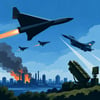
Faster Russian jet drones challenge defenses developed against slower aircraft. August reporting found Ukrainian low-cost interceptors effective against piston Shaheds but too slow for jet variants; current performance against either threat is not established.

Commercial delivery expansion remains uneven
Zipline’s U.S. expansion and local opposition to Amazon illustrate different pressures on delivery growth. Authorization and expansion plans alone do not establish a sustained, scalable network; viable sites and community acceptance also matter.


What's Changed?
Teardown adds evidence of recent foreign components in a Russian jet drone
Ukraine’s military intelligence reported 93 foreign-made electronic components in a Geran-5 K5-K, including 52 from U.S. manufacturers. Date codes on three oscillators indicate manufacture in 2025–26, strengthening evidence that at least some parts were not pre-sanctions stock. The report does not establish procurement routes or supply volumes.
NATO opens a counter-drone buying channel
NATO’s new marketplace offers 16 already-fielded systems without separate tenders. This adds a procurement mechanism to the previously observed movement beyond demonstrations, but it does not itself fund purchases, and no task order had been announced.
What Matters?
The jet-drone challenge combines speed and navigation resilience
The reported K5-K uses image matching for route checks without satellite navigation, adding a resilience dimension to the existing speed challenge. This reinforces the need for threat-specific defenses, but the teardown does not establish how well the navigation performs in combat or whether current interceptors can defeat the variant.
Easier purchasing is not the same as deployed defense
NATO’s catalog lowers a procedural barrier and favors fielded systems, but its effect depends on funded orders, delivery and integration. It strengthens the prior assessment that institutional adoption is advancing without yet demonstrating a corresponding increase in operational capacity.
What's Next?
Test whether faster interceptors close the jet-drone gap
The existing defense watchpoint remains unresolved. Evidence of repeated interceptions against jet variants, including costs and operational conditions, would show whether the earlier speed disadvantage has narrowed.
Track orders and deliveries through NATO’s marketplace
Watch whether Allies place funded task orders and field the resulting systems. Sustained orders and delivery would demonstrate that the new framework is expanding capacity rather than merely adding a purchasing option.
Look for sustained commercial delivery at scale
The prior delivery-scaling question remains open. Watch whether expansion produces sustained operations across viable sites and whether local opposition or authorization constraints limit that reach.