
 AI Governance
 Data Centers
 Drones
 Climate
 Privacy
 2026 Maine Senate
 Bob Dylan
Wisconsin Data Centers Reshape Power Planning
Coverage from Wisconsin Watch, Wisconsin Public Radio, and others
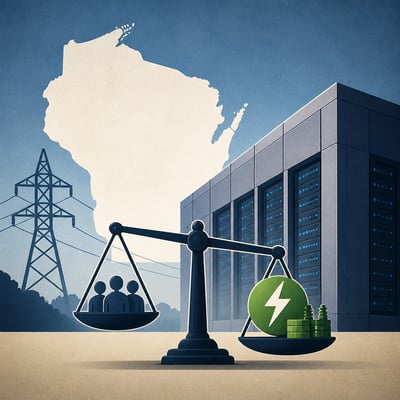
Wisconsin is planning for a sharp increase in electricity demand tied largely to hyperscale data centers in Mount Pleasant, Port Washington, and Beaver Dam.
A state forecast projects peak demand could rise from 14.2 gigawatts in 2026 to about 20 gigawatts by 2032, prompting utilities to consider new gas generation, renewable projects, storage, transmission, and separate rates for very large customers. The buildout is also driving disputes over who should pay for new supply, how much financial protection utilities need, and whether tax incentives, water use, emissions, and local impacts justify the projects.
The story broadens beyond electricity planning and rate disputes to include political opposition, tax incentives, water use, farmland, and environmental safeguards. Invenergy also emerges as a specifically identified gas-plant proposer, while Meta appears among the stakeholders.
The main shift is a sharper policy and cost-allocation dispute: the current version adds stronger emphasis on who pays for infrastructure, along with concerns about new gas plants and delayed coal retirements. It also reframes the story as a broader debate over community and affordability impacts, not just demand growth and rate design.
The story now centers more explicitly on how Wisconsin is trying to make data centers pay for the grid costs they create, with regulators locking in collateral rules and utilities seeking flexibility. The latest version also adds Invenergy’s proposed gas plants and the resulting legal and public backlash, sharpening the policy conflict.
- PSC approved Very Large Customer rate and collateral requirements.
- Oracle is challenging Wisconsin’s collateral requirement.
- We Energies seeks more flexible security rules for Port Washington.
- Invenergy proposed gas plants for Oracle and Microsoft facilities.
- Polling and political responses show growing public opposition.
The story now emphasizes a more concrete and broader regulatory response: Wisconsin is not just forecasting data-center load growth, but actively using special rates, collateral rules, and generation planning to manage it. The updated version also adds new project locations and partners, signaling the issue is widening across the state.
- OpenAI is now associated with the Port Washington project.
- Beaver Dam joins Mount Pleasant and Port Washington as a major load center.
- Paris and Darien are now linked to proposed gas-fired plants.
- Utilities are using special rates to isolate data-center infrastructure costs.
- Planned new or upgraded gas capacity could reach 5.4 GW.
The story has sharpened from a broad conflict over Wisconsin data centers into a more specific fight over tariff design, cost allocation, and how much new grid and gas infrastructure should be built for projected hyperscale demand. The new framing also elevates the financial-risk question, especially whether developers or existing customers will absorb the costs if projects are delayed or canceled.
- Large-load tariff shifts full infrastructure costs to qualifying new data centers.
- Peak electricity demand forecast rises from 14.2 GW to 20 GW by 2032.
- Transmission and contract terms aim to protect non-data-center customers from stranded costs.
- Utility plans now include storage and substations alongside gas and renewables.
- Local debate now includes electricity prices, tax incentives, and community benefits.
The story now more clearly centers on formal utility and regulatory treatment for data center power demand, with explicit requirements for dedicated plants, transmission costs, and financial security. It also broadens the community response from general concerns to active local zoning, moratorium, and benefit-policy debates.
The story has broadened from a dispute over special data-center rate protections into a much larger buildout story centered on huge new electricity demand, new power-supply projects, and community impacts. Wisconsin is now grappling not just with ratepayer risk, but with whether the infrastructure needed for these campuses will be built, how it will be powered, and what local environmental and land-use costs will follow.
- We Energies projects about 3.9 gigawatts of added demand over five years.
- Oracle’s Port Washington guarantees could exceed $7 billion.
- Invenergy is proposing 324-megawatt and 1.1-gigawatt gas plants.
- We Energies is delaying some coal retirements.
- Communities are debating moratoriums and zoning changes.
Wisconsin’s data center rate fight has advanced from a broad debate over stricter utility rules into concrete PSC approval and active legal challenges. The newest wrinkle is that Oracle, We Energies, and others are now contesting how far collateral and credit requirements should go for major projects.
- PSC approved special data center rate structures.
- Approved rules require some customers to post collateral.
- Oracle filed a lawsuit challenging the credit-guarantee rules.
- Confidentiality and load disclosure issues are now being challenged.
The story has become more concrete and legally contested: Wisconsin’s data center rules now center on active lawsuits and rehearing fights over collateral, credit, and who must pay for major new infrastructure. The latest version also adds clearer evidence that these disputes are tied to specific grid buildouts and multi-gigawatt demand forecasts.
- Active lawsuits and rehearing requests now frame the dispute.
- Credit ratings determine collateral exposure for lower-rated developers.
- Open records fights target redactions in project filings and load forecasts.
- Multi-gigawatt demand forecasts are tied to new transmission and generation work.
- Cloverleaf Infrastructure is now part of the story.
The story has sharpened around specific regulatory fights over collateral, stranded-cost protection, and transparency, with Oracle-linked Port Washington now a central flashpoint alongside Meta-linked Beaver Dam. The emphasis has shifted from general tariff reform to concrete disputes over who bears infrastructure risk for dedicated hyperscale power builds.
The story has broadened from a Meta-focused Beaver Dam approval into a wider Wisconsin regulatory regime for hyperscale data centers. New tariff, collateral, and cost-allocation fights now extend to Port Washington and multiple utilities, making ratepayer protection and infrastructure financing the central issue.
- Oracle and Vantage are now central to the Port Washington Lighthouse project dispute.
- PSC actions now include tariff orders, rate cases, and collateral requirements.
- Transmission cost-shifting concerns have become a separate major issue.
- Disclosure demands now include load forecasts and infrastructure plans.
- Some utility planning still relies on new gas generation.
The story now emphasizes a broader regulatory transition: Wisconsin is not just adjudicating Meta's Beaver Dam deal, but actively steering large data centers toward standardized tariffs and clearer cost rules. The transparency dispute also appears more acute, with multiple redacted proposals surfacing in filings.
- PSC is moving Alliant toward a standard tariff for data centers above 100 megawatts.
- Beaver Dam approval now includes protections for existing customers.
- ATC is building new transmission facilities tied to the project.
- Filings revealed multiple redacted data center proposals.
- Separate tariff actions are now involving We Energies.
The story has moved from a general framework for hyperscale data centers to a more concrete Beaver Dam precedent: regulators have now approved a modified Meta/Alliant deal while simultaneously advancing standardized tariffs for future large loads. The remaining fight is shifting toward transmission-cost recovery and disclosure disputes around these projects.
- PSC approved a modified Alliant Energy contract for Meta's Beaver Dam campus.
- New tariffs are being targeted specifically at future loads above 100 megawatts.
- Transmission upgrades for Beaver Dam are already in motion.
- Advocates are suing for unredacted filings.
- Beaver Dam is emerging as a template for future regulation.
The story has broadened from Meta-specific power approvals into a more explicit statewide framework for hyperscale data centers, with regulators emphasizing standardized tariffs, cost allocation, and transparency rules. The biggest new wrinkle is that utility planning and public-access disputes are now as central as the Beaver Dam approval itself.
The story has broadened from a single PSC decision on Meta's Beaver Dam campus into a more explicit statewide framework for hyperscale data-center power pricing and grid cost allocation. The newest angle is that Wisconsin utilities are now being pushed toward standardized tariffs and cost protections amid larger projected demand growth and ongoing transparency fights.
- We Energies is now being pushed toward standardized tariffs for very large data center customers.
- Expected multi-gigawatt demand growth is linked to Microsoft, Meta, and Vantage Data Centers.
- Transparency disputes now include litigation over access to load and contract details.
- The issue is now framed as statewide policy and planning, not isolated project approvals.
Wisconsin regulators are setting new rules for how utilities serve very large data centers, with a focus on making those customers pay full electricity and infrastructure costs. The PSC approved Alliant Energy’s modified deal with Meta for the Beaver Dam campus, but also ordered Alliant to develop a standardized tariff for future projects above 100 megawatts. The decisions reflect concerns about secrecy, cost shifting, and the broader strain that multiple hyperscale projects could place on the state’s grid and ratepayers.