
 AI Governance
 Data Centers
 Drones
 Climate
 Privacy
 2026 Maine Senate
 Bob Dylan
Who Pays for Data Center Power?
Coverage from Wispolitics, Wisconsin Public Radio, and others
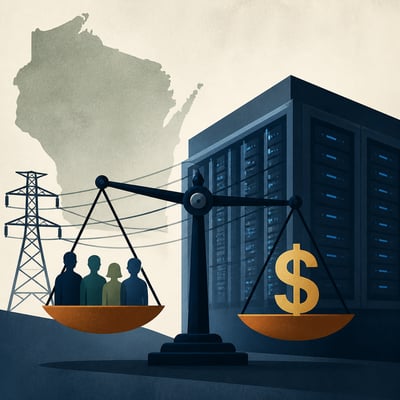
Wisconsin regulators, utilities, Microsoft, and customer advocates are contesting how data center projects should be charged for transmission, generation, storage, and interconnection investments.
The disputes center on preventing costs from shifting to existing customers while ensuring utilities can recover billions of dollars in upgrades and large-load customers face transparent, non-duplicative charges. Wisconsin is developing tariffs and billing safeguards, while related Illinois proceedings highlight broader scrutiny of large-load service agreements.
If you read one thing
It directly introduces the central Mount Pleasant dispute over whether data-center grid costs will fall on Microsoft or existing customers.
Best explainer
It explains how large-load service agreements and FERC-MISO requirements create unresolved cost-allocation and utility-safeguard issues.
The evidence
It adds quantified policy and market evidence on dedicated infrastructure charges, generation costs, and the risks of serving hyperscale loads.
Who bears data-center grid costs remains unresolved
Wisconsin's tariff framework is intended to make very large customers pay dedicated infrastructure costs, and We Energies has proposed assigning them more than 80% of certain generation and storage costs. However, the Mount Pleasant agreement and related large-load arrangements have not settled whether all data-center-related transmission and interconnection costs will be recovered from the projects or partly shifted to existing customers.
Regulatory safeguards and standardized agreements are under pressure
Regulators are still shaping the terms for serving hyperscale loads, including FERC and MISO compliance, enforceable cost allocation, transparent forecasts, and sequencing transmission approvals with confirmed generation. The unresolved requirements indicate that Wisconsin's large-load framework is not yet fully standardized or settled.
roughly 12 percent
share of Wisconsin electricity imported
“Wisconsin already imports roughly 12 percent of its electricity and buys it on a regional market where capacity recently cost $424.30 per megawatt-day, up from $5 in 2021.”
1,400 megawatts
approved generation capacity
“Transparency and enforceability, he argues, need not slow development. Indiana approved a $3.3 billion gas plant conversion in eight and a half months, Louisiana approved 2,262 megawatts in about ten months, and Georgia approved 1,400 megawatts in five and a half months, all within Wisconsin's statutory clock. Very Large Customers care most about speed to power.”
$3.3 billion USD
cost of gas plant conversion
“Transparency and enforceability, he argues, need not slow development. Indiana approved a $3.3 billion gas plant conversion in eight and a half months, Louisiana approved 2,262 megawatts in about ten months, and Georgia approved 1,400 megawatts in five and a half months, all within Wisconsin's statutory clock. Very Large Customers care most about speed to power.”
$424.30 per megawatt-day
regional electricity capacity price
“Wisconsin already imports roughly 12 percent of its electricity and buys it on a regional market where capacity recently cost $424.30 per megawatt-day, up from $5 in 2021.”
more than 80 percent
proposed share of generation and storage project costs assigned to data centers
“Under the Very Large Customer tariff, approved by the Public Service Commission in April, data centers are required to pay the full cost of the power infrastructure built to serve them. Transparency will confirm whether that holds. In a pending request, We Energies has proposed that data centers cover more than 80 percent of the cost of generation and storage projects entering rates in 2027 and 2028.”
There was no material change to the Topic since the prior state.
Previously
Wisconsin regulators, utilities, Microsoft, and customer advocates are contesting how data center projects should be charged for transmission, generation, storage, and interconnection investments. The disputes center on preventing costs from shifting to existing customers while ensuring utilities can recover billions of dollars in upgrades and large-load customers face transparent, non-duplicative charges. Wisconsin is developing tariffs and billing safeguards, while related Illinois proceedings highlight broader scrutiny of large-load service agreements.