
 AI Governance
 Data Centers
 Drones
 Climate
 Privacy
 2026 Maine Senate
 Bob Dylan
West Virginia's Data Center Tradeoffs
Coverage from POWER Magazine, The Intelligencer, and others
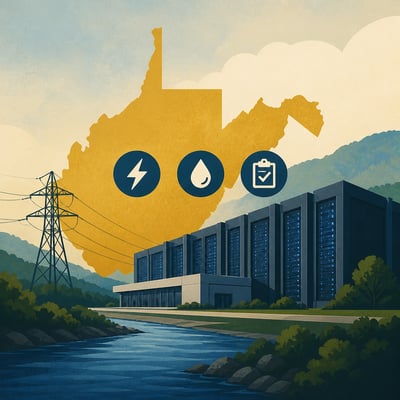
West Virginia is pursuing large hyperscale data centers while shifting major permitting and policy authority toward the state under House Bill 2014 and a proposed 20-year development plan.
Projects led by Monarch Compute, Fundamental Data, and other prospective developers could require hundreds of megawatts to more than 1 gigawatt of power, new generation and utility infrastructure, and substantial land and water resources. The expansion has prompted disputes over local zoning, public disclosure, property impacts, air emissions, land ownership, and how project revenue should be shared between the state, counties, utilities, and residents.
If you read one thing
It provides the clearest broad overview of West Virginia’s centralized approvals, revenue incentives, and community concerns.
Best explainer
It explains how conflicting land-control and permitting standards have left Ridgeline’s scope and status unsettled.
The evidence
It details the proposed framework tying approval to developer-funded power, infrastructure, water safeguards, and community protections.
Latest development
It captures the latest high-signal policy shift linking hyperscale revenue to income-tax reduction and statewide infrastructure investment.
State preemption is driving legal and political conflict
HB 2014 shifts approval of high-impact data centers toward state certification and limits some municipal zoning and noise authority. Residents, local officials, and lawmakers continue challenging that transfer through lawsuits, appeals, and demands to restore local control.
Tax incentives are paired with contested revenue distribution
The state is linking hyperscale development to income-tax reduction and statewide investment, with proposed allocations for the state, host counties, all counties, and infrastructure. The balance between statewide fiscal goals and benefits retained by host communities remains disputed.
Large projects are colliding with power, water, and site impacts
Ridgeline and Monarch have focused opposition on gas-fired generation, air and water effects, land use, flooding, and construction damage. The proposed framework would require developers to secure or fund power and infrastructure and address water and grid-reliability safeguards, but those protections remain contested alongside project impacts.
Ridgeline’s permitting and certification status remains unsettled
Ridgeline has cleared or defended some air-permitting issues, but conflicting agency standards, disputed land control, certification requirements, and unresolved project approvals continue to obscure its scope and legal status. Grid planning and transmission constraints add uncertainty to execution.
50%
Share of revenue from approved hyperscale data center projects allocated to state income-tax reduction
“The plan would dedicate 50% of revenue generated by approved hyperscale data center projects to reducing and ultimately eliminating the state personal income tax. None of the revenue generated through the state’s High Impact Data Center Designation process would enter the general fund.”
10%
Share of project revenue allocated to infrastructure upgrades
“Under the proposed allocation, counties hosting data centers would receive 30% of project revenue for schools and local government. Another 10% would be distributed among all 55 counties, while 10% would fund infrastructure upgrades, including public water systems.”
10%
Share of project revenue distributed among all 55 counties
“Under the proposed allocation, counties hosting data centers would receive 30% of project revenue for schools and local government. Another 10% would be distributed among all 55 counties, while 10% would fund infrastructure upgrades, including public water systems.”
30%
Share of project revenue allocated to counties hosting data centers
“Under the proposed allocation, counties hosting data centers would receive 30% of project revenue for schools and local government. Another 10% would be distributed among all 55 counties, while 10% would fund infrastructure upgrades, including public water systems.”
Grid coordination becomes an explicit condition of West Virginia data-center development
Morrisey’s proposed framework would require data-center developers to coordinate directly with PJM and other interstate grid operators, making regional grid planning an explicit part of the state’s approval and infrastructure approach.
Previously
West Virginia is promoting large data centers through House Bill 2014 and a proposed 20-year oversight framework, while projects in Tucker, Mason, Ohio, Marion, and Berkeley counties face community scrutiny. The law moves oversight of facilities at or above 90 megawatts of IT load toward the state, enables project-specific power arrangements, and limits some local controls, prompting protests, legislative debate, and litigation. The outcome will affect project timelines, local zoning authority, grid and water requirements, tax revenue, and the distribution of construction impacts and benefits.
The story is largely stable: the current version adds limited project-status and technical detail but does not introduce a major new event, policy change, or shift in the underlying conflict.
The story has shifted from a broad oversight proposal toward a more detailed statewide operating and revenue framework, including demand-response rules, water safeguards, and specified allocations. The Ridgeline dispute is also more concrete, with its 750-megawatt gas microgrid and newly identified advocacy and land-ownership challenges.