
 AI Governance
 Data Centers
 Drones
 Climate
 Privacy
 2026 Maine Senate
 Bob Dylan
Virginia Tightens Data Center Oversight
Coverage from Beveridge & Diamond, Virginia Business, and others
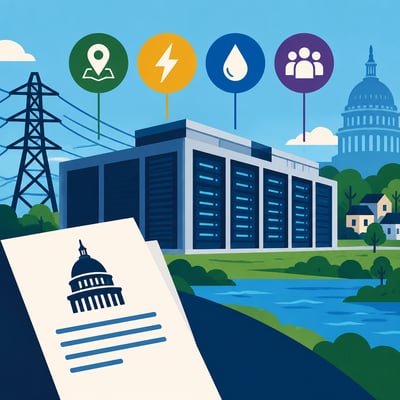
Virginia is pursuing tighter oversight of data center development through Governor Abigail Spanberger’s Executive Order 22 and a proposed accountability framework, while federal lawmakers from the state have introduced related national bills.
The measures would increase local review of large projects, shift more electricity infrastructure costs to large users, and strengthen scrutiny of water use, noise, and generator emissions. Many proposed requirements still depend on agency work or action by the 2027 General Assembly, leaving the scope and timing of changes unsettled.
If you read one thing
This broad overview connects Virginia’s reforms with federal proposals on siting, grid costs, and resource disclosure.
Best explainer
It lays out the proposed Virginia rules, including the 25-megawatt approval threshold, grid-cost responsibility, and environmental standards.
Latest development
It adds material implementation details, including transmission-cost assignment, limits on agency nondisclosure agreements, and water protections.
Federal siting and community-impact review
Proposed federal guidance would make data-center siting account for energy, water, environmental, noise, workforce, security, and community effects while preserving state and local zoning authority. The framework responds to concentrated development concerns, especially in Virginia, but remains unenacted.
Standardized energy and water measurement
Federal proposals would standardize measurement and disclosure of data-center energy, water, emissions, and backup-generation impacts. The intended effect is earlier forecasting of infrastructure needs and more informed approvals, but the standards have not yet been established.
Large-load responsibility for grid costs
The proposed Data Center Fair Share Act would require tariffs assigning generation, transmission, and distribution upgrade costs to data centers and other large-load users rather than residential ratepayers. The proposal frames data centers as infrastructure-scale loads with explicit system costs, but it has not been enacted.
25 megawatts
data center power use threshold for proposed local approval
“Spanberger plans to ask the 2027 General Assembly to require local approval for any data center using more than 25 megawatts and to remove future large data centers from the state’s fast-track permitting process.”
14-year years
contract duration in Dominion Energy’s GS5 rate class
“The rate class includes 14-year contracts and specific allocations for generation, distribution and transmission costs.”
25 megawatts
threshold above which data centers would require conditional-use permits
“Her package would also eliminate by-right local approval for data centers using more than 25 megawatts, requiring conditional-use permits, public hearings and approval by local leaders.”
25 megawatts
power consumption threshold for proposed approval changes
“The governor also proposed ending by-right local approvals for data centers using more than 25 megawatts of power. Many Virginia counties have moved toward conditional-use permits, which require public hearings and approval by local officials.”
8-0
vote approving the zoning text amendment
“On Sept. 22, 2026, Prince William County voted unanimously, 8-0, to approve a zoning text amendment largely eliminating by-right data center development countywide. Projects that do not meet certain criteria will require a special use permit. Developers have a 90-day grace period to file applications before the rules take effect.”
Virginia data-center controls move from proposals to state and county action
Virginia has begun putting data-center oversight into effect: the governor’s executive order immediately bars state-agency nondisclosure agreements and directs environmental reviews, while Prince William County approved zoning changes that largely end by-right development. Broader state rules still require follow-through, and the county measure includes a filing grace period.
Previously
U.S. lawmakers are proposing a four-bill framework to govern data center siting, standardize energy and water measurement, protect nearby communities and infrastructure, and make large users fund associated grid upgrades. The proposals respond to rapid buildout and utility concerns, especially in Virginia, but have not been enacted.
Local review is becoming a source of project-schedule uncertainty: Loudoun and Prince William counties are taking actions amid changing requirements. The broader state and federal proposals remain largely unsettled.
Virginia’s data-center policy has moved beyond proposals toward immediate implementation of transparency, local negotiation, noise, and generator-review measures. The debate also now explicitly covers clean-energy requirements and limits on natural-gas backup generation, while development remains allowed.