
 AI Governance
 Data Centers
 Drones
 Climate
 Privacy
 2026 Maine Senate
 Bob Dylan
Virginia’s Water Limits Data Centers
Coverage from Virginia Mercury, Cardinal News, and others
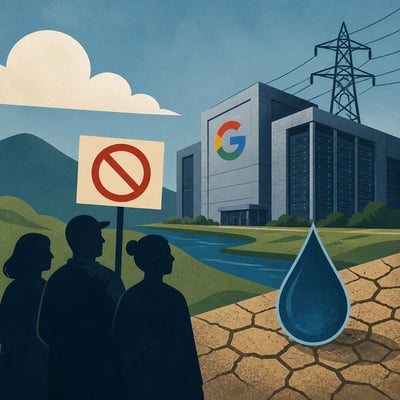
Virginia’s expanding data center pipeline is drawing scrutiny because some facilities require substantial water for cooling while groundwater supplies, particularly in the eastern Coastal Plain, are projected to decline.
Google’s proposed Botetourt County complex illustrates the scale of concern, with reported contracted demand of up to 2 million gallons per day and a possible future increase to 8 million. A delayed Virginia groundwater study recommends stronger authority to reject unsustainable withdrawals and require alternatives such as surface water or reuse, while residents and local officials debate the cumulative effects of new campuses.
The story now adds a statewide scale signal: data centers used about 2.1 billion gallons in 2023 even as overall withdrawals declined. Google’s possible 8-million-gallon demand is also presented more directly as future facility demand rather than primarily as pipe capacity.
The story now adds specific, quantified water-service details for Google’s Botetourt campus and ties the project more directly to a delayed state groundwater study that casts doubt on sustainable large withdrawals in eastern Virginia. It also sharpens the tradeoff between water-saving cooling and higher electricity demand.
The story has shifted from broad scrutiny of Virginia data centers to a more specific regulatory and engineering bottleneck: groundwater constraints and cooling choices are now directly shaping whether projects can proceed as planned. Google’s Botetourt campus has already moved to air cooling for its first building, while state and local reviews are pushing for tighter withdrawal controls and alternative water sourcing.
- Google shifted Botetourt's first building from evaporative to air cooling.
- State recommendations seek stronger rejection power over groundwater withdrawal permits.
- Authorities are pushing evaluation of surface water or reuse instead of groundwater.
- Updated water estimates for later Botetourt buildings remain unresolved.
- Cooling reductions are now tied to greater electricity and infrastructure pressure.
The story now places greater emphasis on how Virginia data center growth will be measured, approved, and held accountable, not just on the scale of expansion itself. It also adds clearer policy and operational details around water reporting and grid-cost concerns.
The story has broadened from a Virginia water-use dispute into a wider debate over the full local cost of data center growth, including electricity demand, grid costs, land conversion, noise, and accountability. The current version also introduces more concrete local actions, especially Botetourt County’s push for a public forum on Google’s campus.
- Botetourt County seeks a public forum on Google’s campus impacts.
- Richmond-area data centers were included in drought conservation requests.
- Virginia data centers numbered more than 600.
- One analysis estimates 1.4% water and 4.6% electricity use.
- Google’s Visakhapatnam project raises similar cooling and land concerns.
The story has narrowed around Google’s Botetourt County proposal and added a clearer regulatory and utility context: officials are treating data centers like other water customers during drought, and Google says it will help fund needed infrastructure upgrades. The framing shifts from general Virginia water scrutiny to a more concrete dispute over local drinking-water supply, utility planning, and project costs.
The story has shifted from a Google-centered Virginia siting dispute to a broader, more regulated statewide water-disclosure fight involving both Google and Amazon. The biggest new development is Virginia's move toward mandatory data-center water reporting, which raises the stakes around actual cooling demand and groundwater impacts.
- Virginia adopted mandatory public reporting of data center water usage.
- Amazon Web Services became a major actor in the Virginia water debate.
- Botetourt County hearings and protests intensified around Google's project.
- New scrutiny emerged over whether annual water-use figures are overstated or understated.
- Groundwater and stream impacts became explicit concerns alongside cooling-water demand.
The story has broadened from Virginia-centered opposition to a more implementation-focused account of Google data center expansion, with new reporting on water stewardship commitments and operational mitigation measures. The main change is that Google is now actively showcasing how it plans to reduce water impacts while local permitting and siting disputes continue.
- Google is promoting water replenishment targets.
- Recycled-water cooling and leak detection are now part of its mitigation strategy.
- Reporting now includes utility and water partners in Nebraska, Iowa, and Georgia.
- Active siting and permitting disputes are now emphasized alongside local opposition.
The story has broadened from a single Virginia data center dispute into a multi-site Google-linked pattern, adding Visakhapatnam, India, and making land-use and displacement concerns more central alongside water and power issues. The core uncertainty remains unchanged, but the controversy now spans more stakeholders and approvals.
- A second Google-linked data center controversy is now included in Visakhapatnam, India.
- Land displacement and farm disruption are newly central concerns.
- Permitting and board actions are actively influencing project timing.
- Google’s community grants have not resolved opposition.
Google’s proposed Botetourt County data center has prompted local scrutiny over water demand, electricity sourcing, and broader infrastructure impacts. Residents have organized public opposition, while the company says it is working through utility agreements and clean-power commitments. The project’s significance now centers on how a large digital infrastructure buildout will fit into local resource constraints and public consent.