
 AI Governance
 Data Centers
 Drones
 Climate
 Privacy
 2026 Maine Senate
 Bob Dylan
Pennsylvania Data Center Rules Tighten
Coverage from PoliticsPA, Adams & Reese, and others
Going On
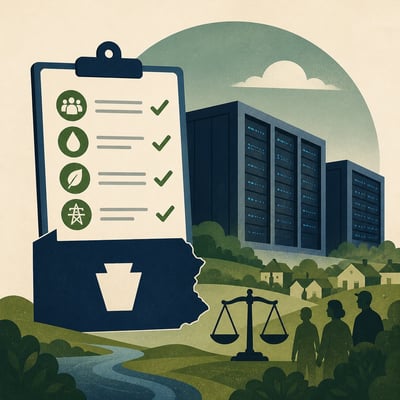
Executive Order 2026-05 generally requires large data centers to secure municipal approvals before Pennsylvania environmental permits advance.
The story now emphasizes Pennsylvania’s response to a large but largely unpermitted data-center pipeline, with utilities and regulators actively revising forecasts, rates, interconnection reviews, and reliability planning.
The story is now framed as moving into implementation and public scrutiny, with compliant projects potentially retaining some state incentives. Most substantive permitting requirements and impacts remain unchanged.
The update mainly confirms the existing permitting framework while adding that projects may follow different review paths depending on filing status and compliance. It also clarifies that, despite more than 100 proposals, only a small number are described as permitted.
The story now includes evidence of implementation: Pennsylvania is publicly tracking more than 100 proposals, yet reports no operational AI data center. The update also clarifies that compliant projects may receive rolling review through consent agreements despite losing fast-track eligibility.
The current version largely confirms the existing account but adds that Pennsylvania’s policy is part of a broader state and federal debate over assigning large-load grid costs and planning responsibility.
The current version mainly confirms Pennsylvania’s binding GRID framework while adding clearer emphasis on public disclosure, the Public Utility Commission’s role, and the absence of operational AI data centers.
Pennsylvania’s policy has been reframed from incentive-linked guidance to a binding, local-first approval regime that removes expedited processing and makes project advancement more contingent on local and environmental compliance. The scale of implementation remains uncertain, with more than 100 proposals but only about five permitted or initially approved, amid intensified election-year opposition.
- Executive Order 2026-05 made GRID conditions binding for new large data centers.
- Local approvals generally must precede Pennsylvania environmental review.
- Projects lose Permit Fast Track access under the revised framework.
- More than 100 proposals exist, but only about five have permits or initial approvals.
- Stacy Garrity is advocating a pause during the gubernatorial campaign.
The current version makes Pennsylvania’s framework more operational by identifying a 25-megawatt threshold, named administrators, and specific certification disclosures. It also clarifies that clean-energy obligations will tighten over time, while otherwise reinforcing the existing regulatory shift rather than introducing a fundamentally new development.
Pennsylvania’s policy has moved from a reported shift toward mandatory GRID standards to an implemented permitting framework centered on local approval, developer-funded grid infrastructure, and enforceable environmental and community conditions. The story is now more clearly about governing data-center growth and assigning its public costs than merely attaching conditions to incentives.
Pennsylvania’s GRID framework has reportedly shifted from a largely voluntary certification model toward mandatory conditions for projects seeking state support, tax benefits, or expedited review. This makes enforcement and compliance, rather than just proposed oversight, the central issue.
- GRID requirements were reportedly made mandatory through an August 2026 executive order.
- Noncompliant data centers were reportedly removed from permit fast-track eligibility.
- The Office of Transformation and Opportunity is administering applications and fast-track eligibility.
- Community benefit agreements and public meetings are now emphasized as central conditions.
- Incremental grid and network costs must be addressed without shifting them to other customers.
Pennsylvania’s data center framework has moved from proposed oversight to enacted reporting and review measures, with PUC authority and GRID-linked incentives now in place. The story also sharpens around unresolved legislative fights over tax exemptions, siting rules, and infrastructure funding that could still reshape project economics.
Pennsylvania’s data-center response has become more concrete and enforcement-oriented, with new tariff, certification, and reporting rules narrowing who pays and what developers must disclose. The story also shifts from general debate to a more defined regulatory package, though major questions on siting, affordability, and broader guardrails remain unresolved.
- PUC large-load tariffs shift more interconnection costs and load commitments to developers.
- Reporting expands to projected demand, generation sources, and environmental measures.
- House Bill 1924 requires tighter coordination with PJM on utility load forecasts.
- GRID standards now tie state support to certification requirements.
- Pennsylvania now has 81 active data center proposals.
Pennsylvania’s data-center debate has moved from general permitting and local conflict into a more concrete statewide regulatory framework. The newest development is mandatory energy and water reporting, stronger PUC oversight of load forecasts, and a sharper fight over tax incentives and infrastructure responsibilities.
- Annual energy and water reporting is now required for data centers above 10 megawatts.
- Civil penalties apply for failing to comply with the new reporting rule.
- The Public Utility Commission can now more closely review PJM-related load forecasts.
- Lawmakers are debating repeal or conditioning of the sales tax exemption.
- Developers are pursuing phased construction and dedicated power arrangements.
The story now adds a clearer state-level policy package: Pennsylvania is not only speeding approvals but also creating formal permit-processing reforms and GRID-based standards for affordability, transparency, and community benefits. The dispute has also broadened from local zoning fights to a more explicit debate over who pays for power and transmission upgrades.
The story has shifted from a broad policy framework to specific project-level conflict, with concrete local pauses, zoning fights, site work, and proposed moratoria now shaping the outcome. Pennsylvania’s debate is increasingly about how fast campuses can advance versus how much control and protection local communities can secure.
- Hazle Township imposed a 180-day pause on new data center applications.
- Katie Muth proposed a three-year pause on hyperscale projects lacking full approval.
- PAX-1 entered site work after zoning approvals.
- NorthPoint proposed a $165 million community fund and $10,000 household grants.
- Archbald is now facing 51 reported buildings plus a proposed 400-megawatt gas plant.
Pennsylvania’s data center story has shifted from a general push for tighter oversight into a more formal statewide approval framework, with explicit standards now tied to incentives, permitting, and infrastructure cost responsibility. The debate has also broadened to include more detailed community, environmental, and utility-planning requirements, while local resistance and industry pushback remain active.
- Pennsylvania is defining formal standards for data center approval.
- Permit fast-track access is now linked to compliance.
- Local benefit agreements and public meetings are now required elements.
- Environmental controls now include efficiency metrics and low-emission commitments.
- Industry groups are warning the standards could complicate development.
Pennsylvania's data center story has sharpened from general tightening of support rules into a more formal regulatory push under Governor Shapiro's GRID framework, with certification and permitting now central. The update also adds stronger legislative pressure, including moratorium proposals and efforts to repeal tax incentives.
- Governor Josh Shapiro's GRID framework now anchors the policy approach.
- Certification and permitting are now explicitly tied to incentive eligibility.
- Lawmakers are considering moratoriums on data centers.
- State tax-break repeal efforts have become part of the debate.
- The issue is increasingly treated as a utility-planning problem.
Pennsylvania’s data center policy has shifted from a broad transparency-and-permitting framework to a more explicit certification regime that conditions state support on grid-cost responsibility, environmental reporting, and community commitments. The latest version also shows the policy moving from proposal into implementation and legislative tightening.
- State incentives and fast-track permitting are now tied to certification.
- Developers may be required to pay incremental grid and interconnection costs.
- Sales tax exemption repeal for data center equipment is being considered.
- Municipalities may gain more authority over data center approvals.
- Local opposition is now centered in northeastern Pennsylvania and Archbald.
Pennsylvania is moving toward a formal framework for data center development that ties incentives and permitting advantages to transparency, community engagement, energy planning, and environmental safeguards. Lawmakers are also considering local zoning powers and temporary application pauses as communities respond to concerns about water use, noise, land use, and infrastructure strain. The result is a coordinated effort to make large-scale data center growth more structured and publicly accountable.