
 AI Governance
 Data Centers
 Drones
 Climate
 Privacy
 2026 Maine Senate
 Bob Dylan
Oregon Data Centers Reshape Power Demand
Coverage from Willamette Week, OPB, and others
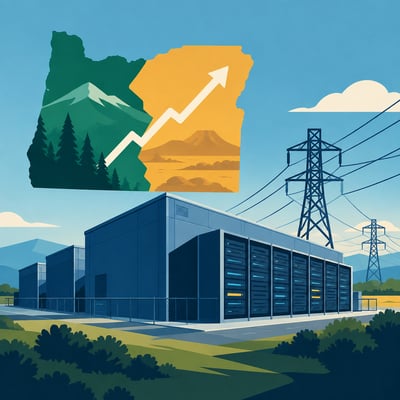
Oregon had 111 operating data centers in 2025, covering 22.
1 million square feet and accounting for roughly 23% of statewide retail electricity sales under the cited study’s measure. Thirty-two additional facilities are planned or under construction, while researchers project data center consumption could approach 25 terawatt-hours by 2030, increasing the need for generation, transmission, and coordinated planning. Growth is concentrated in eastern Oregon’s hyperscale market, while western Oregon is seeing a faster expansion of proposed facilities and greater local zoning scrutiny.
If you read one thing
It provides the broadest overview of Oregon’s data-center growth, electricity demand, geographic expansion, and policy tradeoffs with validated quantitative findings.
Best explainer
It clarifies the east-west geography of Oregon’s expansion and explains how gaps in fiscal, water, and electricity data complicate policy decisions.
The evidence
It adds a focused account of the projected electricity burden and the resulting need for generation, transmission, and coordinated planning.
Data centers are becoming a major grid constraint
Data centers accounted for about 23% of Oregon retail electricity sales in 2025, with consumption projected to approach 25 TWh and 31%–32% of statewide demand by 2030. Accommodating that load is tied to new generation, transmission capacity, and coordinated regional planning.
Expansion is large but geographically uneven
Oregon has 111 operating facilities covering 22.1 million square feet, with another 32 planned or under construction. Eastern Oregon is the center of hyperscale facilities, while proposed development is more concentrated in western Oregon and includes smaller sites.
Policy choices are constrained by information gaps and fiscal tradeoffs
Incomplete information on water use, electricity impacts, fiscal effects, and community consequences limits evaluation of data-center growth. Estimated tax exemptions are substantial relative to collected property taxes, though the research cautions that exemptions are not necessarily foregone revenue.
23% of retail electricity sales
data center share of Oregon retail electricity sales
“Data centers accounted for about 23% of Oregon’s retail electricity sales in 2025. Researchers expect consumption to increase to nearly 25 terawatt-hours by 2030, equivalent to the electricity use of approximately 2.5 million homes, or roughly 31% to 32% of statewide demand.”
111 facilities
operational data centers
“Researchers counted 111 operational facilities totaling about 22.1 million square feet, plus 32 planned or under-construction facilities representing 6.9 million square feet of potential development.”
22.1 million square feet
operational data center space
“Researchers counted 111 operational facilities totaling about 22.1 million square feet, plus 32 planned or under-construction facilities representing 6.9 million square feet of potential development.”
32 facilities
planned or under-construction data centers
“Researchers counted 111 operational facilities totaling about 22.1 million square feet, plus 32 planned or under-construction facilities representing 6.9 million square feet of potential development.”
6.9 million square feet
potential data center development
“Researchers counted 111 operational facilities totaling about 22.1 million square feet, plus 32 planned or under-construction facilities representing 6.9 million square feet of potential development.”
No new-member articles were supplied, so there is no evidence of a material change in Oregon’s data-center growth, electricity demand, geographic concentration, or associated policy concerns.
Previously
Oregon had 111 operating data centers in 2025, covering 22.1 million square feet and accounting for roughly 23% of statewide retail electricity sales under the cited study’s measure. Thirty-two additional facilities are planned or under construction, while researchers project data center consumption could approach 25 terawatt-hours by 2030, increasing the need for generation, transmission, and coordinated planning. Growth is concentrated in eastern Oregon’s hyperscale market, while western Oregon is seeing a faster expansion of proposed facilities and greater local zoning scrutiny.