
 AI Governance
 Data Centers
 Drones
 Climate
 Privacy
 2026 Maine Senate
 Bob Dylan
Oracle’s Backlog Meets Buildout Costs
Coverage from The New York Times, CNBC, and others
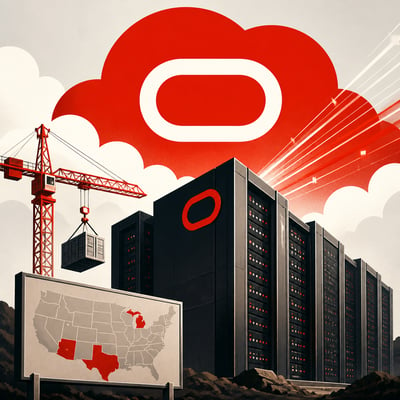
Oracle is rapidly adding AI data center capacity to support a large cloud backlog, including projects tied to OpenAI and the Stargate program.
The company activated more than a gigawatt of capacity in fiscal 2026, expects another roughly gigawatt online in the next quarter, and has several large campuses under development. The expansion is increasing capital needs, debt exposure, and negative free cash flow, making construction delivery, power availability, customer commitments, and backlog conversion central issues.
The current version largely confirms the existing expansion and financing-risk narrative, while adding that Oracle has already raised tens of billions and cloud infrastructure revenue grew 93% year over year.
Oracle’s expansion has moved from planning toward execution, with construction beginning at the Michigan Stargate campus and funding needs becoming more explicitly quantified. The update also sharpens the financial pressure through a reported $23.7 billion free-cash-flow deficit and planned $40 billion fiscal 2027 financing.
The story is increasingly framed as Oracle’s transformation into a major AI infrastructure operator, with leadership and financing pressures receiving greater emphasis. New site and cooling details sharpen the execution challenge, but the underlying expansion plans and risks remain largely consistent.
The story becomes more concrete and Oracle-specific: previously planned AI infrastructure is now being activated at gigawatt scale, while quantified backlog, funding needs, and customer support reveal greater execution and financing exposure.
- Oracle reported a $638 billion contracted future revenue backlog.
- Oracle activated about 1.2 gigawatts of capacity in fiscal 2026.
- Oracle plans roughly $40 billion of additional fiscal 2027 funding.
- Five data centers totaling approximately 5.5 gigawatts are in development.
- Customer prepayments and supplied hardware reportedly totaled about $75 billion.
The story has broadened from Oracle’s leveraged expansion into an industry-wide hyperscaler buildout involving Amazon, Alphabet, Microsoft, and Meta. The key concern now extends beyond meeting AI demand to whether financing, infrastructure constraints, and potential oversupply will produce acceptable returns.
- Amazon, Alphabet, Microsoft, and Meta are now central actors in the buildout.
- Hyperscalers reportedly plan approximately $595 billion in 2026 infrastructure spending.
- AWS expects AI capacity shortages through 2027, with reservations extending into 2028.
- Debt, leases, joint ventures, and project loans increasingly fund hyperscaler infrastructure spending.
- Potential oversupply and investor concerns about leverage and stranded capacity have become more prominent.
The story is largely unchanged, but the latest version reframes Oracle’s AI buildout as even more financially exposed by adding the reported $638 billion backlog and emphasizing negative free cash flow and interest costs. It also drops some earlier supporting details, such as the prior capacity-development count and more explicit references to water and customer-concentration risk.
The story is now framed more broadly around Oracle’s financing and execution of a much larger AI buildout, with new details on funding sources, project-level loans, and additional geography. The current version also sharpens the emphasis on customer-concentration risk and operational constraints like power, equipment, and cooling.
- Oracle now cites roughly $40 billion of fiscal 2027 funding needs.
- Another filing puts planned capital spending at $90 billion to $95 billion.
- Customer-supplied hardware and project-level loans are now part of the financing mix.
- The United Arab Emirates appears as a new site geography.
- Backlog and remaining-performance-obligation figures are described as inconsistent across reports.
The story has narrowed from a broad hyperscaler AI-capex buildout to a more specific Oracle-led execution update centered on Stargate and OpenAI demand. The new version adds concrete spending, capacity, and project-location details, while making Oracle’s financing and delivery risks more explicit.
- Oracle spent $55.7 billion on capital in fiscal 2026.
- Oracle activated about 1.2 gigawatts in fiscal 2026.
- Nearly 1 gigawatt more is expected online in fiscal 2027.
- Five major data centers totaling about 5.5 gigawatts are in development.
- A reported five-year OpenAI deal is worth about $300 billion.
The story broadens from Oracle’s aggressive data-center buildout to a wider hyperscaler race, with AWS now showing explicit demand shortfalls through 2027 and much larger 2026 capex plans. Oracle’s backlog is now quantified at $638 billion, reinforcing that demand is real but also deepening concern about financing, execution, and returns.
- AWS shortages are expected to persist through 2027.
- Amazon plans about $220 billion in 2026 capital spending.
- Oracle reported a $638 billion contracted future revenue backlog.
- Hyperscalers are increasingly relying on debt, equity issuance, and bond markets.
- AWS reservations are already extending into 2028.
The main update is a tighter, more concrete framing of Oracle’s AI buildout: the Saline Township campus is now specified as a roughly one-gigawatt project, and the story more explicitly emphasizes financial strain and local benefits alongside the risks. The narrative also broadens to include additional partners and the growing power-demand backdrop for AI infrastructure.
The story has shifted from a broad account of Oracle's AI buildout and financing to a more acute risk narrative centered on execution, funding pressure, and credit quality. The new material adds a major rating downgrade and a clearer list of operational and permitting constraints that could determine whether the expansion pays off.
- S&P Global cut Oracle’s credit rating to BBB-.
- Oracle’s Michigan campus is now described as a $16 billion project.
- Analysts question how much contracted demand will convert into cash flow.
- Execution risks now include GPU shortages, grid limits, and denied permits.
- Local concerns now include traffic, energy use, and environmental impacts.
The biggest new development is that Oracle’s Michigan Stargate project has moved from planning into construction, making the buildout more tangible and execution-dependent. The current version also sharpens the financing burden, with larger stated capital-raising needs and rising interest costs alongside the record backlog.
- Construction has started on the Stargate campus in Saline Township, Michigan.
- The Michigan campus is planned for more than one gigawatt of capacity.
- Oracle expects about $40 billion in additional capital raising.
- Interest expense has risen alongside negative free cash flow.
- The Michigan project includes closed-loop cooling plans and a community grant.
Oracle is expanding aggressively into AI infrastructure, with cloud demand and long-term contracts driving a record backlog and a wave of data center construction. The company is adding capacity across multiple sites, including major projects tied to OpenAI, but investors remain focused on the cost of that buildout, negative free cash flow, and rising funding needs. The topic also includes early-stage site-level development in Michigan, Norway, Texas, and New Mexico, showing how broad the infrastructure push has become.